| OSANAI KAORU |
|
Playwright name:
Existence: 26 July 1881 ~ 25 December 1928 Career: 26 July 1881: born in Hiroshima. 1906: graduation from Tôkyô Imperial University. 1909: he co-founded the Jiyû Gekijô study group (the 'Free Theatre') with Ichikawa Sadanji II, a Kabuki actor who had recently returned from Europe. November 1909: for their inaugural production, the Jiyû Gekijô staged at the Yûrakuza Henrick Ibsen's 1896 play "John Gabriel Borkman", translated by Mori Ôgai. Seeking to introduce realism, which was emerging as a dominant artistic movement in Europe at the time, Osanai Kaoru initiated what became known as the New Theatre movement in Japan. In the early twentieth century, Kabuki remained the predominant form of Japanese theatre. It was fundamentally actor-centered, and audiences attended performances largely to appreciate the distinctive styles and reputations of individual actors. In contrast, Osanai’s vision of modern theatre placed the play itself at the center of theatrical creation. Direction was conceived as the means through which the playwright’s intentions could be accurately realized, while acting was to follow the interpretive framework established by the director. Guided by these principles, the Jiyû Gekijô went on to stage a series of works by Western realist and naturalist playwrights, including Anton Chekhov and Maxim Gorky, thereby laying the foundation for modern drama in Japan. December 1912 ~ August 1913: Osanai traveled throughout Europe (Paris, Moscow, Berlin, London) to experience modern theater first-hand. September 1919: ninth and final program for the Jiyû Gekijô with the premiere in Japan at the Imperial Theater of Eugène Brieux's "La Foi". 1920: Osanai was hired by the Shôchiku Company to head their actors school. March 1923: premiere at the Imperial Theater of Osanai's drama "Musuko" [more details]. September 1923: Osanai temporarily resided in Ôsaka after the Great Kantô Earthquake (Kantô Daijishin). During this time, Kawaguchi Matsutarô worked as a student of Osanai. November 1927: Osanai went to Moscow to celebrate the 10th anniversary of the founding of the USSR. He engaged in a long and productive discussion with a Soviet government official from which the idea of a Kabuki tour in the USSR emerged. Summer 1928: Ichikawa Sadanji II did the first tour of a Kabuki troupe outside Japan, without Osanai who was ill and could not participate. The destination was the USSR and the troupe performed in Moscow and Leningrad [more details]. 25 December 1928: Osanai died of cerebral infarction in Yotsuya. Comments: Osanai Kaoru was a pioneering Japanese playwright, director, and critic who played a central role in the birth of modern Japanese theatre (Shingeki). Educated at Tôkyô Imperial University, he became deeply influenced by Western drama and realist theory, especially the works of Ibsen, Chekhov, and Gorky, which he translated and introduced to Japanese audiences. He co-founded the Jiyû Gekijô with Kabuki star Ichikawa Sadanji II, advocating a new theatrical model that prioritized the dramatic text and director’s interpretation over star-centered performance traditions. Through his productions, critical writings, and organizational leadership, Osanai challenged the dominance of Kabuki and helped align Japanese theatre with contemporary European realism and naturalism. Although his career was cut short by his early death, his ideas laid the intellectual and practical foundations for twentieth-century Japanese modern drama. In the history of Kabuki, he is remembered primarily as the author of the play "Musuko", which was staged 8 times between 1946 and 2024, almost once every ten years. |

 |
|
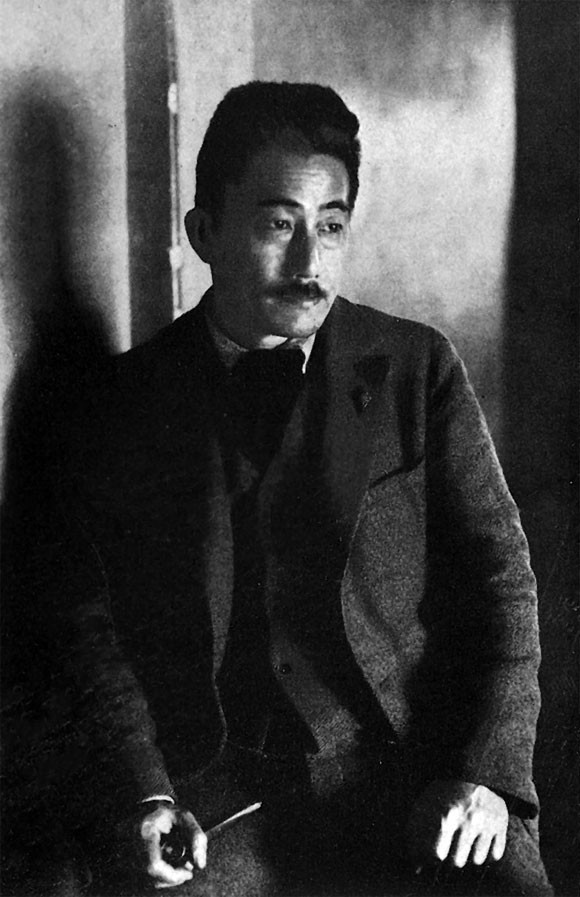
Osanai Kaoru |
|
|
| Contact | Main | Top | Updates | Actors | Plays | Playwrights | Programs | Links | FAQ | Glossary | Chronology | Illustrations | Prints | Characters | Derivatives | Theaters | Coming soon | News |