FIVE GENERATIONS
Bandô Mitsuemon I
Bandô Mitsuemon I  In Japanese | Bandô Kumahei  In Japanese
 

Born in Edo in 1788. He started his career as a disciple of Bandô Mitsugorô III and made his debut on stage in the 11th lunar month of 1803 at the Nakamuraza, where he received the name of Bandô Kumahei and performed as a koyaku. He became katakiyaku in the 11th lunar month of 1808 at the Moritaza, where he performed in the kaomise drama "Hana to Mitsu Yuki no Kusunoki". He took the name of Bandô Mitsuemon I in the 11th lunar month of 1817 at the Nakamuraza, where he performed in the kaomise drama "Hana to Yuki Wagô Taiheiki". He went on a long tour in 1821 in Nagoya and the Kamigata with his master and they went back to Edo in the 5th lunar month of 1822. He appeared on stage for the last time in the 6th lunar month of 1836, in Edo at the Moritaza, where he played the roles of Kô no Moronô, Kinai, Ishidô Umanojô, Hara Kazuemon and Amakawaya Gihei in the classic "Kanadehon Chûshingura". He retired from the Kabuki world and opened a restaurant, which was called Sugisaka. He called himself Sugisakaya Heiroku up to his death the 4th day of the 4th lunar month of 1846. This popular and talented actor excelled as a handôgataki or a katakiyaku. He had a great kôseki and was said to be equally at home in jidaimono or sewamono dramas. He was nicknamed Araguma, which is literally in English the Wild (ara) Bear (guma); guma is in fact the word kuma in the first name of his first stage name.

There will be in the future to come a full page dedicated to Bandô Mitsuemon I in kabuki21.com.

Haimyô Yagô
Yûzan Yamatoya, Sakaiya, Yamadaya, Sugisakaya

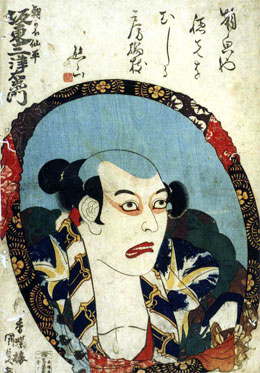
Bandô Mitsuemon I portraying Asagao Sempei ("Sukeroku") in a print made by Utagawa Kunisada I

Bandô Mitsuemon II
Bandô Matasaburô II  In Japanese | Bandô Wakô  In Japanese | Bandô Mitsuemon II  In Japanese | Bandô Tamae  In Japanese
 

Born in 1855. He was the son of Nakanishi Jûbei, a dekata at the Moritaza. He started his career at the beginning of the 1860s as a disciple of Bandô Mitsugorô VI, who gave him the name of Bandô Tamae. He took the names of Bandô Mitsuemon II in 1881 and Bandô Wakô in May 1895 at the Ryûseiza, a koshibai venue, where he made a fame for himself and earned the nicknamed Nisen Danshû. This expression could be translated as Tuppenny Danshû, Danshû being the haimyô of the Meiji star Ichikawa Danjûrô IX. Nisen meant two sen; the sen was one hundredth of a yen, which was the new currency created in Japan by the New Currency Act of 1871, to replace the complex monetary system of the Edo period. Nisen was two sen, the price of a ticket in Tôkyô koshibai. He became a disciple of Morita Kan'ya XII and took the name of Bandô Matasaburô II in July 1897 at the Miyatoza, where he played the roles of Ôboshi Yuranosuke and Makiyama Jôzaemon in the classic "Kanadehon Chûshingura". He had the chance to perform at the Kabukiza in August 1899 but the performance was not a success. He ended his career at the Miyatoza, where he was a mainstay. He died the 16th of February 1906.

Yagô Honmyô
Yamatoya Nakanishi Yomohachi
Bandô Mitsuemon III
Bandô Mitsuemon III  In Japanese
 

Dates of birth and death Uunknown. Unknown relationship to the Bandô clan. Unknown previous stage name(s). This minor actor held the name of Bandô Mitsuemon III from 1896 to 1915.

Bandô Mitsuemon IV
Bandô Mitsuemon IV  In Japanese | Bandô Sampei I  In Japanese
 

Born in 1902. He was the brother of Bandô Mitsusaburô and a disciple of Bandô Mitsugorô VII. He held the names of Bandô Sampei I and Bandô Mitsuemon IV. He most likely died at the end of the 1950s.

Yagô Honmyô
Yamatoya Irogawa Seizô
Bandô Mitsuemon V
Bandô Mitsuemon V  In Japanese | Bandô Sampei II  In Japanese
 

Born in Tôkyô the 8th of November 1960. He became disciple of Bandô Minosuke VII in April 1977 and received the name of Bandô Sampei II in May 1977, making his debut on stage at the Kabukiza, where he performed minor roles in "Suzu-ga-Mori" and "Sukeroku". He took the name of Bandô Mitsuemon V in January 2001 at the Kabukiza, playing the role of Samezu Goheiji in the drama "Gosho no Gorozô". He appeared on a major stage for the last time in July 2010 at the Shimbashi Embujô, where he played the roles of the tedai Jûsuke and Tagata Umpachi in "Meigetsu Hachiman Matsuri" and "Shibaraku". He left the Japan Actors Association and became a free-lance actor afterwards, performing nowadays under the name of Kikuzuki Kichiju.

Yagô Honmyô
Yamatoya Adachi Masao
 
Search this site powered by FreeFind
  Site map
Contact | Main | Top | Updates | Actors | Plays | Playwrights | Programs | Links | FAQ | Glossary | Chronology | Illustrations | Prints | Characters | Derivatives | Theaters | Coming soon | News