| YAMATO TAKERU |
| Play title | Yamato Takeru  |
|||
| History |
"Yamato Takeru", the first Sûpâ Kabuki drama in Kabuki history, was premiered in February 1986 at the Shinbashi Enbujô [more details]. |
|||
| Key words |
Ainu Akashi no Ura Chûnori Ennosuke Shijûhassen Etachibana-hime Ezo Ibukiyama Ise Jingû Jidaimono Keikô Tennô Kibi Takehiko Kofun Jidai Kojiki Kumaso Musashi Nihon Shoki Ototachibana-hime Ousu no Mikoto Ôusu no Mikoto Owari Sagami Shinsaku Sûpâ Kabuki Jûban Sûpâ Kabuki Yamato Yamato Takeru |
|||
| Summary |
The action is set in the distant past, when Japan was called Yamato, and tells of the emperor's twin sons, Ôusu no Mikoto and Ousu no Mikoto [1]. Ousu is dispatched to Ôusu's palace to get the neglectful heir to report to the emperor at once. Ôusu has forced Princess Etachibana to marry him, although her sister, Princess Ototachibana [2] is often the object of his lewdness. Ousu falls in love with her at first sight. Ôusu responds to the orders by declaring that, since the empress, their stepmother, is plotting to put her own son on the throne and kill the twins, she and the emperor must be slain. During Ôusu's attempt to get Ousu to join his scheme, Ousu accidentally kills him. He confesses his deed to the emperor but does not reveal Ôusu's plans. The angry emperor sends Ousu on a mission to subjugate the Kumaso barbarians of Kyûshû. Princess Etachibana follows him to Akashi Beach, seeking to avenge Ôusu's death, but changes her mind when she learns of how Ousu hid his brother's assassination plans. She falls in love with him, thereby confusing the innocent young man. In the land of Kumaso, he sneaks into a party being given by the barbarian Takeru brothers, who are being paid tribute to by various nations. Dressed as a beautiful female dancer, he so entrances the brothers that they fight over him. He slays one, creating a riot, and then kills all who try to stop him, including the other Takeru. As the barbarian dies, he honors his killer by calling him Yamato Takeru, and the Kumaso people bow low to this conquering warrior. Back at the Yamato court, the empress's son is now heir to the throne. Yamato Takeru is awarded by being given Princess Etachibana as his bride, but is ordered now to subjugate the land of Ezo (Ainu). Having once more been cast into danger by the emperor, he ends his filial relationship with him. He visits Princess Yamato at the Grand Shrine of Ise to express his disappointment, and receives the sacred sword Ame no Murakumo no Tsurugi and a small bag to be opened only in an emergency. Accompanied by Takehiko, but joined midway by Ototachibana, he encounters a messenger named Mindara who discloses that a Kumaso man named Yairamu, having assassinated his maladroit brother, Yairepo, is now magistrate of Sagami. Takeru visits Yairamu's mansion where he is asked to defeat an evil marsh god. He sets off with Ototachibana and Takehiko but the trio get lost on the endless prairie. The story about Yairepo and the god were lies to lure Takeru into a trap, and they suddenly find themselves surrounded by a prairie fire set by enemy Ainu. Takeru, finding a flint stone in the small bag, uses his sacred sword to cut the grass and set it afire with the flint in order to battle the fire around them. The sword is renamed Kusanagi no Tsurugi or "Grass-Mowing Sword." Yairepo and Yairamu, angry about Yamato's treatment of the Ainu, attack, but are slain, although Takeru cannot rejoice. Takeru and the others leave by boat for Musashi, With the Ainu boy Hetarube piloting the craft. But the journey turns treacherous when the sea, filled with the spirits of Takeru's victims, grows angry, and is only pacified when Ototachibana, loved by Takeru, offers herself as a sacrifice to the god of the sea. Takeru and the others arrive at the residence of the magistrate of Owari and his wife, where the magistrate hopes to marry his daughter, Miyazu, to Takeru, now a national favorite. The magistrate informs Takeru of the empress's passing and of the emperor's regret for having mistreated him, which Takeru hopes will lead to a reconciliation. But Takeru receives another mission, to subdue the god and goddess of Mount Ibuki. Takeru, meeting the magistrate's exquisite daughter, Miyazu, proposes to marry her. He promises to settle down and give up his martial ways following the completion of his Mount Ibuki task. He leaves his sword behind with Miyazu. At Mount Ibuki, Takeru, following a white boar (the transformed god of the mountain), struggles through fog and gets pounded by a hailstorm, but the god and goddess succumb, and Takeru grows ill. He heads home, too ill to make progress, and rests at a wayside house. He dreams of his battles and of reporting his success to the happy emperor. Etachibana visits the dying man with their son, Wakatakeru, and Takeru passes away. The emperor celebrates Takeru's victories, and Wakatakeru will be the new heir. Following Takeru's grand funeral a swan-like bird (Takeru in feathers and sequins, with wing-like sleeves and a plumed headdress), presumably his spirit, flies out of the grave and soars over the auditorium (chûnori).
|
|||
| Notes |
[1] The twin brothers are played by the same actor (Ichikawa Ennosuke III in 1986). [2] The two sisters are played by the same actor (Nakamura Kotarô V in 1986). |


 |
|
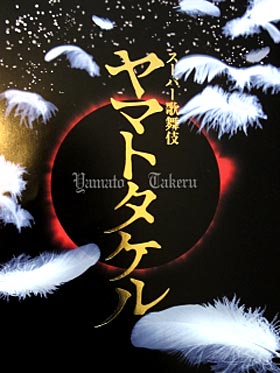
A flyer for "Yamato Takeru" |
|
|
| Contact | Main | Top | Updates | Actors | Plays | Playwrights | Programs | Links | FAQ | Glossary | Chronology | Illustrations | Prints | Characters | Derivatives | Theaters | Coming soon | News |