| YOSHIOKA MOTOME |
| THREE GENERATIONS | |
| Yoshioka Motome I Yoshioka Motome I  |
|
|
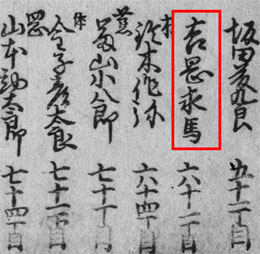
Dates of birth and death unknown. He was recorded for the first time in 1672, in Kyôto where he performed as a wakashugata. He performed in Fall 1686 in Ôsaka. He was recorded for the last time in the in the 1687 hyôbanki "Yarô Tachiyaku Butai Ôkagami". No record afterwards. |
|
 |
|
|
The name of Yoshioka Motome I in the hyôbanki "Yarô Tachiyaku Butai Ôkagami" (the zone within the red box) |
|
| Yoshioka Motome II | |
|
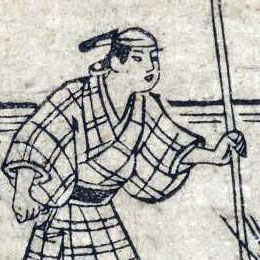
The actor Yoshioka Motome II held this name from the 11th lunar month of 1699 to 1710. |
|
 |
|
|
Yoshioka Motome II playing the role of the role of Ageya Gonjûrô in the new year ni-no-kawari drama "Keisei Yata no Kagami", which was staged in Kyôto in the 1st lunar month of 1709 |
|
| Yoshioka Motome III Yoshioka Saburosuke [1] |
Yoshioka Motome III |
|
|
Dates of birth and death unknown. Disciple of Yoshioka Motome II, he took the name of Yoshioka Motome III and performed as a wakashugata during the first half of the 1710s, after the passing away of his master. He became jitsuaku and took the name of Yoshioka Saburosuke [1] in 1716. He became katakiyaku in the 11th month of 1716 in Kyôto at the Miyako Mandayû's theater, where he performed in the kaomise drama "Eboshidakara Mangoku no Kaname". He settled in Ôsaka in Fall 1723 and he performed in the 11th lunar month of 1723 at the Ônishi no Shibai in the kaomise drama "Fukujukai Kogane no Minato", which was produced by Sakakiyama Shirotarô I. He went back to Kyôto in Fall 1724. He performed as a katakiyaku in the 11th lunar month of 1724 in Kyôto in the kaomise drama "Ôjigawa Kogane no Mizuguruma", which was produced at Miyako Mandayû's theater by Segawa Kikunojô I, welcomed in Kyôto the Edo actor Ôtani Hiroji I and celebrated the shûmei of Ichiyama Hankurô. He performed in the 2nd lunar month of 1728 in Kyôto in the drama "Man'yô no Hana Nishiki no Akebono", which was produced by Kanazawa Hikogorô. No record in ôshibai afterwards. He performed as a tachiyaku in Nagoya at the Seijuin no Shibai from 1733 to 1735. His rank in the 1735 Nagoya hyôbanki, tachiyaku section, was jô-jô-(shiro)hankichi (superior - superior - (white) half excellent) [visual]. |
|
|
|
|
|
|
| Contact | Main | Top | Updates | Actors | Plays | Playwrights | Programs | Links | FAQ | Glossary | Chronology | Illustrations | Prints | Characters | Derivatives | Theaters | Coming soon | News |