| CHIKAMATSU MONZAEMON I |
|
Playwright names:
Real Name: Sugimori Nobumori Line number: SHODAI (I) Existence: 1653 ~ 22nd day of the 11th lunar month of 1724 [1] Connection: Disciples: Takeda Izumo I, Chikamatsu Kannosuke Career: 1653: born in the city of Furue in the province Echizen; he is the second son of the samurai Sugimori Ichizaemon Nobuyoshi. 9th lunar month of 1683: premiere in Kyôto at Ujiza of Monzaemon's first official puppet play "Yotsugi no Soga"; this is Monzaemon's first work for the jôjûri reciter Uji Kaganojô. 1st lunar month of 1685: premiere in Ôsaka at the Takemotoza of Monzaemon's play "Shusse Kagekiyo"; this is Monzaemon's first work for the jôjûri reciter Takemoto Gidayû. This jidaimono is considered as the first "new" jôjûri (in opposition to the "old" jôjûri (kojôjûri), a new style which will be called Gidayû in the future. 3rd lunar month of 1693: the first drama written by Monzaemon for the star Sakata Tôjûrô I is performed in Kyôtô at Miyako Mandayû's theater. The play's title is "Butsumo Mayasan Kaichô" and the others actors in the casting are Yamashita Hanzaemon I, Yoshizawa Ayame, Kirinami Senju I, Kaneko Kichizaemon and Iwai Heijirô. 11th lunar month of 1696: premiere in Kyôto at Miyako Mandayû's theater of Monzaemon's play "Tôhôsaku", which is produced by Sakata Tôjûrô I. 4th lunar month of 1697: premiere in Kyôto at Miyako Mandayû's theater of Monzaemon's play "Uzuki Kokonoka Sono Akatsuki no Myôjôgachaya", which is produced by Sakata Tôjûrô I. 1st lunar month of 1698: premiere in Kyôto at Miyako Mandayû's theater of Monzaemon's play "Kamigyô no Uta Hajime", which is produced by Sakata Tôjûrô I (it is said that the actor revised the script quite a lot himself). 1st lunar month of 1699: premiere in Kyôto at Miyako Mandayû's theater of Monzaemon's play "Keisei Hotoke no Hara", which is produced by Sakata Tôjûrô I. This is a huge success. 10th lunar month of 1699: premiere in Kyôto at Miyako Mandayû's theater of Monzaemon's play "Amidagaike Shin Teramachi", which is produced by Sakata Tôjûrô I. 1st lunar month of 1700: premiere in Kyôto at Miyako Mandayû's theater of Monzaemon's play "Keisei Guzei no Fune", which is produced by Sakata Tôjûrô I. 5th lunar month of 1701: Takemoto Gidayû takes the name of Takemoto Chikugonojô. 1st lunar month of 1702: premiere in Kyôto at Miyako Mandayû's theater of Monzaemon's drama "Keisei Mibu Dainenbutsu", which was produced by Kokon Shinzaemon [more details]. 7th lunar monthof 1702: premiere in Kyôto at Miyako Mandayû's theater of Monzaemon's drama "Mibu Aki no Nenbutsu", a follow-up of "Keisei Mibu Dainenbutsu" [more details]. 5th lunar month of 1703: premiere in Ôsaka at the Takemotoza of Monzaemon's first his first shinjûmono "Sonezaki Shinjû"; it is also Monzaemon's first sewamono and it is based on a real event that happened in Ôsaka in the 4th lunar month of 1703; "Sonezaki Shinjû" will be adapted for Kabuki a few years later and staged for the first time in Edo in the 4th lunar month of 1719 at the Nakamuraza [more details]. 11th lunar month of 1704: premiere in Kyôto at Miyako Mandayû's theater of Monzaemon's drama "Kisshô Tennyo Anzan no Tama". Summer (?) 1705: the play "Keisei Kinryû no Hashi" is staged in Kyôto at Miyako Mandayû's theater; this is the last script written directly for Kabuki actors by Monzaemon. 2nd lunar month of 1707: premiere in Ôsaka at the Takemotoza of Monzaemon's play "Horikawa Nami no Tsuzumi"; it will be adapted for Kabuki for the very first time more than 2 centuries later, in April 1914 in Ôsaka at the Nakaza. End of 1707: premiere in Ôsaka at the Takemotoza of Monzaemon's play "Shinjû Kasane Izutsu"; it will be adapted for Kabuki for the first time in the 1st lunar month of 1720 in Edo in the 3 main theaters (Nakamuraza / Ichimuraza / Moritaza), to commemorate the 16th anniversary (17th memorial service) of the suicide of the couple Tokubê and Ofusa. 8th lunar month of 1708: premiere in Ôsaka at the Takemotoza of Monzaemon's play "Keisei Hangonkô"; it will be adapted for Kabuki for the first time in the 1st lunar month of 1719, staged in Ôsaka at the Kado no Shibai [casting]. 1st day of the 11th lunar month of 1709: the actor Sakata Tôjûrô I dies. 21st day of the 1st lunar month of 1711: the jôjûri master Uji Kaganojô dies. 3rd lunar month of 1711: premiere in Ôsaka at the Takemotoza of Monzaemon's play "Meido no Hikyaku". It is based on a real event that happened in Ôsaka the 5th of the 12th lunar month of 1710: a messenger named Chûbê was executed because he used some official money, which was entrusted to him, for the love of a courtesan named Umegawa. 7th lunar month of 1712: premiere in Ôsaka at the Takemotoza of Monzaemon's play "Komochi Yamanba"; it will be adapted for Kabuki more than 8 decades later, in the 3rd lunar month of 1795 in Ôsaka at the Kado no Shibai [more details]. 10th day of the 9th lunar month of 1714: the jôjûri master Takemoto Chikugonojô dies. 11th lunar month of 1715: premiere in Ôsaka at the Takemotoza of Monzaemon's play "Kokusen'ya Gassen". It is extremely successful and is extended up to the 3rd lunar month of 1717 (this is the longest run in Japan theater history, all genres taken into account). It will be adapted for Kabuki for the first time in Fall 1716 in Kyôto at Miyako Mandayû's theater [casting]. 8th lunar month of 1717: premiere in Ôsaka at the Takemotoza of Monzaemon's play "Yari no Gonza Kasane Katabira"; It is based on real events, which occurred in Ôsaka in the 7th lunar month of 1717. 1st lunar month of 1718: premiere in Ôsaka at the Takemotoza of Monzaemon's play "Yamazaki Yojibê Nebiki no Kadomatsu". 2nd lunar month of 1718: premiere in Ôsaka at the Takemotoza of Monzaemon's play "Nihon Furisode Hajime"; it is immediately adapted for Kabuki the same month and staged for the first time in Kyôto [casting]. 11th lunar month of 1718: premiere in Ôsaka at the Takemotoza of Monzaemon's play "Hakata Kojorô Nami Makura"; it is based on a real incident involving a gang of seven smugglers who were caught in Nagasaki and were nose-cutted and put in the stocks for three days in Ôsaka in the 10th lunar month of 1718. 8th lunar month of 1719: premiere in Ôsaka at the Takemotoza of Monzaemon's play "Heike Nyogo no Shima"; It will be adapted for Kabuki for the first time in the 1st lunar month of 1720 in Ôsaka at the Naka no Shibai [casting]. 12th lunar month of 1720: premiere in Ôsaka at the Takemotoza of Monzaemon's play "Shinjû Ten no Amijima". It is based on a real event that happened in Ôsaka the 14th day of the 10th lunar month of 1720: the double suicide in Amijima in the precinct of the Daichôji Temple of Kamiya Jihê (a paper merchant from the Tenma district) and the courtesan Kinokuniya Koharu (from the Kita-Shinchi pleasure quarter). This drama will be adapted for Kabuki the following year and staged for the first time in Edo at the Moritaza [more details]. 7th lunar month of 1721: premiere in Ôsaka at the Takemotoza of Monzaemon's play "Onna Goroshi Abura no Jigoku". It is not a hit and quickly goes into oblivion. It will adapted for Kabuki for the very first time by Takeshiba Manji in October 1907 at the Misakiza, where it will be staged by a troupe of female Kabuki. A new script will be written by Watanabe Katei for the actor Jitsukawa Enjirô I. It will be successfully staged in November 1909 in Ôsaka at the Asahiza [casting], in January 1910 in Kyôto at the Minamiza [casting] and in Tôkyô at the Shintomiza [casting]. 1st lunar month of 1724: premiere in Ôsaka at the Takemotoza of Monzaemon's play "Kanhasshû Tsunagi Uma"; this is Monzaemon last drama. 22nd day of the 11th lunar month of 1724 [1]: Monzaemon died. Comments: "The most renowned of puppet theatre and Kabuki playwrights, popularly but unrealistically called the Japanese Shakespeare". "The giant among the playwrights of his time was Chikamatsu Monzaemon, but as his
best plays were written for the Doll-theatre, he does not rightly belong to an account
of Kabuki playwrights. It is true, however, that the great influence his compositions
had upon Kabuki, even to the present day, can hardly be over-estimated. "Chikamatsu Monzaemon (1653~1725), generally ranked as the greatest Japanese dramatist, by some estimates wrote 160 plays for the
puppet and Kabuki theaters. There are doubtful attributions, and other works of slight literary importance,
but no matter how we pare the list, we are left with at least thirty or forty plays of exceptional interests." "Chikamatsu, who never hesitated to take his ideas, plots, and materials from any
source that suited his purpose, borrowed to some extent from Kabuki. One of his plays,
"Tanba Yosaku", was originally played twenty years before his own composition by
the first Arashi San'emon. "Yuki Onna Gomai Hagoita" (lit., "the Snow-Woman-Five-Battledores"),
a Chikamatsu masterpiece, was in reality one of Arashi San'emon's favourite plays." [1] The 22nd day of the 11th lunar month of the 9th year of the Kyôhô era was the 6th of January 1725 in the western calendar. |

 |
|
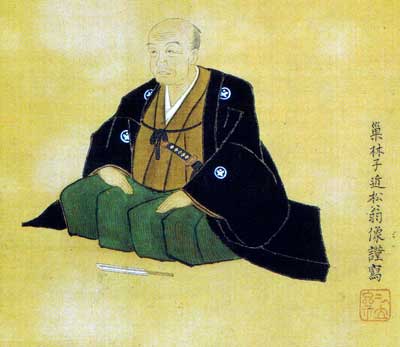
Chikamatsu Monzaemon I The Chikamatsu Monzaemon line of playwrights |
|
|
| Contact | Main | Top | Updates | Actors | Plays | Playwrights | Programs | Links | FAQ | Glossary | Chronology | Illustrations | Prints | Characters | Derivatives | Theaters | Coming soon | News |