| KOI BIKYAKU YAMATO ÔRAI |
| Play titles | Meido no Hikyaku Koi Bikyaku Yamato Ôrai Koi no Hikyaku Yamato Ôrai Koi no Tayori Yamato Ôrai Keisei Koi no Hikyaku Umegawa Chûbê |
| Authors | Chikamatsu Monzaemon ("Meido no Hikyaku") Namiki Shôzô I ("Koi no Tayori Yamato Ôrai") Suga Sensuke, Wakatake Fuemi ("Keisei Koi no Hikyaku") |
| History |
The play "Meido no Hikyaku" was originally written for the puppet theater (Bunraku) by Chikamatsu Monzaemon and staged for the first time in Ôsaka at the Takemotoza in the 3rd lunar month of 1711. It was based on a real event that happened in Ôsaka the 5th of the 12th lunar month of 1710: a messenger named Chûbê was executed because he used some official money, which was entrusted to him, for the love of a courtesan named Umegawa. Chikamatsu Monzaemon was not the first author to work on this thema: the first drama was "Keisei Kuhonji Jôdo", which was staged in the 1st lunar month of 1711 in Kyôto at Miyako Mandayû's theater and starred Hanaoka Bunzaemon and Yamamoto Kamon in the roles of Chûbê and Umegawa. There was also a similar drama staged in Ôsaka in Spring 1711, starring Otowa Jirosaburô I and Sodeshima Genji in the roles of Chûbê and Umegawa (title unknown). Chikamatsu's rival Ki-no-Kaion wrote also his own version, entitled "Keisei Sandogasa", which was staged in the 10th lunar month of 1713 at the Toyotakeza. A Kabuki drama similar to "Meido no Hikyaku" was written by Namiki Shôzô I and staged under the title "Koi no Tayori Yamato Ôrai" (an other possible reading is "Koi no Hikyaku Yamato Ôrai") in the 7th lunar month of 1757 in Ôsaka at the Ônishi no Shibai (casting unknown). Another drama, which had a deep impact on the current contents of "Koi Bikyaku Yamato Ôrai", was written for the puppets by Suga Sensuke and Wakatake Fuemi, which was staged under the title "Keisei Koi no Hikyaku" in the 12th lunar month of 1773 at the Toyotakeza. It was adapted for Kabuki in the 2nd lunar month of 1796 at the Kado no Shibai [casting]. |
| Structure |
The original structure was in 3 acts, the second one being "Fûin Giri" and the final one a michiyuki. Nowadays "Koi Bikyaku Yamato Ôrai" is made up of two acts, "Fûin Giri" and "Ninokuchi-mura". Both acts are frequently staged. |
| Key words | Sewamono Kuruwa Shinjûmono |
| Summary |
Act I: Fûin Giri In the pleasure quarters, the most important possessions were money and reputation. In danger of losing his lover, the courtesan Umegawa, the money courier Kameya Chûbê breaks the seals on a package of money entrusted to him after being taunt by his rival Tanbaya Hachiemon, even though the use of such money is punishable by death. Act II: Ninokuchi-mura Kameya Chûbê and Umegawa travel throughout the countryside with the stolen money, hoping for a few meeting moments of happiness before the money runs out and they are captured and punished. They go through the snow covered landscape on their way to the Kameya Chûbê's home town where they meet their end. |
 |
|
|
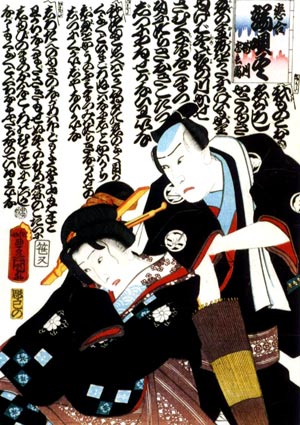
The actors Onoe Kikugorô IV and Kataoka Nizaemon VIII portraying Umegawa and Kameya Chûbê in a print made by Utagawa Toyokuni III in 1860 |
|
|
|
| Contact | Main | Top | Updates | Actors | Plays | Playwrights | Programs | Links | FAQ | Glossary | Chronology | Illustrations | Prints | Characters | Derivatives | Theaters | Coming soon | News |