| HONCHÔ NIJÛSHIKÔ |
| Play title | Honchô Nijûshikô  Twenty-Four Examples of Filial Piety in Japan |
| Authors | Chikamatsu Hanji Miyoshi Shôraku Takeda Inaba Takeda Heishichi Takemoto Saburobê II |
| History |
From ancient time, the Twenty-Four Examples of Filial Piety, one of the Confucian classics, has taught respect for one's parents with stories that seem rather strange and even grotesque today. For example, there is the story of the man whose sick mother wanted fresh fish in the dead of winter and so the man lay naked on the ice until he melted a hole through and the gods, taking pity on his plight saw that fish jumped out through this hole. Another story has a mother who wants to eat fresh bamboo shoots in the dead of winter. A dutiful son digs through the snow and finds that, miraculously, there are bamboo shoots growing underneath the snow. Chikamatsu Hanji, a playwright for the puppet theatre, combined these legends with the story of two feuding clans in the Japanese age of warring states (sengoku jidai), Nagao Kenshin and Takeda Shingen, to produce a fantastic historical drama on a grand scale, which was entitled "Honchô Nijûshikô" ("Twenty-Four Examples of Filial Piety in Japan"). It was staged for the first time in the 1st lunar month of 1766 in Ôsaka at the Takemotoza. It was adapted for Kabuki a few months later and was produced by both Nakamura Utaemon I and Mimasu Daigorô I in Ôsaka at the Naka no Shibai [casting]. In this play, the Shôgun is assassinated and both Nagao Kenshin and Takeda Shingen are suspected of being behind it. They are granted three years to investigate the incident and this play shows the various events surrounding this. |
| Structure |
"Honchô Nijûshikô" was made up of 5 acts: |
|
|
| Key words |
Ashikaga Yoshiharu Daimyô Echigo Gidayû Kyôgen Giri/Ninjô Hyakudo Ishi Hyakushô Jidaimono Jinja Jôshi Kago Kai Kikori Kikyô-ga-Hara Kitsunebi Michiyuki Nagao Kagekatsu Nagao Kenshin Nagao-shi Nyûdô Omiwatari Saitô Dôsan Saitô Toshimasa Sanbaba Sanhime Sengoku Jidai Seppuku Shinano Shiojiri Suwa Hosshô no Kabuto Suwa Myôjin Suwa Taisha Suwa-ko Takeda Katsuyori Takeda Shingen Takeda-shi Teppô Uesugi Kagekatsu Yamamoto Kansuke |
| Summary |
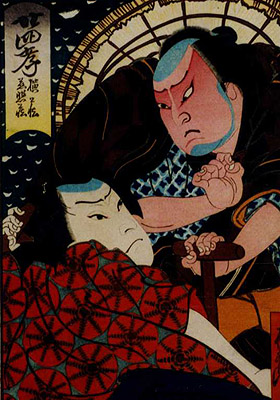
Act I, scene 1: Ashikaga Yakata Ôhiroma To celebrate the Shôgun Yoshiharu’s impending fatherhood by his concubine Shizunokata, leading daimyô, including Hôjô Ujitoki and Nagao Kagekatsu, arrive at the Ashikaga residence bearing gifts. During the audience, Ujitoki claims that the ongoing conflict between Nagao Kenshin and Takeda Harunobu conceals a shared intention to exploit the disorder and topple the Shogunate. Kagekatsu counters this accusation by explaining that the fighting stems solely from a dispute over the sacred helmet of Suwa Hôsshô, which Kenshin has borrowed from Harunobu. Harunobu then appears in person, prompting Ujitoki and his follower Murakami Yoshikiyo to repeat their charges of treason. Kagekatsu firmly denies these claims, insisting they are without foundation. Seeking to restore harmony, Lady Taoyame proposes a marriage between Harunobu’s son Katsuyori and Kenshin’s daughter Yaegaki as a means of reconciling their rival houses, a plan the Shôgun approves. Act I, scene 2: Ashikaga Yakata Okugoten In a secluded chamber of the Ashikaga mansion, Naoe Yamashiro-no-Kami [2], a retainer of Kenshin, secretly meets a woman he believes to be Yatsuhashi, a maid of the Shôgun. To his shock, she reveals herself as Shizunokata, the Shôgun’s mistress, who professes her love for him despite his rejection. Their encounter is interrupted by the Shôgun, who bursts in with drawn sword and seeks to kill Shizunokata for her supposed illicit feelings. Taoyame intervenes, explaining that Shizunokata’s confession of love is feigned. Shizunokata then admits that she wished for death as penance for bearing the Shôgun’s child before Taoyame. The Shôgun spares her life but renounces her and orders her to become a nun before giving birth. Moments later, a samurai calling himself Inoue Shinzaemon presents the Shôgun with a rifle and, under the pretext of demonstrating it, assassinates him before escaping. Amid the ensuing chaos, a masked giant abducts Shizunokata, pursued by Kagekatsu. Kenshin and Harunobu arrive shortly afterward and publicly vow to Taoyame that, unless they capture the assassin within three years, they will atone by executing their own sons. Harunobu marks his resolve by cutting his hair and taking the religious name Shingen. Naoe offers to take responsibility for Shizunokata’s abduction through suicide, but Kenshin absolves him and allows him to depart with Yatsuhashi. Their escape is opposed by Murakami Yoshikiyo, who desires Yatsuhashi, but Naoe drives him off and kills Yoshikiyo’s retainer Yokota Heinai in the confrontation. Act II, scene 1: Suwa Myôjin Hyakudo Ishi Minosaku, a humble cart driver, pauses to rest on the sacred hyakudo-ishi within the grounds of Suwa Myôjin Shrine, where other carters confront him, insisting that anyone who sits on the stone must either lift it or make an offering. Their harassment is halted by Itagaki Hyôbu, a senior retainer of Takeda Shingen, who intervenes and brings Minosaku back to his lodgings. Elsewhere at the shrine, Nureginu, a maid serving the Takeda household, comes to pray for the safety of Katsuyori, Shingen’s son and the man she loves. Her anxiety is heightened by the fact that the assassin of the shogun remains at large, even though the deadline set by Shingen has long passed. While praying, she shakes the shrine bell and the attached ribbon breaks loose—an omen she initially interprets as ominous. A passerby named Yokozô examines the ribbon’s inscription and reassures her that it in fact signifies good fortune, noting that it bears a prayer for the health of a seventeen-year-old youth, the same age as her beloved. Comforted, Nureginu departs with the ribbon. Once alone, Yokozô reveals his lawlessness by stealing both money from the offertory box and a sword from the shrine. When Ochiai Tôma, a retainer of Nagao Kenshin, confronts him over the theft, Yokozô kills him. Kagekatsu then arrives with his followers but, rather than seeking justice, deliberately overlooks Yokozô’s crimes. Act II, scene 2: Takeda Shingen Yakata Seppuku The curtain opens in the mansion of Takeda Shingen. The Shôgun has been assassinated and the top warlords Takeda Shingen and Nagao Kenshin have been ordered to find the assassin. Even though they are bitter rivals, in a political marriage, Takeda Shingen’s son Katsuyori has long been betrothed to marry Princess Yaegaki, the daughter of Nagao Kenshin. Shingen’s son Katsuyori is blind and must die by ritual suicide if Shingen is unable to find the assassin of the Shôgun. Eventually he dies, but as it turns out, the Katsuyori that dies is an imposter, substituted as a child by a villain trying to take over Shingen’s clan. Nureginu, a lady-in-waiting who is the only one to truly love the false Katsuyori, mourns this false Katsuyori. The real Katsuyori has lived as a humble gardener and Shingen sends Katsuyori and Nureginu to sneak into the mansion of Nagao Kenshin to recover a precious helmet that is a treasure of Shingen’s clan. Act III, scene 1: Kikyô-ga-Hara On the border between the territories of Takeda Shingen and Nagao Kenshin, a dispute breaks out when servants from both sides quarrel over mowing rights on the Kikyô field, escalating until the wives of the two chief retainers intervene and exchange insults before being restrained. Soon after, Jihizô, son of the famed strategist Yamamoto Kansuke, abandons an infant at the border, placing the child so that his body crosses both domains. When Takeda retainer Kôsaka Danjô and Kenshin’s retainer Koshina Danjô each claim the boy based on which part of his body lies in their lord’s territory, the argument is resolved by letting the child choose between the arms of their wives. The infant calms only when held by Karaori, wife of Kôsaka Danjô, and thus the child is taken into the Takeda household. Act III, scene 2 ~ scene 3: Takenoko Hori The Nagao Kenshin and Takeda Shingen clans seem to be bitter rivals, but both are ordered to search for the assassin of the Shôgun. In the rare "Takenoko Hori" scenes, the rivalry between the two clans is very clear as they fight over the services of the sons of the brilliant strategist Yamamoto Kansuke, now dead. There are two brothers, the gentle Jihizô and the rough Yokozô. Their mother worries over whom to declare their father's heir by bestowing the secrets of strategy. The two brothers fight in the snow, furiously digging up the box of strategic secrets. This scene resembles the ancient legend of the filial son digging up bamboo shoots in the snow, giving this act its title. Act IV, scene 1: Michiyuki Niai no Meotogan This michiyuki dance scene shows the journey of Katsuyori and Nureginu to Kenshin’s mansion. The title of the dance ironically describes them as a “perfect couple,” but Nureginu loved the Katsuyori that died who was an imposter, but she must travel with a man who has the same name, but is a totally different person. Meanwhile, Katsuyori must travel to Princess Yaegaki, who has long been promised to him in marriage, but he must masquerade as Minosaku, a humble gardener. Act IV, scene 2: Kenshin Yakata Teppô Watashi At his mansion on Lake Suwa, Nagao Kenshin prepares to receive Lady Taoyame and her son, but instead their palanquin delivers Kagekatsu in disguise, who accuses Kenshin of failing to kill him as promised and demands immediate execution. Kenshin pretends not to recognize his son and hesitates, prompting Kagekatsu to attempt suicide, only to be stopped by the gardener Sekibê, secretly Saitô Dôsan. Sekibê introduces his assistant Minosaku, whom Kenshin recognizes as Katsuyori but also treats as a stranger. Kenshin orders Kagekatsu to go ahead to Shiojiri and later entrusts Sekibê with a rifle used to assassinate the Shôgun, instructing him to identify the killer. Left alone, Sekibê doubts his ability to fulfill this dangerous task and longs for his former life as a simple gardener. Act IV, scene 3: Kenshin Yakata Jusshukô At Kenshin’s mansion, Princess Yaegaki is mourning the death of Katsuyori. She has never met him, but since they were betrothed to marry, she has always regarded herself as Katsuyori’s wife. She spends her days gazing at a portrait of Katsuyori. Meanwhile, in another room, Nureginu, who has become a lady-in-waiting to the princess, mourns for the Katsuyori who has died as well. But Nureginu knows that the Katsuyori that died was an imposter. At the same time, the real Katsuyori, who entered the mansion as a gardener wears the robes of a samurai and looks exactly like the portrait of Katsuyori that the princess has treasured for so long. When the princess sees Katsuyori, she knows at once that this is the genuine Katsuyori and asks Nureginu to help her to be united with the man she loves. Act IV, scene 4: Kenshin Yakata Okuniwa Kitsunebi This section is a musical highlight, as magical foxes that will allow her to save the life of her beloved Katsuyori possess the princess. Act V, scene 1: Dôsan Saigo Late at night, Sekibê’s attempt to secretly reach Nagao Kenshin’s quarters is interrupted when he is confronted by Nagao Kagekatsu, Takeda Katsuyori—still disguised as the gardener Minosaku—and the strategist Yamamoto Kansuke, recently returned from Shiojiri. Sekibê is exposed as the monk Saitô Dôsan, the true assassin of the Shôgun three years earlier. Nagao Kenshin and Takeda Shingen reveal that their long-standing rivalry was merely a façade, devised to entrap Dôsan, who had planned to destroy both men and seize control of the empire. Cornered, Dôsan boasts that he has murdered Lady Taoyame with the same rifle used in the Shôgun’s assassination, but it is revealed that the victim was actually Nureginu, whom Kenshin had disguised as Taoyame in anticipation of the attack—causing Dôsan to kill his own daughter unknowingly. The conspiracy ends when Kenshin executions Dôsan with a single arrow, bringing the rebellion to its fatal conclusion. |
| Notes |
[1] In October 1971 at the National Theatre, the apparition of the nyûdô Saitô Dôsan was added at the end of "Kitsunebi" but he was not killed. Jitsukawa Enjaku III played the role. |
 |
 |
|
The actors Onoe Tamizô II (upper right corner) and Arashi Rikaku II (lower left corner) playing the roles of Yokozô and Jihizô in the "Takenoko Hori" scene of the drama "Honchô Nijûshikô", which was staged in Ôsaka in the 10th lunar month of 1861 at the Kado no Shibai (print made by Enjaku) |
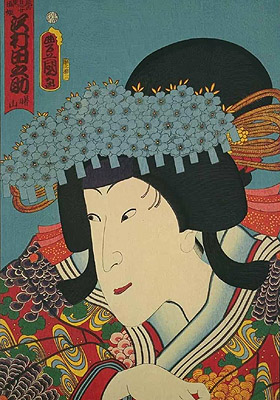
The actor Sawamura Tanosuke III playing the role of Princess Yaegaki in the drama "Honchô Nijûshikô", which was staged in the 9th lunar month of 1861 at the Ichimuraza (print made by Utagawa Toyokuni III) |
|
|
| Contact | Main | Top | Updates | Actors | Plays | Playwrights | Programs | Links | FAQ | Glossary | Chronology | Illustrations | Prints | Characters | Derivatives | Theaters | Coming soon | News |