Play title Kanadehon Chûshingura  In Japanese
Authors Takeda Izumo II
Miyoshi Shôraku
Namiki Senryû I
History

The play "Kanadehon Chûshingura" was originally written for the puppet theater (Bunraku) and staged for the first time in August 1748 in Ôsaka at the Takemotoza. It was adapted to Kabuki the same year and staged for the first time in December 1748 in Ôsaka at the Naka no Shibai [casting]. The "Yodanme" act (4th act) was performed with the actors Ichinoyama Hikoshirô II, Arashi Sanjûrô II, Anegawa Shinshirô I, Kataoka Nizaemon IV and Tamiya Jûzaburô II in the roles of Hen'ya Hangan, Ôboshi Yuranosuke, Ishidô Umanojô, Ono Kudayû and Yakushiji Jirozaemon.

Structure

The "Yodanme" act, the fourth act of "Kanadehon Chûshingura", is made up of 2 scenes commonly called "Hangan Seppuku" (literally "Hangan's seppuku") and "Shiro Akewatashi" (literally "Vacating the Castle"). Scene 1 and 2 are always performed for a tôshi kyôgen production of this drama and are never staged independently of the others acts.

Key words Gidayû Kyôgen
Adauchi
Jidaimono
Seppuku
Summary

Act 4, Scene 1: "Hangan Seppuku"

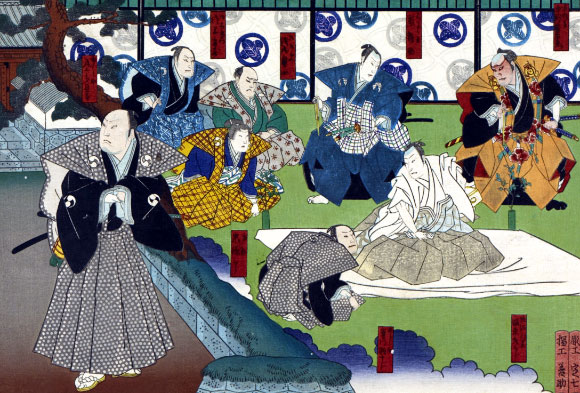
The story moves on and despite the slight nature of lord Moronô's wound, Hangan is sentenced to death. His property is disolved and his entire household is disbanded. His retainers become rônin, (literally "wave men"), the term used for samurai who lose their master. The whole of this rather long scene is extremely heavy and sombre in mood. When handed his sentence of death by the Shôgun's two envoys Hangan shows how he was prepared for the verdict by revealing his pale undergarments... the traditional attire of those about to take their own lives. Hangan must now cut open his own stomach before the eyes of the envoys and then his lands must be handed over. Hangan would be ready... except that he needs to speak one last word in secret with his chief retainer, Yuranosuke, who has not yet returned to the mansion. He tries to stall for time, but must not appear cowardly, and repeatedly asks Yuranosuke's son, Rikiya,whether his father is back yet. Meanwhile, the slow ritual of seppuku,("disembowlment"), is carried on in front of us with a gruesome attention to detail and correct procedure that keeps our attention in its feeling of being true-to-life. It takes a long time, but finally the moment arrives when Hangan must plunge the short-sword into his belly and draw it across from the left side to the right thereby slitting it open. But death does not come quickly and it is only now at the last minute that Yuranosuke rushes in along the hanamichi. He is allowed to approach his lord who has just enough breath left to hint at his final instructions to his faithful retainer. Yuranosuke is the only one who can be trusted and as he is also wise he understands his lord's dying wish. His wish is for revenge. Prevented from defending his honour by Kakogawa Honzô, it is now up to Yuranosuke to seek satisfaction on his behalf.

After this the envoys leave the stage and Hangan's corpse is placed inside a palanquin for its later removal to the near-by temple. Kaoyo appears briefly, dressed all in white and revealing that she's taken the tonsure by cutting her hair. All pay their last respects and burn incense for the departed soul. Finally, the palanquin is carried off, Kaoyo retires and Yuranosuke is left in the room with the other men.

Though the effectual leader of all Hangan's retainers, Yuranosuke is not infact the most senior. That position belongs to the elderly Ono Kudayû whom Yuranosuke does not necessarily trust. The old man's loyalty is called into doubt when he nods off during the sad but tedious proceedings, and Yuranosuke knows him well enough not to expose any plan for revenge while Kudayû is still in the room. It is only after he's gone that Yuranosuke makes his intentions known to those loyal samurai who are left. He insists that they do not oppose the Shôgun's orders to hand over the property for afterall, it is not the Shôgun who is their enemy but rather the wicked Moronô. They must bide their time untilthey are ready to attack and kill that lord. He and the men then rush to the front gate of the mansion to stop and inform other retainers.

Act 4, Scene 2: "Shiro Akewatashi"

Yuranosuke and men manage to persuade the rest not to resist the Shôgun's orders and to withdraw. This leaves Yuranosuke alone on stage before the front gate of what used to be Hangan's mansion. This is a short scene but a very important one because for the first time in the play, we get to concentrate on the drama's main hero, Yuranosuke... on his intense grief at the loss of his lord and on his rock-hard conviction to avenge his death. As he stands alone outside the gate it is a dark night and the cawing of crows fills the air. Yuranosuke clutches the dagger which Hangan used and which is still smeared withhis blood. He licks it, and pledges to fulfill Hangan's final wish.

Among famous roles for leading actors of male characters Yuranosuke is classed as one of the heaviest and most difficult. The character is intelligent and though certainly very loyal, he exhibits none of the impulsive and over-passionate dedication of many of the other retainers. Yuranosuke is calm and collected on the outside and all his actions are carefully planned. He is just as determined and just as committed as any of the others but he waits for the right time to express this. He also feels the sad loss of his lord as painfully as anyone and here at the end of this scene the audience finally gets to see this private hurt seep out.

Courtesy of Paul M. Griffith

Ichikawa Ebizô V and Sawamura Tosshô I playing the roles of Yuranosuke and En'ya Hangan in the "Hangan Seppuku" scene of the drama "Kanadehon Chûshingura", which was staged in March 1833 at the Kawarazakiza (print made by Utagawa Kunisada I)

 
Search this site powered by FreeFind
  Site map
Contact | Main | Top | Updates | Actors | Plays | Playwrights | Programs | Links | FAQ | Glossary | Chronology | Illustrations | Prints | Characters | Derivatives | Theaters | Coming soon | News