| KIKYÔ-GA-HARA |
| Play title | Honchô Nijûshikô  Twenty-Four Examples of Filial Piety in Japan |
| Common title | Kikyô-ga-Hara The Bellflowers Plain |
| Authors | Chikamatsu Hanji Miyoshi Shôraku Takeda Inaba Takeda Heishichi Takemoto Saburobê II |
| History |
The play "Honchô Nijûshikô" was originally written for the puppet theater (Bunraku) and staged for the first time in the 1st lunar month of 1766 in Ôsaka at the Takemotoza. It was adapted for Kabuki a few months later and was produced by both Nakamura Utaemon I and Mimasu Daigorô I in Ôsaka at the Naka no Shibai [casting]. The "Jusshukô" scene is performed for the first time with the actors Arashi Hinasuke I, Arashi Sangorô II and Yamashita Kinsaku II in the roles of Princess Yaegaki, Takeda Katsuyori and Nureginu. |
| Structure |
"Kikyô-ga-Hara", or "The Bellflowers Plain" is the first scene of the 3rd act of the drama "Honchô Nijûshikô". It is sometimes revived as part of a tôshi kyôgen production. |
| Key words |
Gidayû Kyôgen Giri/Ninjô Jidaimono Kikyô-ga-Hara Nagao Kenshin Nagao-shi Sengoku Jidai Takeda Katsuyori Takeda Shingen Takeda-shi Yamamoto Kansuke |
| Summary |
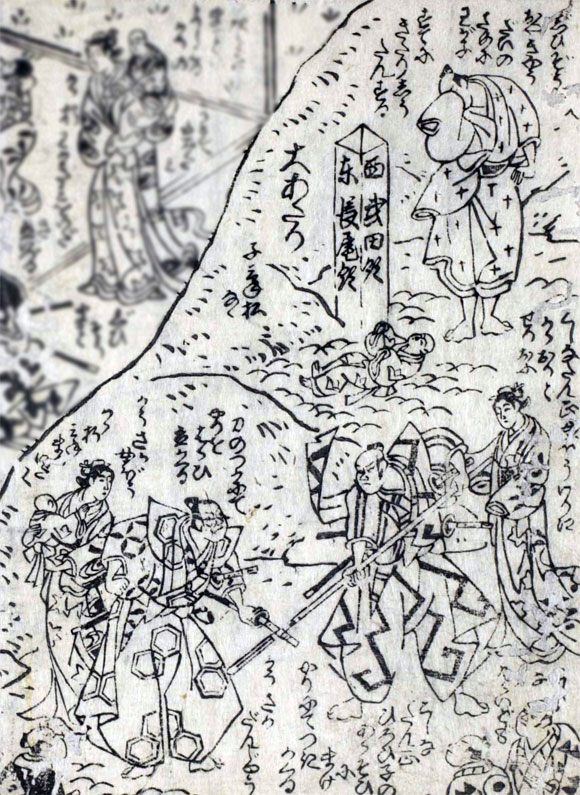
On each side of the border between the territories of Takeda Shingen and Nagao Kenshin, which crosses Kikyô-ga-Hara, servants of the two feudal lords mow grasses and begin quarreling over trespassing. Karaori, wife of Shingen's chief retainer Kôsaka Danjô, and Irie, wife of Kenshin's chief retainer Koshina Danjô, appear and take over the quarrel, speaking ill of each other's husbands, but are restrained by the servants before the dispute becomes too serious. Jihizô, the second son of the late great strategist Yamamoto Kansuke, brings a male infant and abandons him, placing him across the border with his feet in Shingen's territory and his head in Kenshin's territory. Kôsaka passes by and, finding the infant, notices that a tag bearing the name of Yamamoto Kansuke is attached to him. Considering that the infant is somehow related to the strategist, he tries to take him home when Koshina Danjô appears and claims that he has the right to have the boy because his head were in Kenshin's territory. Kôsaka refutes him, saying that his feet, which was in Shingen's territory, is more important than the head. Karaori and Irie take part in the argument and propose to settle the dispute by seeing which the infant will prefer, Karaori's bosom or Irie's. As the boy ceases crying in Karaori's arms, Kôsaka and Karaori take him home. |
 |
|
A picture for the "Kikyô-ga-Hara" scene of "Honchô Nijûshikô" from the ezukushi banzuke for the staging in the 1st lunar month of 1766 in Ôsaka at the Takemotoza of the puppet play "Honchô Nijûshikô" |
|
|
| Contact | Main | Top | Updates | Actors | Plays | Playwrights | Programs | Links | FAQ | Glossary | Chronology | Illustrations | Prints | Characters | Derivatives | Theaters | Coming soon | News |