| Dates |
5 ~ 26 March 2026
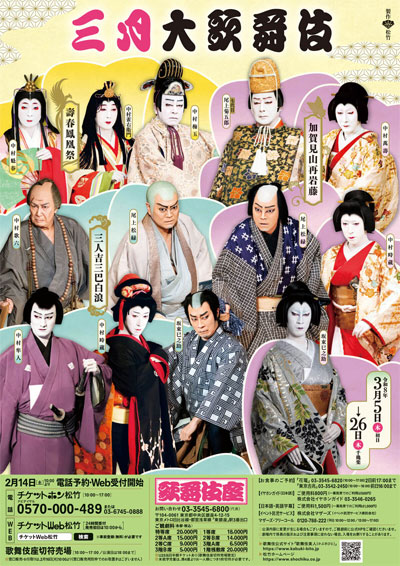
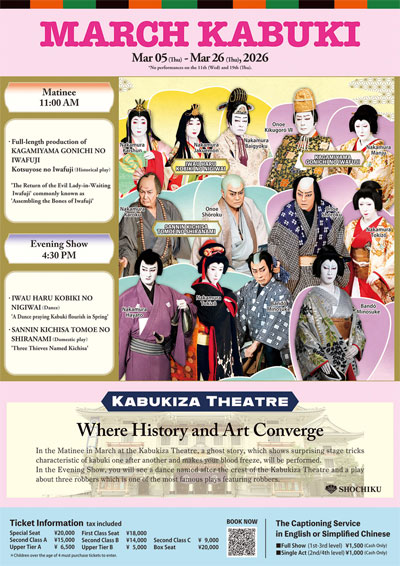
Sangatsu Ôkabuki
March Grand Kabuki |
| Matinée |
Kagamiyama Gonichi no Iwafuji
|
| Evening |
Iwau Haru Kobiki no Nigiwai
Sannin Kichisa Tomoe no Shiranami
A tôshi kyôgen production in 3 acts (5 scenes)
|
| Casting |
Living National Treasure Onoe Kikugorô, Living National Treasure Nakamura Baigyoku, Living National Treasure Nakamura Karoku, Nakamura Manju, Nakamura Kaishun, Nakamura Shikan, Nakamura Jakuemon, Nakamura Senjaku, Onoe Shôroku, Bandô Minosuke, Nakamura Hayato, Nakamura Matagorô, Bandô Hikosaburô, Bandô Kamezô, Nakamura Tokizô, Ôtani Tomoemon,
Ichikawa Monnosuke, Ichikawa Komazô, Ichimura Manjirô, Kawarasaki Gonjûrô, Ichikawa Omezô, Nakamura Matsue, Sawamura Sônosuke, Ichikawa Somegorô, Bandô Shingo, Nakamura Toranosuke, Nakamura Kashô, Nakamura Hashinosuke, Nakamura Mantarô, Nakamura Tanenosuke, Nakamura Kangyoku, Nakamura Utanosuke, Onoe Sakon, Ichikawa Otora,
Arashi Kitsusaburô, Nakamura Kamenojô, Nakamura Kichinojô, Ichimura Kitsutarô
|
| Comments |
The March Grand Kabuki at the Kabukiza.
Gonichi no Iwafuji:
(The Return of Iwafuji)
This play is a sequel to an earlier classic in which the evil lady-in-waiting
Iwafuji caused the death of her rival Onoe by excessively persecuting her,
including beating Onoe with a saddle. One ear later, Onoe's servant Onoe II (Nakamura Manju/Nakamura Tokizô),
who avenged her death by killing Iwafuji, has come to pray for the comfort of
Iwafuji's spirit (Onoe Shôroku/Bandô Minosuke). Iwafuji's bones come together magically and her spirit
floats among the cherry blossoms. Later the spirit appears at the mansion to beat
Onoe II with a saddle. Evil forces are plotting to take over the Taga household where
Onoe works. The servant Torii Matasuke (Onoe Shôroku/Bandô Minosuke) is harboring the faithful retainer
Motome (Nakamura Mantarô). He decides to kill his lord's consort, an evil woman who is one of the main
forces in the plot, but through the scheming of another, he ends up killing his
lord's wife instead. The death is blamed on Motome, and Matasuke must take his own
life to clear Motome's name. In the end, the lord defeats all the evil forces
threatening his realm and the ghost of Iwafuji returns to the afterworld.
This play is one of the many that the popular star Ennosuke has revived and adapted
to his own personal style, and it features spectacular special effects and large-scale
fight scenes. Featuring also Living National Treasure Onoe Kikugorô, Nakamura Shikan, Nakamura Senjaku & Nakamura Matagorô.
Kobiki no Nigiwai: this dance, which was named after the phoenix that has been believed to be auspicious
from old times and is the crest of the Kabukiza Theatre, was first performed in 2014 celebrating the
opening of the fifth-generation Kabukiza.
Featuring Living National Treasure Nakamura Baigyoku, Nakamura Jakuemon, Nakamura Kaishun, Bandô Hikosaburô, Ôtani Tomoemon, Kawarasaki Gonjûrô, Ichimura Manjirô, Ichikawa Monnosuke & Ichikawa Komazô.
Sannin Kichisa:
(Three Thieves Named Kichisa)
The late 19th century playwright Kawatake Mokuami excelled at plays about thieves and
this play is considered to be one of his greatest. Three thieves, all with the name Kichisa, meet on a riverbank.
Ojô Kichisa (Nakamura Tokizô) was once a Kabuki onnagata and robs in the guise
of a woman. Obô Kichisa (Nakamura Hayato) is a handsome young man while Oshô Kichisa (Onoe Shôroku/Bandô Minosuke) has more weight and stature as the head of a
derelict temple. Though they start out as rivals, they decide to become blood brothers and form a gang.
The three are bound by fate in many ways, with the crimes of one leading to hardship of the family of another.
But the same sins and crimes also lead to rescue and salvation. The play combines dark drama with the most
beautiful of poetry. In the famous scene on a riverbank Ojô Kichisa kills a young prostitute and then speaks
in the playwright’s famous rhythmical speech of the moon on a hazy night and the gold coins that have fallen
into his hands. Soon, these gold coins will link together the three thieves named Kichisa, and in turn,
draw these three into a larger drama of crime and retribution. The play combines the playwright Kawatake Mokuami's
gritty depiction of the lowest levels of society with intoxicatingly beautiful music and poetry to bring life to
his vision of the cycles of sin and retribution. Featuring also Living National Treasure Nakamura Karoku in the role of Dozaemon Denkichi.
Sources: Earphone Guide Website or Shôchiku Kabuki Official Website
|
| Minamiza (Kyôto) |
 |
|
| Dates |
3 ~ 25 March 2026
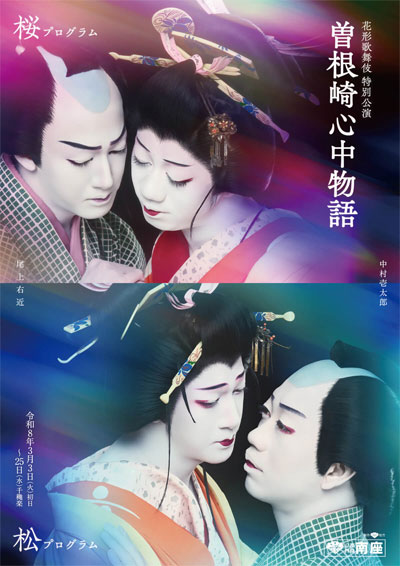
Sangatsu Hanagata Kabuki
March Young Actors Kabuki |
Sakura Puro
('Cherry Tree Program') |
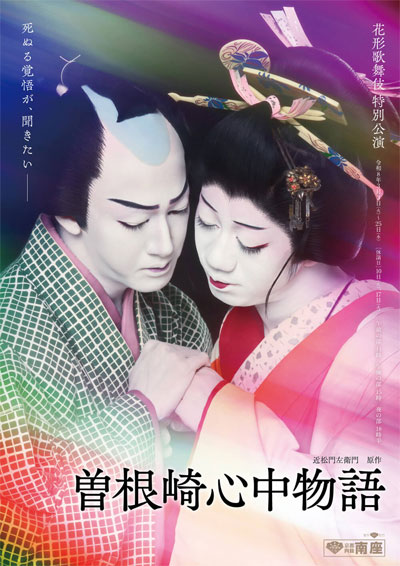
Sonezaki Shinjû
Hanagata Kabuki Tokubetsu Taidan
|
Matsu Puro
('Pine Tree Program') |
Sonezaki Shinjû
Hanagata Kabuki Tokubetsu Taidan
|
| Casting |
Onoe Ukon, Nakamura Kazutarô, Kamimura Kichitarô, Kataoka Matsujûrô, Kataoka Senjirô,
Nakamura Kansei, Nakamura Kansei, Kataoka Takashi, Kataoka Nisaburô, Onoe Kikuji, Onoe Kikusaburô, Kamimura Orinosuke, Bandô Takenosuke
|
| Comments |
Young actors performing in Kyôto at the Minamiza. The second item in this program is a speech on stage.
In the 'Cherry Tree Program', the roles of Tenmaya Ohatsu and Hiranoya Tokubê are played by Nakamura Kazutarô and Onoe Ukon.
In the 'Pine Tree Program', the roles of Tenmaya Ohatsu and Hiranoya Tokubê are played by Onoe Ukon and Nakamura Kazutarô.
Sonezaki Shinjû: a young merchant named Hiranoya Tokubê has long been in
love with the courtesan Tenmaya Ohatsu and is diligently trying to buy out her contract.
But he is swindled out of his money by someone he considered a friend.
Then he is beaten and humiliated in the precincts of the Ikutama Shrine.
He sneaks into the teahouse where Ohatsu is and she hides him under the veranda.
At this point, Tokubê's "friend" comes and calls him a criminal.
Ohatsu fiercely defends Tokubê and asks whether he is prepared to defend his
honor by committing love suicide. Silently, from under the veranda,
he holds her bare foot and draws it across his neck. The journey to the forest
where they commit love suicide is like a dream, half-way between this world
and the next and has some of the most famous lines in Japanese theatre:
"Farewell to this world and to this night, farewell. To what should we who go
to our deaths be likened? We are like the frost on the road leading to the
graveyard, vanishing with each step". Starring Onoe Ukon/Nakamura Kazutarô and Nakamura Kazutarô/Onoe Ukon in
the roles of Tokubê and Ohatsu.
Sources: Earphone Guide Website or Shôchiku Kabuki Official Website
|
| Dates |
5 ~ 27 March 2026 |
| Program |
Rupan Sansei (Hekisui no Reijô)
Dainisen (2nd round)!
|
| Casting |
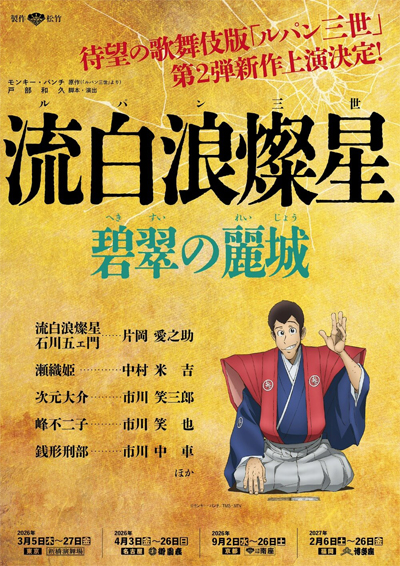
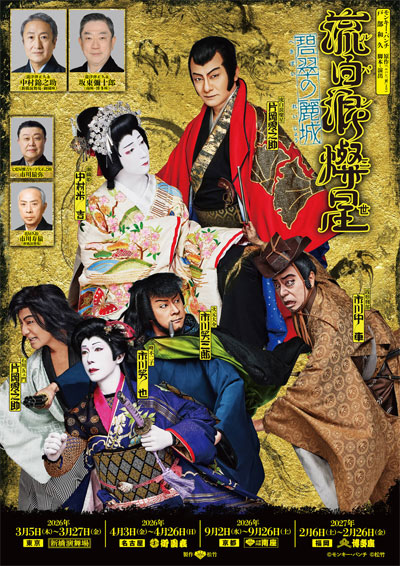
Kataoka Ainosuke, Nakamura Kinnosuke, Ichikawa Chûsha, Nakamura Yonekichi, Ichikawa Emisaburô, Ichikawa Emiya,
Ichikawa En'ya, Ichikawa Juen
|
| Comments |
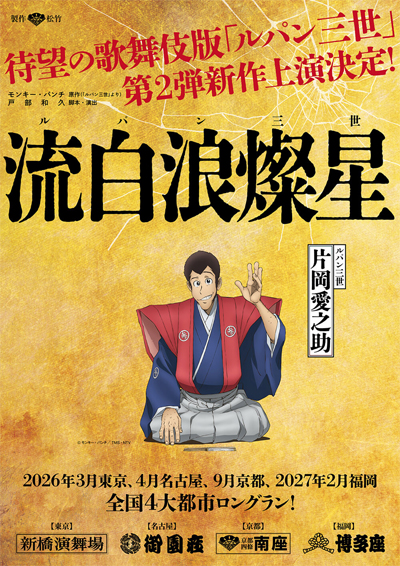
The newly-created Kabuki hero "Rupan Sansei", which was based on Monkey Punch's famous manga/anime "Lupin the Third", which was premiered in December 2023 at the Shinbashi Enbujô and which was staged in September 2025 at the Minamiza,
is ready for new adventures in 2026. The first round was a huge success and the second round is premiered in March in Tôkyô at the Shinbashi Enbujô.
Then, it will be staged in April 2026 in Nagoya at the Misonoza, in September 2026 in Kyôto at the Minamiza and in February 2027 in Fukuoka at the Hakataza.
It stars Kataoka Ainosuke (Lupin III & Ishikawa Goemon XIII), Ichikawa Chûsha (Inspector Zenigata Kôichi),
Ichikawa Emiya (Mine Fujiko), Ichikawa Emisaburô (Jigen Daisuke) & Nakamura Yonekichi (Princess Seori).
Hekisui no Reijô: the story is set in the feudal era. Princess Seori (Nakamura Yonekichi), the daughter of the Lord of Suwa,
head of the Harumiya family, was living a quiet life at the Hatsuse Temple in Kamakura. However, following her father’s death,
she is forced to marry the Regent Takitsu Danjô Hisanaga (Nakamura Kinnosuke) to ensure her family's survival. Into this situation comes the master thief Lupin the Third (Kataoka Ainosuke),
aiming to steal the vast fortune being hoarded at the temple, which leads to their fateful encounter. For this sheltered princess who dreamed of freedom, Lupin arrives like a sudden gust of wind. Together,
they embark on an adventure in pursuit of a secret treasure hidden within a phantom ancient castle. Lupin and the Princess begin to develop an affection for each other, their hearts swaying as they have different destinies.
Lupin, the Princess, Jigen Daisuke (Ichikawa Emisaburô),
Ishikawa Goemon XIII (Kataoka Ainosuke in a second role), and Mine Fujiko (Ichikawa Emiya) clash with their formidable enemy,
Danjô, over the treasure, whom Inspector Zenigata (Ichikawa Chûsha) follows in hot pursuit. The curtain now rises on this "Heroine’s Tale", weaving together the world of Kabuki and Lupin the Third.
Sources: Earphone Guide Website or Shôchiku Kabuki Official Website
|
| Shungyô Special Tour |
| Dates |
7 ~ 25 March 2026
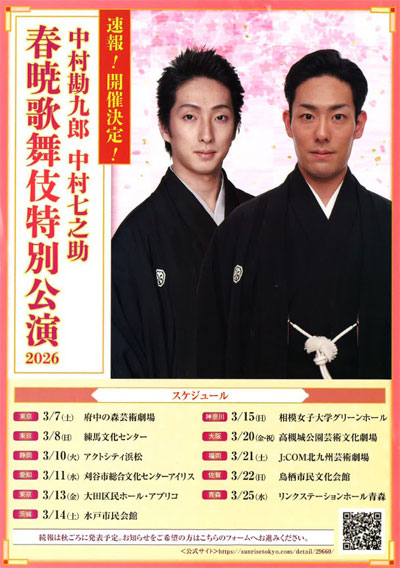
Shungyô Kabuki Tokubetsu Kôen
The Dawn of Spring Kabuki Special Performances |
| Program |
Tôku Kônâ
Iro Momiji Tsugiki no Futsutsuka (Benikan)
Suminuri Onna
|
| Casting |
Nakamura Kankurô, Nakamura Shichinosuke, Nakamura Ichô, Sawamura Kunihisa, Nakamura Nakasuke, Nakamura Nakanosuke, Nakamura Nakashirô, Nakamura Nakaya, Nakamura Nakaji, Nakamura Sanzaemon
|
| Comments |
A Spring Tour of the Nakamuraya guild with performances in 11 venues.
Tôku Kônâ: Literally 'Talk Corner'. A speech on stage with Nakamura Kankurô and Nakamura Shichinosuke.
Benikan: in the late Edo period, Beniya Kanbê (Benikan for short), a peddler of cosmetics,
traveled through the streets of Asakusa and the Yoshiwara pleasure district performing with a shamisen
made of a broomstick for the neck, a round sieve for the body of the instrument and the paddle used to scoop rice for the plectrum.
He also had a drum and gong tied to his waist and played light, entertaining music on his unusual instrument.
This dance recreates the figure of Benikan (Nakamura Ichô) and features several supporting actors as a variety of the colorful peddlers
to be seen around Asakusa selling fans, morning glories and insects.
Suminuri Onna: not staged for 77 years! Mannojô (Nakamura Kankurô), a daimyô, having successfully settled a lawsuit in Kyôto,
prepares to return to his home province. Before departing, he goes to bid farewell to his beloved concubine, Hanano (Nakamura Shichinosuke),
with whom he has grown especially close. Hanano, reluctant to let him go, tries to seduce and emotionally sway him.
Yet beneath her display of sorrow lies a cunning and cold-hearted nature. Though she pretends to weep, not a single tear falls.
Tarôkaja (Nakamura Ichô), who has accompanied Mannojô throughout the trip, notices her deception and warns his master.
However, the daimyo—soft-hearted and sympathetic—refuses to believe anything ill of Hanano.
Determined to reveal the truth, Tarôkaja devises a plan. He secretly mixes ink into a tea bowl.
Unaware of this, Hanano uses the tainted water to moisten her eyes in an attempt to fake tears.
The moment she does, the area around her eye turns pitch-black, exposing her lie and revealing her true intentions.
Sources: Earphone Guide Website or Shôchiku Kabuki Official Website
|