APRIL 2026

2 shows in Ôsaka (Shôchikuza), 2 in Tôkyô (Kabukiza), 2 on Shikoku island (Kanamaruza) & 1 in Nagoya (Misonoza)!

  • Living National Treasure Kataoka Nizaemon, Living National Treasure Nakamura Karoku, Nakamura Ganjirô, Nakamura Senjaku, Matsumoto Kôshirô, Kataoka Takatarô, Nakamura Kazutarô, Nakamura Shidô, Nakamura Hayato, Ichikawa Monnosuke, Ichikawa Komazô & Kamimura Kichiya perform at the Shôchikuza!
  • Living National Treasure Nakamura Baigyoku, Living National Treasure Nakamura Tôzô, Nakamura Manju, Onoe Kikugorô, Nakamura Kaishun, Nakamura Shikan, Nakamura Fukusuke, Nakamura Kankurô, Nakamura Shichinosuke, Bandô Yajûrô, Bandô Hikosaburô, Onoe Ukon & Nakamura Tokizô perform at the Kabukiza!
  • Nakamura Jakuemon, Onoe Shôroku, Bandô Kamezô, Bandô Minosuke & Bandô Shingo perform at the Kanamaruza!
  • Kataoka Ainosuke, Ichikawa Chûsha, Nakamura Yonekichi, Ichikawa Emiya & Ichikawa Emisaburô perform at the Misonoza!
  • Shôchikuza (Ôsaka)
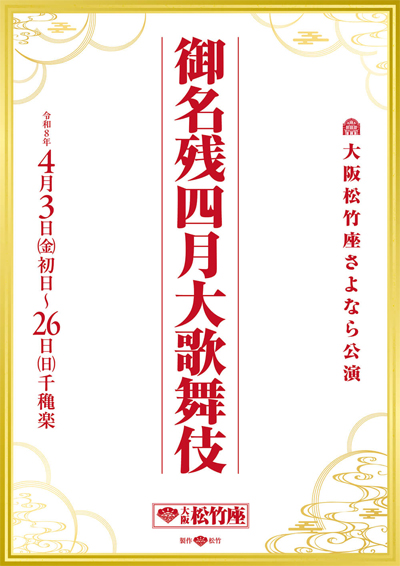
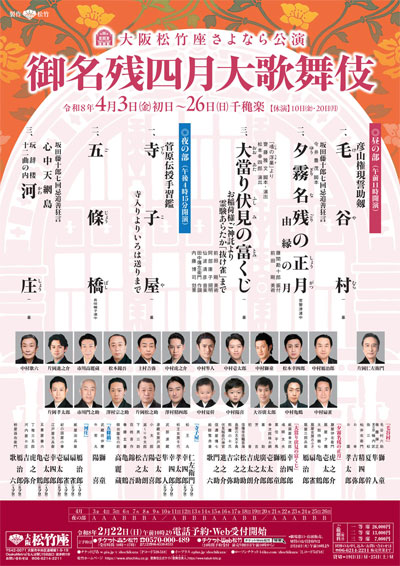
    Dates 3 ~ 26 April 2026 (Onagori Shigatsu Ôkabuki)
    Farewell April Grand Kabuki
    Matinée

    Hikosan Gongen Chikai no Sukedachi (Keya-mura)

    Yûgiri Nagori no Shôgatsu

    Ôatari Fushimi no Tomikuji

    Evening

    Sugawara Denju Tenarai Kagami (Terakoya)

    Gojôbashi

    Shinjû Ten no Amijima (Kawashô)

    Casting

    Living National Treasure Kataoka Nizaemon, Living National Treasure Nakamura Karoku, Nakamura Ganjirô, Nakamura Senjaku, Matsumoto Kôshirô, Kataoka Takatarô, Nakamura Kazutarô, Nakamura Shidô, Nakamura Hayato, Ichikawa Monnosuke, Ichikawa Komazô, Kamimura Kichiya, Nakamura Kikaku, Matsumoto Kingo, Nakamura Toranosuke, Sawamura Sônosuke, Ôtani Hirotarô, Kamimura Kichitarô, Sawamura Kiyoshirô, Kataoka Matsunosuke, Nakamura Haruki, Nakamura Natsuki

    Comments

    The historic Shôchikuza, located in the vibrant heart of the Dôtonbori district in Ôsaka and affectionately nicknamed the 'Arc de Triomphe of Dôtonbori', will definitively close its doors at the end of May 2026. 1st of the two Ôsaka Shôchikuza Sayonara Kôen, the Shôchikuza Farewell Performances.

  • Keya-mura: Rokusuke (Nakamura Shidô), a sword master who lives a simple country life, is taking care of a small foundling child. He hangs the boy's kimono outside his house in the hope that the boy's relatives will see it and know where he is. One day he finds himself attacked by a woman named Osono (Kataoka Takatarô) who turns out to be the aunt of the child. As they talk, they find that they are in fact linked by promises of marriage although they have never met directly. Osono is searching for Kyôgoku no Takumi (Nakamura Hayato), the killer of her father, Rokusuke's master, and Rokusuke promises to help in her vendetta.
  • Yûgiri Nagori no Shôgatsu: the roots of this play go back to the earliest days of Kabuki. The young lover Fujiya Izaemon (Nakamura Toranosuke) has been disowned by his family for loving a courtesan. This role is a classic example of wagoto, the gentle style of acting that was popular in the Kansai region. His lover Ôgiya Yûgiri (Nakamura Kazutarô), the fabulous courtesan, died pining away with love for him. As he prays to Amida Buddha to hold a memorial service for her, he faints and she appears. They celebrate their reunion and reminisce about the past, but she disappears. He is pleased with seeing her though in dream. This particular version of the play was originally written by Chikamatsu Monzaemon. But since the original script had long been lost, this version of the story was written in 2005. Nakamura Toranosuke will also wear a real paper kimono, the trademark of Sakata Tôjûrô I.
  • Ôatari Fushimi no Tomikuji:
    (A Winning Lottery Ticket of Fushimi)
    This is a light comedy portraying Kôjirô (Matsumoto Kôshirô), now a waste paper man but who was originally a clerk in a large business that went bankrupt. Now he dreams of restoring the shop of his old master. He has also lost his heart to the courtesan Nioteru (Nakamura Ganjirô). It looks like his dreams will come true when he buys a winning lottery ticket, but it seems that the ticket gets lost among his wastepaper. This month's performance is a revival of this play, giving new life to old-fashioned Ôsaka comedy. Featuring also Living National Treasure Nakamura Karoku, Nakamura Kazutarô, Nakamura Shidô and Ichikawa Monnosuke.
  • Terakoya: Genzô and his wife Tonami run a small school and are protecting Kan Shôjô's son and heir, saying that he is their son. However, word has gotten out Kan Shôjô's son is there and Genzô has been ordered to behead him. Moreover, Matsuômaru is to come to inspect the head. Their only alternative is to kill one of the other students as a substitute, but all of the students are farmer's children who could never pass for the son of a court aristocrat. However, a new boy arrives that day and Genzô makes the terrible decision to kill him in the place of his lord. As it turns out, Matsuômaru has sent his own son to be sacrificed, because of his family's long loyalty to Kan Shôjô. But he must face the most terrible situation for a father, inspecting the head of his own son and lying when he says that it is the genuine head of the son of Kan Shôjô. Finally Matsuômaru reveals his true feelings to Genzô and he and his wife Chiyo mourn their dead son. Starring Living National Treasure Kataoka Nizaemon/Matsumoto Kôshirô as Matsuômaru, Matsumoto Kôshirô/Nakamura Hayato as Genzô, Kataoka Takatarô as Chiyo and Nakamura Kazutarô as Tonami. Featuring also Nakamura Kikaku as Shundô Genba.
  • Gojôbashi: a short dance showing Ushiwaka, a delicate young man who actually is a powerful warrior picking fights on the Gojô Bridge in Kyôto and Benkei, the stout warrior priest who challenges him. Starring Nakamura Shidô as Benkei with Nakamura Haruki as Ushiwakamaru.
  • Kawashô: this late love suicide play by Chikamatsu Monzaemon is considered by many to be his masterpiece. The paper seller Jihê (Nakamura Ganjirô/Nakamura Senjaku) is in love with the courtesan Koharu (Nakamura Senjaku/Nakamura Kazutarô) and all those around them are afraid that they will commit love suicide. Jihê’s wife Osan urgently pleads with Koharu to pretend that she does not love Jihê any more, in order to save his life. In the first and most famous scene in the Kawashô teahouse, Jihê’s brother Magoemon (Living National Treasure Nakamura Karoku/Nakamura Ganjirô) masquerades as a samurai to find out Koharu’s true feelings. Jihê listens in from the outside and is astonished to hear her say that she does not want to commit love suicide. In a rage, Jihê breaks off all relations with her, while Magoemon is moved to learn that she has done this out of consideration for Osan’s feelings. This play is a classic example of the Ôsaka style of acting. Featuring also Matsumoto Kôshirô, Kamimura Kichiya & Nakamura Toranosuke.
  • Sources: Earphone Guide Website or Shôchiku Kabuki Official Website

    Kabukiza (Tôkyô)
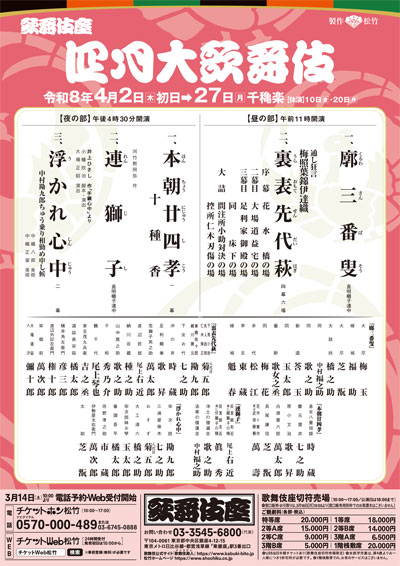
    Dates 2 ~ 27 April 2026
    Shigatsu Ôkabuki
    April Grand Kabuki
    Matinée

    Kuruwa Sanbasô

    Ume Momiji Nishiki no Date-ori
    (Ura Omote Sendai Hagi)

    Evening

    Honchô Nijûshikô (Jusshukô)

    Renjishi

    Ukare Shinjû

    Casting

    Living National Treasure Nakamura Baigyoku, Living National Treasure Nakamura Tôzô, Nakamura Manju, Onoe Kikugorô, Nakamura Kaishun, Nakamura Shikan, Nakamura Fukusuke, Nakamura Kankurô, Nakamura Shichinosuke, Bandô Yajûrô, Bandô Hikosaburô, Onoe Ukon, Nakamura Tokizô, Kataoka Ichizô, Ichimura Manjirô, Kawarasaki Gonjûrô, Nakamura Matsue, Nakamura Kashô, Nakamura Tanenosuke, Nakamura Mantarô, Nakamura Hashinosuke, Nakamura Kangyoku, Nakamura Fukunosuke, Nakamura Utanosuke, Nakamura Tamatarô, Onoe Maholo, Nakamura Hidenosuke, Nakamura Kichinojô, Ichimura Kitsutarô, Nakamura Baika, Nakamura Kamenojô, Onoe Kotoya

    Comments

    The April Grand Kabuki at the Kabukiza.

    Kanamaruza (Konpira)
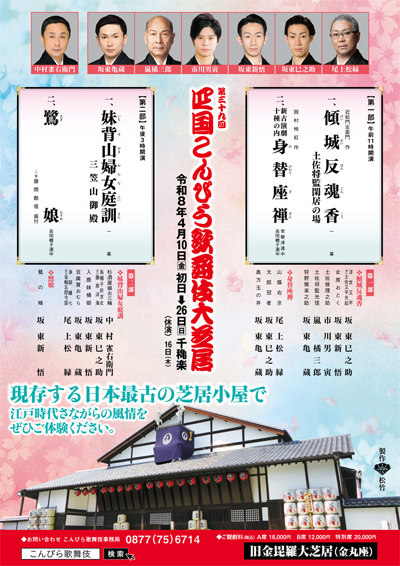
    Dates 10 ~ 26 April 2026
    Shikoku Konpira Kabuki Ôshibai
    Shikoku Konpira Kabuki Grand Theatre
    Matinée

    Keisei Hangonkô (Domo Mata)

    Migawari Zazen

    Evening

    Imoseyama Onna Teikin
    (Mikasayama Goten)

    Sagi Musume

    Casting

    Nakamura Jakuemon, Onoe Shôroku, Bandô Kamezô, Bandô Minosuke, Bandô Shingo, Arashi Kitsusaburô, Ichikawa Otora

    Comments

    The 39th edition of the Spring Kabuki performance Shikoku Konpira Kabuki Ôshibai at the Kanamaruza on Shikoku Island.

  • Domo Mata: the artist Matahei has been refused a professional name because of his stuttering. He makes a poor life by drawing folk paintings and decides to make one last effort to gain respectability. His wife Otoku, who is given as much to chatter as Matahei is silent, pleads his case. Turned down again by his master, Matahei decides to take his life. He draws a farewell portrait of himself, a painting so skillful that the lines seep through solid rock and this miracle convinces his master to confer a professional name. Starring Bandô Minosuke as Matahei and Bandô Shingo as his wife Otoku. Featuring Arashi Kitsusaburô as Matahei's master Tosa Shôgen Mitsunobu, Ichikawa Otora as Utanosuke & Bandô Kamezô as Shûrinosuke.
  • Migawari Zazen: a dance play adopted from a classical kyôgen farce. A man (Onoe Shôroku) wants nothing more than to visit his lover Hanako, but he has one important problem, his homely and overbearing wife (Bandô Kamezô). He creates a scheme saying that he will be practicing Zen meditation all night and has his servant (Bandô Minosuke) take his place while he visits Hanako. He returns, giddy from a night of pleasure and tells his story to his servant in dance, unaware that his wife has discovered his deception and has taken his servant's place.
  • Mikasayama Goten: a fantastic Kabuki period play showing intrigues in the imperial court in the earliest days of Japan. The dictator Soga no Iruka has set up his own court and now seeks to destroy his opponent Kamatari. A mysterious fisherman named Fukashichi (Onoe Shôroku) comes as a messenger from Kamatari, claiming to bring a message of surrender. Meanwhile, Iruka's younger sister, Princess Tachibana (Bandô Shingo) has fallen in love with a handsome young man named Motome (Bandô Minosuke). But Motome is actually the son of Kamatari and says that he will only grant her love if she will cut off Iruka's head. Moreover, a country girl named Omiwa (Nakamura Jakuemon) has also followed Motome. Omiwa's blood and the work of all these people combined are what is necessary to finally defeat the magical powers of the evil Iruka.
  • Sagi Musume: one of the most famous dances in Kabuki, this figure is familiar through pictures and Japanese dolls. A beautiful young woman all in white appears in the snowy landscape. She dances lightly of love, but then reveals that she is the spirit of a bird, a magnificent heron that struggles wounded through a snowstorm. Starring Bandô Shingo.
  • Sources: Earphone Guide Website or Shôchiku Kabuki Official Website

    Misonoza (Nagoya)
    Dates 3 ~ 26 April 2026
    Program

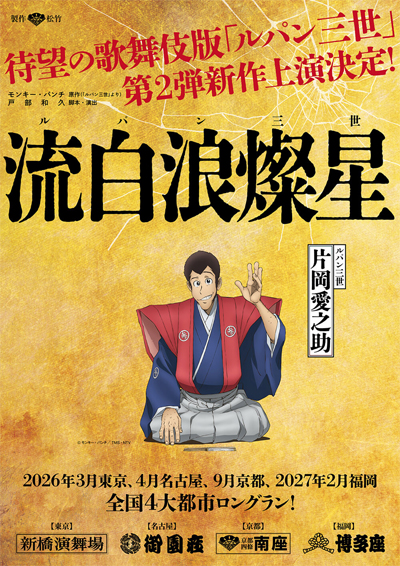
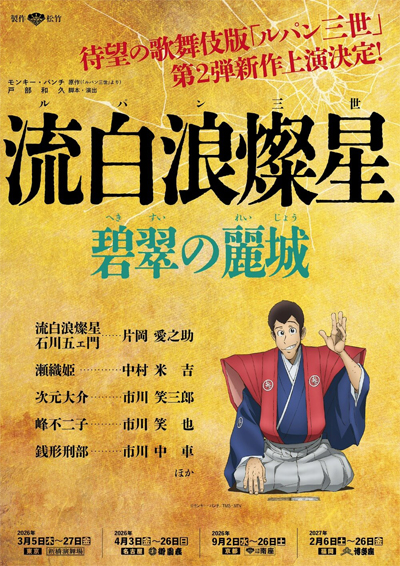
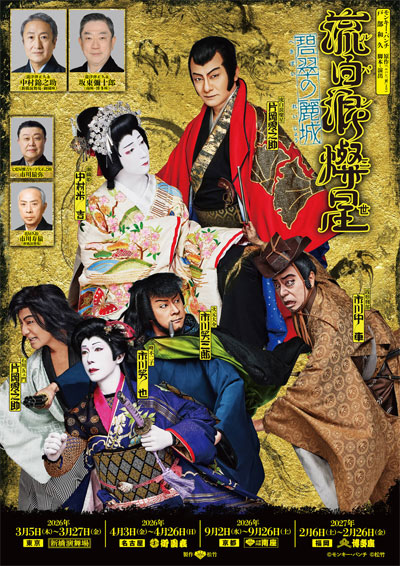
    Rupan Sansei (Hekisui no Reijô)
    Dainisen (2nd round)!

    Casting

    Kataoka Ainosuke, Nakamura Kinnosuke, Ichikawa Chûsha, Nakamura Yonekichi, Ichikawa Emisaburô, Ichikawa Emiya, Ichikawa En'ya, Ichikawa Juen

    Comments

    The newly-created Kabuki hero "Rupan Sansei", which was based on Monkey Punch's famous manga/anime "Lupin the Third", which was premiered in December 2023 at the Shinbashi Enbujô and which was staged in September 2025 at the Minamiza, is ready for new adventures in 2026. The first round was a huge success and the second round was premiered in March 2026 in Tôkyô at the Shinbashi Enbujô. Then, it will be staged in September 2026 in Kyôto at the Minamiza and in February 2027 in Fukuoka at the Hakataza. It stars Kataoka Ainosuke (Lupin III & Ishikawa Goemon XIII), Ichikawa Chûsha (Inspector Zenigata Kôichi), Ichikawa Emiya (Mine Fujiko), Ichikawa Emisaburô (Jigen Daisuke) & Nakamura Yonekichi (Princess Seori).

  • Hekisui no Reijô: the story is set in the feudal era. Princess Seori (Nakamura Yonekichi), the daughter of the Lord of Suwa, head of the Harumiya family, was living a quiet life at the Hatsuse Temple in Kamakura. However, following her father’s death, she is forced to marry the Regent Takitsu Danjô Hisanaga (Nakamura Kinnosuke) to ensure her family's survival. Into this situation comes the master thief Lupin the Third (Kataoka Ainosuke), aiming to steal the vast fortune being hoarded at the temple, which leads to their fateful encounter. For this sheltered princess who dreamed of freedom, Lupin arrives like a sudden gust of wind. Together, they embark on an adventure in pursuit of a secret treasure hidden within a phantom ancient castle. Lupin and the Princess begin to develop an affection for each other, their hearts swaying as they have different destinies. Lupin, the Princess, Jigen Daisuke (Ichikawa Emisaburô), Ishikawa Goemon XIII (Kataoka Ainosuke in a second role), and Mine Fujiko (Ichikawa Emiya) clash with their formidable enemy, Danjô, over the treasure, whom Inspector Zenigata (Ichikawa Chûsha) follows in hot pursuit. The curtain now rises on this "Heroine’s Tale", weaving together the world of Kabuki and Lupin the Third.
  • Sources: Earphone Guide Website or Shôchiku Kabuki Official Website

     
    Search this site powered by FreeFind
      Site map | Disclaimer
    Contact | Main | Top | Updates | Actors | Plays | Playwrights | Programs | Links | FAQ | Glossary | Chronology | Illustrations | Prints | Characters | Derivatives | Theaters | Coming soon | News