JANUARY 2026

7 shows in Tôkyô (Kabukiza, New National Theatre, Asakusa Kôkaidô, Shinbashi Enbujô), 2 in Ôsaka (Shôchikuza) & 2 in Kyôto (Minamiza, Kyôto Gekijô)!

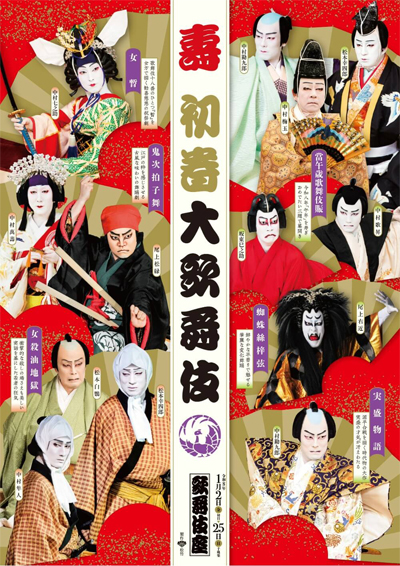
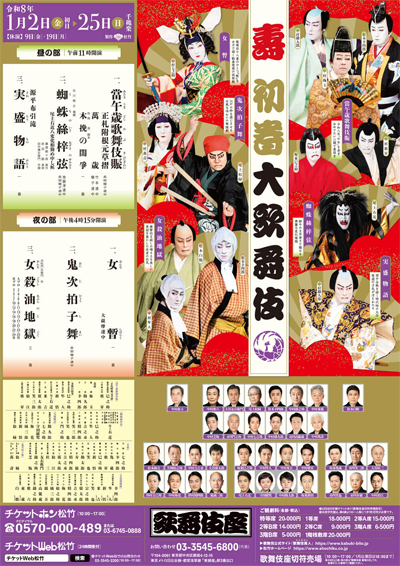
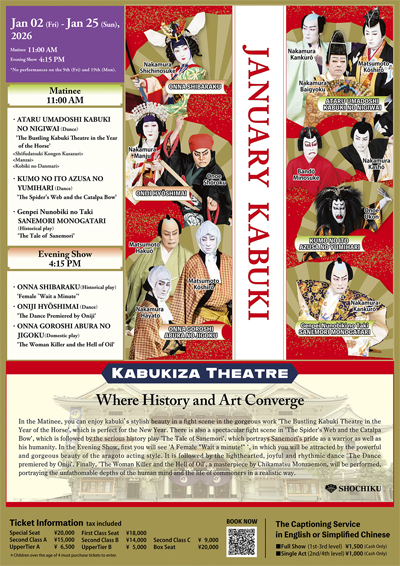
  • Living National Treasure Nakamura Baigyoku, Living National Treasure Nakamura Karoku, Nakamura Manju, Nakamura Shikan, Nakamura Kankurô, Nakamura Shichinosuke, Matsumoto Kôshirô, Onoe Shôroku, Nakamura Kinnosuke, Bandô Minosuke, Nakamura Hayato, Onoe Ukon & Ichikawa Monnosuke perform at the Kabukiza!
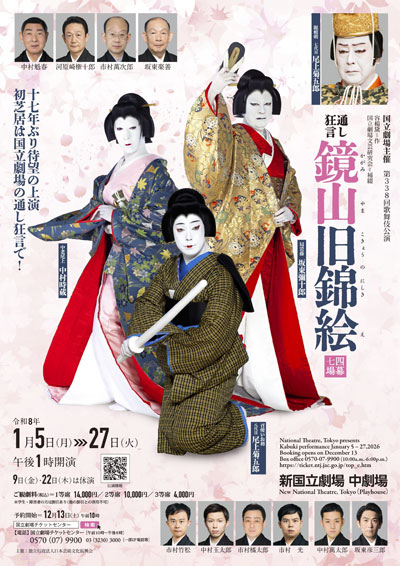
  • Living National Treasure Onoe Kikugorô, Onoe Kikugorô, Nakamura Kaishun, Bandô Yajûrô, Bandô Hikosaburô & Nakamura Tokizô perform at the New National Theatre!
  • Nakamura Ganjirô, Kataoka Ainosuke, Kataoka Takatarô, Nakamura Kazutarô, Ichikawa Chûsha & Kamimura Kichiya perform at the Shôchikuza!
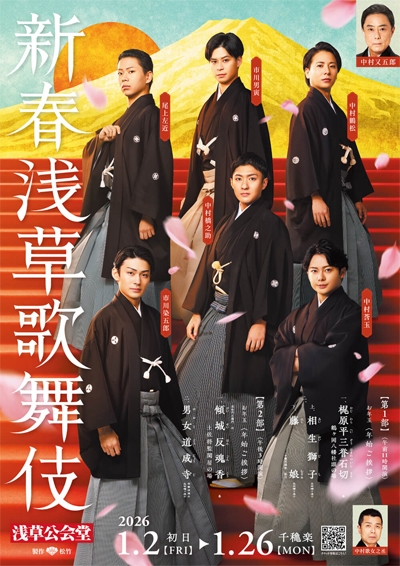
  • Lots of young talented actors at the Asakusa Kôkaidô!
  • Ichikawa Danjûrô, Nakamura Jakuemon, Nakamura Senjaku, Ichikawa Udanji, Kataoka Ichizô, Ichikawa Sai'nyû, Ichimura Kakitsu & Ichikawa Omezô perform at the Shinbashi Enbujô!
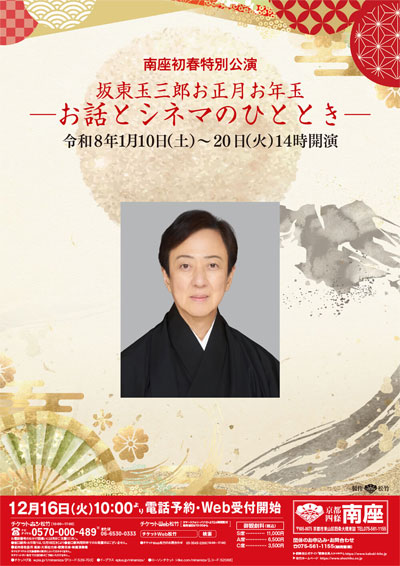
  • Living National Treasure Bandô Tamasaburô performs at the Minamiza!
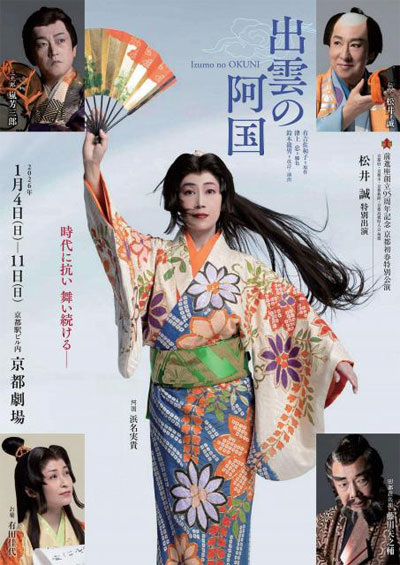
  • The Zenshinza troupe perform at the Kyôto Gekijô!
  • Kabukiza (Tôkyô)
    Dates 2 ~ 25 January 2026
    Kotobuki Hatsuharu Ôkabuki
    Congratulation Early Spring Grand Kabuki
    Matinée

    Ataru Umadoshi Kabuki no Nigiwai

  • Shôfudatsuki Kongen Kusazuri
  • Manzai
  • Kobiki no Danmari
  • Kumo no Ito Azusa no Yumihari

    Genpei Nunobiki no Taki
    (Sanemori Monogatari)

    Evening

    Onna Shibaraku

    Oniji Hyôshimai

    Onna Goroshi Abura no Jigoku

    Casting

    Living National Treasure Nakamura Baigyoku, Living National Treasure Nakamura Karoku, Nakamura Manju, Nakamura Shikan, Nakamura Kankurô, Nakamura Shichinosuke, Matsumoto Kôshirô, Onoe Shôroku, Nakamura Kinnosuke, Bandô Minosuke, Nakamura Hayato, Onoe Ukon, Ichikawa Monnosuke, Ôtani Tomoemon, Ichikawa Komazô, Matsumoto Kingo, Ichikawa Emisaburô, Ichikawa Emiya, Ichikawa Juen, Bandô Kamezô, Nakamura Yonekichi, Bandô Shingo, Nakamura Kashô, Ôtani Hirotarô, Arashi Keishi, Nakamura Matsue, Sawamura Sônosuke, Arashi Kitsusaburô, Sawamura Kiyoshirô, Nakamura Kichinojô, Nakamura Baika, Kataoka Matsunosuke, Nakamura Kantarô, Morita Oto

    Comments

    The two programs for the New Year Grand Kabuki at the Kabukiza.

  • Kusazuri:
    (the Tug-of-War Over the Armor)
    A short dance in the oldest style of Kabuki, leisurely and full of humor, combining the charm of an onnagata female role specialist with the larger-than-life heroism of the bombastic aragoto style of acting. The strong woman Maizuru stops the powerful, but rash, warrior Soga no Gorô from rushing to a fight by pulling on the set of armor he is carrying. Starring Bandô Minosuke and Nakamura Kashô as Gorô and Kobayashi no Asahina.
  • Manzai: Manzai are performers with hand drums that would go from door to door at the New Year to perform auspicious songs and dances, said to bring good fortune to the people. This dance shows the lively songs of the Manzai, here performed by Living National Treasure Nakamura Baigyoku, Matsumoto Kôshirô & Nakamura Kankurô.
  • Kobiki no Danmari: characters connected to the Soga brothers line up and search silently in the dark. This is an acting convention called danmari which is characteristic of Kabuki. ‘Kobiki’ in the title refers to Kobiki-chô, the old name of the town where the Kabukiza is situated. In the city of Edo, it was considered auspicious to perform Kabuki works concerning the vendetta of the Soga brothers at New Year’s and this continues today as a theatrical tradition. Featuring Nakamura Kashô (Kudô Saemon Suketsune), Bandô Minosuke (Soga Gorô Tokimune) and Nakamura Hayato (Soga Jûrô Sukenari).
  • Sanemori Monogatari: a play about the early days of the rivalry between the Genji and Heike warrior clans. The warrior Saitô Bettô Sanemori (Nakamura Kankurô) has been charged by the leaders of the dominant Heike clan with finding Aoi Gozen, the pregnant wife of the leader of the enemy Genji clan. He is to kill her child if it is a son who can succeed to head of the clan, but old loyalties to the Genji lead him to protect the boy. Sanemori tells the story of how Koman (Nakamura Shichinosuke), the daughter of the old couple who is protecting Aoi Gozen, bravely fought to protect the sacred standard of the Genji from the Heike. Koman mysteriously comes back to life when her severed arm is rejoined to it. Featuring also Onoe Shôroku as Senoo Jûrô.
  • Onna Shibaraku: more ceremony than play, "Shibaraku" is one of the oldest pieces in Kabuki. Just as an evil villain is about to execute a group of loyal retainers, a voice calls out for him to wait and a hero appears to save the day. This version is a parody, though, as the hero is played by an onnagata female role specialist, who mixes the super-human strength of an aragoto hero with the soft gentleness of a Kabuki heroine. Featuring Nakamura Shichinosuke as the heroine Tomoe Gozen and Nakamura Shikan as the larger-than-life villain Kaba no Kaja Noriyori, with Matsumoto Kôshirô as a friendly stage attendant who makes sure that everything goes right. Featuring also Nakamura Kinnosuke, Ôtani Tomoemon & Ichikawa Emiya.
  • Oniji Hyôshimai: this is a classical dance filled with the stylized beauty of gesture and pose and including a fight scene. Osada no Tarô (Onoe Shôroku), a warrior of the Heike clan who is disguised as a woodcutter, encounters a shirabyôshi dancer (Nakamura Manju) in the mountains in Kyôto. They struggle with each other for the possession of a valuable flute.
  • Abura no Jigoku: this play has become phenomenally popular in modern times for its hard-boiled sensibility and sensuous killing scene with the protagonists slipping and struggling through puddles of spilled oil, but was virtually ignored at the time it was written. It shows Yohê, the wastrel son of a well-to-do merchant, who constantly tries to borrow money from Okichi, the wife of a neighboring oil merchant. Pressed for funds, he tries to blackmail her, but ends up killing her in the long, dream-like scene that gives this plays its title, "the woman killer and the hell of oil". Starring Matsumoto Kôshirô/Nakamura Hayato and Bandô Shingo/Nakamura Yonekichi in the roles of Yohê and Okichi. Featuring also Matsumoto Hakuô, Living National Treasure Nakamura Tôzô & Living National Treasure Nakamura Karoku.
  • Sources: Earphone Guide Website or Shôchiku Kabuki Official Website

    New National Theatre (Tôkyô)
    Dates 5 ~ 27 January 2026
    Reiwa 8 Hatsuharu Kabuki
    8th Year of the Reiwa Era Early Spring Kabuki
    Program

    Kagamiyama Kokyô no Nishikie

    Casting

    Living National Treasure Onoe Kikugorô, Onoe Kikugorô, Nakamura Kaishun, Bandô Yajûrô, Bandô Hikosaburô, Nakamura Tokizô, Bandô Rakuzen, Ichimura Manjirô, Kawarasaki Gonjûrô, Nakamura Mantarô, Ichimura Takematsu, Nakamura Tamatarô, Ichimura Hikaru, Ichimura Kitsutarô

    Comments

    No performance at the National Theatre, which was destroyed in 2024, but there is a subsitute theater: the New National Theatre!

  • Kagamiyama: "Kagamiyama" is the ultimate play about rivalry and revenge in the women's quarters of a samurai mansion. It is said to be based on life in the Shôgun's castle since the original play was written by a doctor familiar with things in that exalted realm far from the eyes of the common people. Starring Bandô Yajûrô, Nakamura Tokizô and Onoe Kikugorô in the roles of the evil Iwafuji, the gentle Onoe and the valorous Ohatsu.
  • Sources: Earphone Guide Website or Shôchiku Kabuki Official Website

    Shôchikuza (Ôsaka)
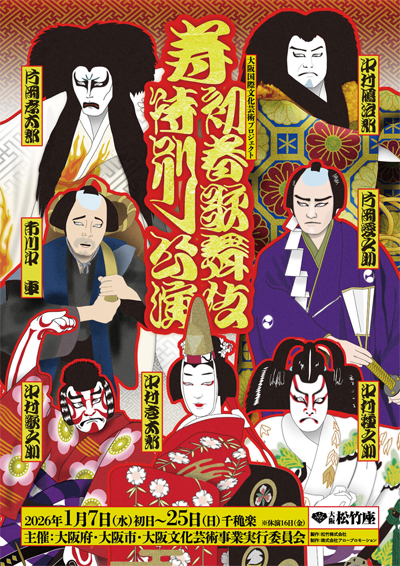
    Dates 7 ~ 25 January 2026 (Kotobuki Hatsuharu Ôkabuki)
    Congratulation Early Spring Grand Kabuki
    Matinée

    Sugawara Denju Tenarai Kagami (Kurumabiki)

    Gion Sairei Shinkôki (Kinkakuji)

    Nemuru-ga-Rakuda Monogatari (Rakuda)

    Evening

    Onna Narukami

    Kanadehon Chûshingura
    (Gion Ichiriki Jaya)

    Kyôganoko Musume Dôjôji

    Casting

    Nakamura Ganjirô, Kataoka Ainosuke, Kataoka Takatarô, Nakamura Kazutarô, Ichikawa Chûsha, Kamimura Kichiya, Ichikawa En'ya, Nakamura Kikaku, Nakamura Tanenosuke, Nakamura Utanosuke, Kamimura Kichitarô

    Comments

    The traditional two programs for the New Year Grand Kabuki in Ôsaka at the Shôchikuza.

  • Kurumabiki: this short scene shows the three brothers that dominate the drama "Sugawara Denju Tenarai Kagami", each with a distinctive personality. Sakuramaru (Kamimura Kichitarô) and Umeômaru (Nakamura Utanosuke) have been rendered masterless by Kan Shôjô's exile. The third brother Matsuômaru (Nakamura Tanenosuke) serves the villain Shihei (Ichikawa En'ya), who is responsible for the downfall of Kan Shôjô. Sakuramaru and Umeômaru try to destroy Shihei's carriage but are stopped by Matsuômaru and the magical glare of Shihei. Finally the brothers agree to suspend their disputes until they all meet at their father's seventieth birthday party.
  • Kinkakuji: "Kinkakuji" retains the epic scale of plays adapted from the Bunraku puppet theater and is full of miracles and larger-than-life characters common on the puppet stage. It is full of the classical forms of all kinds of stylized characters and the role of Princess Yuki is considered to be one of the most difficult and beautiful roles for an onnagata female role specialist. Matsunaga Daizen (Nakamura Ganjirô) has defeated the Shôgun and has set up base in the Golden Pavilion. The brilliant strategist Hisayoshi, disguised as a disgruntled retainer named Tôkichi (Kataoka Ainosuke), pretends to come under Daizen's employ to try to sabotage his plans from within. Princess Yuki (Nakamura Kazutarô) is being held prisoner by Daizen, but is able to free herself by drawing a mouse in the cherry petals of the tree that she is tied to. It comes to life and chews the ropes holding her. Starring the best of the actors in their prime in a production sure to be full of fire and excitement. Featuring also Kamimura Kichiya and Kataoka Takatarô in the roles of Kanônosuke Naonobu and Keijuin.
  • Rakuda: this is a popular dramatization of a rakugo comic story. A petty gang boss named Rakuda (Nakamura Kikaku) has died after eating blowfish. Kumagorô (Kataoka Ainosuke), one of his gang members, finds him and hopes to bury him, but has no money. When he tries to get the neighbors to contribute, everyone is overjoyed that such a nuisance is dead, but won't contribute a cent towards his burial. Finally Kumagorô pulls in a passing waste paper collector named Kyûroku (Ichikawa Chûsha) and forces him to carry around Rakuda's body and threaten to make it dance if the neighbors won't pay up. They get a great sum of money and start drinking together. But as he drinks, the hapless Kyûroku becomes surprisingly aggressive. Featuring also Nakamura Ganjirô & Ichikawa En'ya.
  • Onna Narukami: this is a parody of "Narukami", one of the oldest plays in the kabuki repertory, but in this version the leading character is played by an onnagata female role specialist. To place a curse on her father's killer Oda Nobunaga, the priestess Narukami (Kataoka Takatarô) imprisons the rain gods in a pool beneath a waterfall, causing a severe drought. A handsome young man named Kumo no Taemanosuke (Nakamura Ganjirô) appears who happens to resemble her former fiancé. Having been seduced by his story, she is convinced that he is her former lover and she exchanges cups with him in token of marriage-vows. However, in reality, he is a spy sent by Nobunaga to break her power. When she realizes that she has been betrayed, she flies into a rage and fights against Sakuma Genba Morimasa (Ichikawa Chûsha) who comes to arrest her.
  • Gion Ichiriki Jaya: "Chûshingura" is one of the most popular plays in the theatre and shows a true event when forty-seven masterless samurai avenged the death of their lord by killing his enemy. The seventh act is one of the most popular and shows the leader of the vendetta Yuranosuke as he is hiding his intention to avenge his lord’s death by pretending to be only interested in pleasure, but also encountering key figures on his side and the side of the enemy. Yuranosuke (Kataoka Ainosuke) spends his days and nights in the pleasure quarters of Kyôto in an effort to make their lord’s enemy, Moronô, believe he is not planning a vendetta. His acting is so good that even men in his own group believe he has given his life up to pleasure. Moronô is not so easily convinced, though, and has sent spies, including a former retainer of their late lord, En'ya Hangan, to find Yuranosuke's true intentions. Okaru (Nakamura Kazutarô), the wife of one of the retainers is now a courtesan at the Ichiriki Teahouse, unaware that her husband is dead. Okaru's brother Heiemon (Nakamura Tanenosuke), a servant in the Hangan household, has also come to the teahouse and the interaction of these characters becomes a matter of life and death and ends with Yuranosuke preparing to lead the vendetta.
  • Musume Dôjôji: a beautiful young woman dances under cherry blossoms at a dedication ceremony for a temple bell. She dances the many aspects of a woman in love, but is actually the spirit of a serpent, driven to destroy the bell out of jealousy. In addition to being the most famous of all Kabuki dances, "Musume Dôjôji" is considered to be the pinnacle of the art of the onnagata. This month’s production stars Nakamura Kazutarô as the maiden and also features a rare performance of the second part of the dance where the maiden appears as a serpent and is pushed back by a powerful hero (Nakamura Ganjirô) played in the bombastic aragoto style.
  • Sources: Earphone Guide Website, Shôchiku Kabuki Official Website or others sources

    Shinbashi Enbujô (Tôkyô)
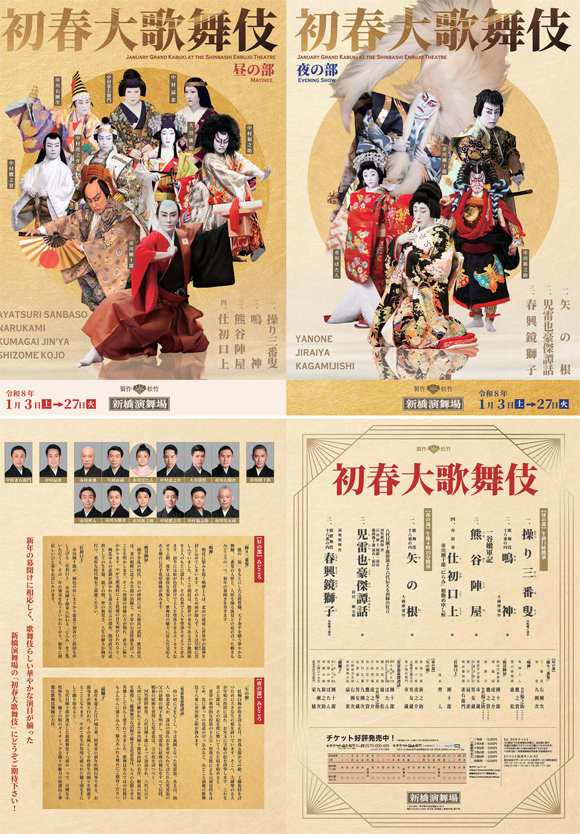
    Dates 3 ~ 27 January 2026
    Hatsuharu Kabuki Kôen
    Early Spring Kabuki Performances
    Matinée

    Ayatsuri Sanbasô

    Narukami

    Ichi-no-Tani Futaba Gunki (Kumagai Jin'ya)

    Kôjô

    Evening

    Ya-no-Ne

    Jiraiya Gôketsu Monogatari

    Shunkyô Kagami Jishi

    Casting

    Ichikawa Danjûrô, Nakamura Jakuemon, Nakamura Senjaku, Ichikawa Udanji, Kataoka Ichizô, Ichikawa Sai'nyû, Ichimura Kakitsu, Ichikawa Omezô, Ichikawa Shinnosuke, Nakamura Toranosuke, Ôtani Hiromatsu, Nakamura Takanosuke, Nakamura Fukunosuke, Ichikawa Kudanji, Ichikawa Botan

    Comments

    The traditional New Year Kabuki at the Shinbashi Enbujô with a troupe led by Ichikawa Danjûrô.

  • Ayatsuri Sanbasô:
    (The Puppet Sanbasô)
    The Sanbasô is part of the ritual play "Okina", a prayer for prosperity and in Kabuki the vigorous Sanbasô dance is often performed separately. To make the dance especially auspicious, the old man Okina and attendant Senzai appear as well. In Kabuki, the Sanbasô dance appears in all kinds of versions. In this particular version, the Sanbasô is actually a giant marionette (Ichikawa Udanji), dancing lightly until his antics tangle his strings, creating problems for his puppeteer (Ichikawa Kudanji).
  • Narukami: one of the most popular and universally appealing plays in the Kabuki Jûhachiban collection of plays featuring the bombastic aragoto style of acting. The holy man Narukami (Nakamura Fukunosuke/Nakamura Takanosuke) is angry at the Imperial Court and has taken refuge in the mountains where he has imprisoned inside a waterfall the dragon that brings rain, bringing a severe drought to the country. Princess Taema (Ôtani Hiromatsu) is sent by the Imperial Court to try to seduce Narukami, destroying his magical powers and release the rain. When he finds that he has been betrayed, anger transforms Narukami into a Thunder God.
  • Kumagai Jin'ya: this play is a dramatization of the clash between the Genji general Kumagai Jirô Naozane and the Heike warrior Taira no Atsumori at the battle of Ichi-no-Tani, one of the most famous passages of the epic "Tales of the Heike". In the Kabuki version, on the cryptic orders of the Genji leader Yoshitsune, Kumagai hides the enemy warrior Atsumori and has his own son take the warrior's place. On the battlefield, Kumagai has to kill his own son in Atsumori's place. Things become worse when his wife Sagami and Atsumori's mother Fuji-no-Kata arrive at his camp. In the highlight of the play, he tells them the story of his mortal battle with Atsumori, keeping Atsumori's well-being and his own sacrifice a secret. He then shows the head of Atsumori for inspection by his leader to see if he has interpreted his orders correctly. This performance stars Ichikawa Danjûrô as Kumagai, with Nakamura Jakuemon as Kumagai's wife Sagami, Nakamura Senjaku as Fuji-no-Kata, Nakamura Toranosuke as Yoshitsune and Ichikawa Omezô as Midaroku.
  • Kôjô: the close relationship between the actors and the audience is shown by these stage announcements, lavish ceremonies to commemorate various important events. Ichikawa Danjûrô makes a formal stage announcement to the audience at the Shinbashi Enbujô and performs a nirami no mie.
  • Ya-no-Ne: like a picture come to life, this play combines the most exaggerated costumes and movements with leisurely humor. The aragoto hero Soga no Gorô is sharpening a giant arrow and sleeping in wishes of good fortune for the New Year when he sees his brother Jûrô in a dream asking him to come and rescue him. The two Soga brothers are part of one of the most popular vendetta stories in Kabuki, suffering for eighteen years before being able to avenge the death of their father. In this play, when Gorô finds out that his brother is in trouble, he jumps on the horse of a passing daikon vendor and, brandishing a giant daikon as a whip prepares to rush to his brother's side. Starring Ichikawa Shinnosuke and Nakamura Toranosuke as Gorô and Jûrô.
  • Jiraiya: Jiraiya (Ichikawa Danjûrô) lost his father when he was a child, and he has now become a chivalrous bandit (a heroic outlaw who steals from the corrupt and helps the innocent). One day, he encounters a hermit named Senso Dôjin in the mountains of Echigo Province, who tells him how Jiraiya's father was falsely accused of rebellion and killed. He initiates Jiraiya into all the mysteries of his sorcery. After Jiraiya has mastered toad magic, he sets out to avenge his father's death. Written by Kawatake Mokuami and first performed by the Ichikawa Danjûrô VIII, this treasured masterpiece has long been passed down through generations and holds special ties to the Ichikawa Danjûrô acting family. The heroic outlaw Jiraiya, dazzling audiences with his boundless exploits and mastery of toad sorcery, has for centuries been beloved as a thrilling folk hero—featured in ukiyoe woodblock prints, kôdan storytelling, and film, stirring the imagination of people across eras. Featuring also
  • Kagami Jishi: one of the most important dances for onnagata female role specialists and is an audience favorite. The maidservant Yayoi performs an auspicious lion dance for the Shôgun in his opulent palace, but she gradually finds herself under the control of the lion spirit. In the second half of the dance, the lion spirit itself appears and performs its crazed dance among peonies and fluttering butterflies. Starring Ichikawa Danjûrô as both Yayoi and the spirit of the lion.
  • Sources: Earphone Guide Website or Shôchiku Kabuki Official Website

    Asakusa Kôkaidô (Tôkyô)
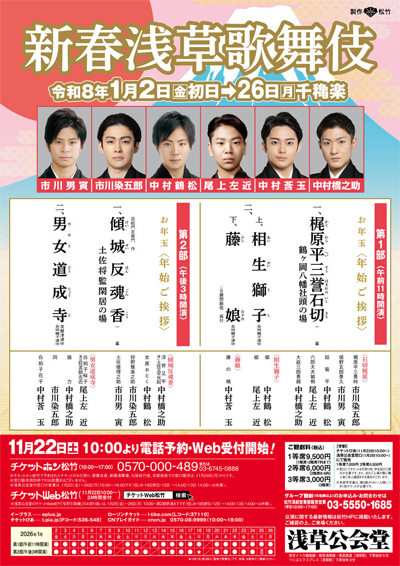
    Dates 2 ~ 26 January 2026
    Shinshun Asakusa Kabuki
    New Year Asakusa Kabuki
    Matinée

    Otoshidama (Nenshi Goaisatsu)

    Kajiwara Heizô Homare no Ishikiri
    (Ishikiri Kajiwara)

    Aioi Jishi

    Fuji Musume

    Evening

    Otoshidama (Nenshi Goaisatsu)

    Keisei Hangonkô (Domo Mata)

    Meoto Dôjôji

    Casting

    Nakamura Hashinosuke, Ichikawa Somegorô, Nakamura Kangyoku, Nakamura Tsurumatsu, Onoe Sakon, Ichikawa Otora, Nakamura Matagorô, Nakamura Kamenojô, Nakamura Hashigo, Nakamura Kichibê

    Comments

    The yearly show for young promising actors at the Asakusa Kôkaidô in Asakusa, a lively and colorful neighboorhood that keeps the scent of old Edo.

  • Otoshidama: a special kôjô for new year greetings (nenshi goaisatsu in Japanese).
  • Ishikiri Kajiwara: the Heike general Kajiwara (Ichikawa Somegorô) is asked to test the sharpness of a sword by slicing two live human beings in half. He deliberately makes the sword fail the test to keep the sword, a priceless heirloom belonging to the enemy Genji clan, from falling into the hands of his Taira clan. A miracle has convinced Kajiwara to change sides. Kajiwara finally demonstrates the true power of the sword by cutting a large stone basin in two. Featuring also Nakamura Matagorô Nakamura Hashinosuke & Nakamura Tsurumatsu.
  • Aioi Jishi: shishi (mythical lion-like spirits) are usually thought of as vigorous masculine creatures, but when shishi dances were first adapted for Kabuki from the classical theatre, they were danced by actors portraying an elegant, feminine atmosphere. This dance is one of the earliest in the genre and stars onnagata female role specialists. Featuring Nakamura Tsurumatsu and Onoe Sakon.
  • Fuji Musume: the spirit of wisteria blossoms dances of love in the form of a beautiful young maiden. One of Kabuki's most famous and colorful dances, it will feature the dancing skills of Nakamura Kangyoku.
  • Otoshidama: a special kôjô for new year greetings (nenshi goaisatsu in Japanese).
  • Domo Mata: the artist Matahei has been refused a professional name because of his stuttering. He makes a poor life by drawing folk paintings and decides to make one last effort to gain respectability. His wife Otoku, who is given as much to chatter as Matahei is silent, pleads his case. Turned down again by his master, Matahei decides to take his life. He draws a farewell portrait of himself, a painting so skillful that the lines seep through solid rock and this miracle convinces his master to confer a professional name. Starring Nakamura Hashinosuke as Matahei and Nakamura Tsurumatsu as his wife Otoku.
  • Meoto Dôjôji: "Musume Dôjôji" is based on a legend about a woman transformed into a serpent out of jealousy and who destroys a temple bell keeping her from the object of her love. The original dance shows the spirit of the woman who appears at Dôjôji temple as a dancer who wants to celebrate the dedication of a new bell and does a series of dances showing the many faces of femininity. In this version there are two dancers and one is revealed to be a man in disguise and, in the highlight of the dance, transforms the romantic highpoint of the original piece into a comic scene by using masks. Starring Nakamura Kangyoku as the female dancer and Onoe Sakon as the male dancer.
  • Sources: Earphone Guide Website or Shôchiku Kabuki Official Website

    Minamiza (Kyôto)
    Dates 10 ~ 20 January 2026
    Minamiza Hatsuharu Tokubetsu Kôen
    Minamiza Early Spring Special Performances
    Program

    More details

    Casting

    Living National Treasure Bandô Tamasaburô

    Comments

    Living National Treasure Bandô Tamasaburô in Kyôto at the Minamiza. Stage speeches, sometimes one dance, interviews and the projection of film-recorded past performances. Different programs with different guest stars: Living National Treasure Kataoka Nizaemon, the tarento/rakugo storyteller Shôfukutei Tsurube II & the rakugo storyteller Shunpûtei Koasa.

    Kyôto (Kyôto Gekijô)
    Dates 4~ 11 January 2026
    Zenshinza Tokubetsu Kôen
    Zenshinza Special Performances
    Program

    Izumo no Okuni

    Casting

    Fujikawa Yanosuke, Arashi Yoshisaburô & others

    Comments

    The traditional Zenshinza New Year performances in Kyôto. Not at the Minamiza, as it used to be, but at the Kyôto Gekijô. It celebrates the 95th anniversary of the troupe!

     
    Search this site powered by FreeFind
      Site map | Disclaimer
    Contact | Main | Top | Updates | Actors | Plays | Playwrights | Programs | Links | FAQ | Glossary | Chronology | Illustrations | Prints | Characters | Derivatives | Theaters | Coming soon | News