| NININ YÛGIRI |
| Play titles | Keiseikai Shinanjo [1]  Jitsu Kurabe Kuruwa Bunshô Momo Chidori Naruto no Shiranami (1797) Momo Chidori Naruto no Shiranami (1837) |
| Common title | Ninin Yûgiri The Two Yûgiri |
| Authors | Chikamatsu Tokuzô & Nagawa Tokusuke I [2] (1797) Takarada Jusuke & Fukumori Kyûsuke II (1837) |
| History |
Chikamatsu Tokuzô's drama "Keiseikai Shinanjo" was premiered in the 2nd lunar month of 1797 in Ôsaka at the Kado no Shibai [more details]. It was staged as an ôgiri for the new year ni-no-kawari drama "Momo Chidori Naruto no Shiranami". The drama "Jitsu Kurabe Kuruwa Bunshô", the first Edo version of "Ninin Yûgiri", was premiered 40 years later, in the 2nd lunar month of 1837 at the Moritaza [more details]. It was a Tokiwazu-based shosagoto which was staged as an ôgiri for the new year drama "Momo Chidori Naruto no Shiranami". "Ninin Yûgiri" was revived by Nakamura Utaemon VI in April 1965 at the Tôyoko Hall [more details]. It was staged 10 times between 1965 and 2019. |
| Structure |
The current version of "Ninin Yûgiri" is made up of 1 act (1 scene). |
| Key words |
Ageya Deshi Fujiya Izaemon Ise Ise Jingû Kakikae Kyôgen Kamiko Kandô Keisei Keiseikai Keiseimono Kotatsu Kuruwa Mitsumonoya Ôgiya Yûgiri Sewamono Shamisen Shinanjo Shinmachi Tayû Tokiwazu Wagoto Wakadanna Yûge Yûgiri-izaemonmono Yûgirimono |
| Summary |
Fujiya Izaemon, the son of a wealthy Ôsaka merchant, has caused a major scandal through his extravagant devotion to the courtesan Yûgiri. He has spent recklessly, sinking deep into debt, and has been ultimately disowned by his parents because of his excesses (kandô). After Yûgiri's death, her name has been assumed by another courtesan known as the second Yûgiri. Izaemon promptly has fallen in love with her, and the two have married. They now live modestly in Kyôto, running an unusual business in which they teach the etiquette and art of courting a courtesan (keiseikai)-an art in which Izaemon is a recognized master. Students are plentiful. Iyakaze, Tenretsu and Koren arrive for instruction, bringing a keg of sake as a gift for their teacher. The lesson begins at once, with Izaemon offering guidance while Yûgiri takes on the role of the courtesan. Meanwhile, a pot of rice burns on the stove, conveniently bringing the first part of the lesson to an end. Yûgiri hurries off to buy food for the evening meal (yûge), while Izaemon continues instructing his pupils. At that moment, the mitsumonoya Shikubê arrives with several men to seize whatever can be taken in repayment of Izaemon's unpaid debts. Quilts, the kotatsu brazier, and even the costumes used in the love lessons are carried off. The "disciples" flee. Izaemon is left wearing only an undergarment, as Shikubê takes even the kimono he had on. The undergarment itself is made from paper love letters sent to him by the first Yûgiri (kamiko). Okisa, the proprietress of the ageya Yoshidaya, where Izaemon once met the first Yûgiri, comes to visit him. Izaemon greets his old friend with delight, and she immediately recognizes the paper garment and its meaning. Together they reminisce about the days when the first Yûgiri was alive and play a shamisen melody in her memory. Suddenly, the first Yûgiri appears. Terrified, Izaemon believes she is a ghost, but she explains that she never died at all, having staged her death to escape marriage to a wealthy and relentless patron. A love scene follows, as Yûgiri sorrowfully laments the hardships she endured during her separation from Izaemon. Just then, the second Yûgiri returns from her errand and finds the first Yûgiri clinging to Izaemon. Enraged, she storms into the room and pushes the first Yûgiri aside, declaring that she is now Izaemon's wife and that there is no place for a ghostly rival. The two Yûgiri immediately begin to fight, until Okisa steps in and proposes that all three live together in harmony. Reconciled, the three decide to make a pilgrimage together to the Grand Shrine of Ise. A mime dance follows, portraying the making of identical garments to wear on their journey. The dance continues, depicting the trip to Ise itself. Meanwhile, Izaemon's supposed disciples, Iyakaze and the others, return. They reveal that they are actually clerks from Izaemon's father's business, sent to see how he is faring. They announce that his parents have forgiven him and present boxes containing three thousand ryô. Overjoyed, Izaemon and the others scatter the gold in celebration. |
| Notes |
[1] Keiseikai or Keiseigai, 2 possible readings. [2] The others sakusha were Nagawa Kunisuke, Morita Monkyô, Arashi Sangyô, Tanabe Yashichi & Chikamatsu Sakuhei. |
 |
|
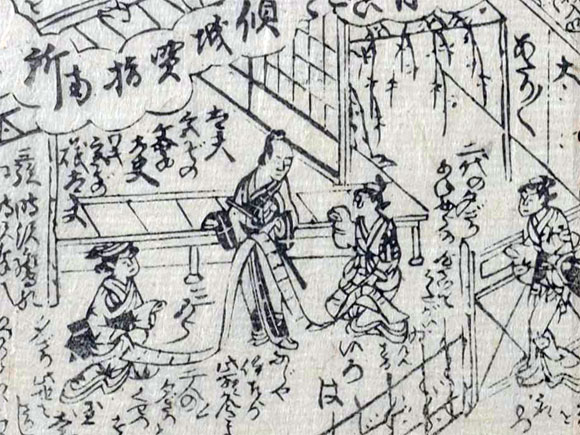
The actors Sawamura Kunitarô I (1st from left), Arashi Sangorô II (2nd from left), Yoshizawa Iroha I (2nd from right) and Azuma Tôzô III (1st from right) playing the roles of the first Yûgiri, Fujiya Izaemon, the second Yûgiri and the Yoshidaya nyôbô in the drama "Keiseikai Shinanjo", which was staged in the 2nd lunar month of 1797 in Ôsaka at the Kado no Shibai |
|
|
| Contact | Main | Top | Updates | Actors | Plays | Playwrights | Programs | Links | FAQ | Glossary | Chronology | Illustrations | Prints | Characters | Derivatives | Theaters | Coming soon | News |