| SADOSHIMA CHÔGORÔ I |
|
Stage name:
Line number: SHODAI (I) Existence: 1700 ~ 13th day of the 7th lunar month of 1757 [1] Connections: Grandfather: Sadoshima Denbê Father: Sadoshima Denpachi Disciples: Sadoshima Chôgorô II (???) [2], Sadoshima Chôzô, Sadoshima ??? Career: 1700~1712: born in Kamigata. Son of the dôkegata Sadoshima Denpachi and grandson of Sadoshima Denbê,
who headed one of the Onna Kabuki ('Woman Kabuki') troupe in Kyôto. He started his career at the end of the Shôtoku era,
performing in Ôsaka as a wakashugata.
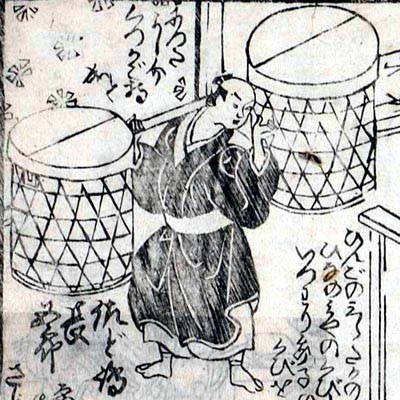
An interesting story about Chôgorô's youth: 12th day of the 12th lunar month of 1712 [3]: his father Sadoshima Denpachi died. 11th lunar month of 1719: Chôgorô played in Kyôto at Miyako Mandayû's theater the role of Suminoe Nasakenosuke in Sadoshima Saburôzaemon's kaomise drama "Shôjô Zakaya Mannen-gura". 1st lunar month of 1720: Chôgorô played in Kyôto at Miyako Mandayû's theater in the new year drama "Keisei Hachimannichi". He achieved a great success by performing the dance "Nichô Tsuzumi". The origin of this dance was quite interesting: while on tour in Ise, Chôgorô had almost no musician with him and only one instrument, a kotsuzumi (shoulder drum). Chôgorô cut a piece of bamboo and made an ôtsuzumi (hip drum) out of it. He decided to call this short dance "Nichô Tsuzumi", which literally means "the two drums". 11th lunar month of 1720: Chôgorô played at the Kado no Shibai the role of Miumanosuke [illustration] in the kaomise drama "Hana Yakata Chibikizuru", which was produced by Kirinoya Gonjûrô I. 11th lunar month of 1722: Chôgorô played at the Naka no Shibai the role of the gofukuya Hanzaburô (in reality Ichiyô Kaguranosuke) in the kaomise drama "Odori Hotei", which was produced by Takeshima Kôzaemon II. 11th lunar month of 1723: Chôgorô played at the Naka no Shibai the role of Minamoto no Yorimitsu in the kaomise drama "Chûshin Futaba no Matsu", which was produced by Matsushima Hyôtarô. 11th lunar month of 1724: Chôgorô played at the Kado no Shibai the role of the wakadono Eitarô in the kaomise drama "Banzei no Minato", which was produced by Arashi San'emon III. 11th lunar month of 1725: Chôgorô played at Miyako Mandayu's theater in Kyôto the role of the nakama Utasuke in the kaomise drama "Sanpukutsui Eiga no Shikishi", which was produced by Mihogi Gizaemon I. Summer 1730: tour in the Yamato province with Sugiyama Kanzaemon III. Fall 1731: Chôgorô went to Edo. 11th lunar month of 1731: Chôgorô played at the Nakamuraza the role of En'ya Hangan in the kaomise drama "Wagô Ichiji Taiheiki". He successfully performed within this drama a dance called "Kantan". 1st lunar month of 1732: Chôgorô played in the same theater the role of Soga Jûrô in the new year sogamono drama "Hatsugoyomi Ainai Soga"; his stage partners in the roles of Soga Gorô and Kudô Saemon Suketsune were Ogino Izaburô I and Sawamura Sôjûrô I. 11th lunar month of 1733: Chôgorô played at Kameya Kumenojô's theater (Kyôto) the role of Tanomonosuke in the kaomise drama "Chôseiden Kogane no Shikigawara", which was produced by Sakakiyama Shirotarô I. 1741: Chôgorô sent an invitation to Ichikawa Ebizô II (and his adopted son Ichikawa Danjûrô III) to perform in Ôsaka in his theater. The Edo star "demanded an enormous salary for those days, something quite out of the ordinary in the way of remuneration. And Sadoshima Chôgorô, thinking that Ebizô would never ask such a sum unless he had something startling to offer, did not hesitate to comply with the extraordinary request" (Zoë Kincaid in "Kabuki, the Popular Stage of Japan"). The sum was 2,000 ryô! 11th lunar month of 1741: Chôgorô produced at the Ônishi no Shibai the kaomise drama "Bankoku Taiheiki", which included the "Uirô Uri" scene and starred Ichikawa Ebizô II, Ichikawa Danjûrô III, Yamamoto Kyôshirô I, Arashi Shichigorô I, Onoe Kikugorô I, Yamashita Kinsaku I, Nakamura Jirôsa I, Bandô Toyosaburô I, Shibazaki Taminosuke, Yamanaka Heijûrô I and Yamatogawa Akashi. 1st lunar month of 1742: premiere at the Ônishi no Shibai of the drama "Narukami Fudô Kitayama Zakura", which was produced by Chôgorô [casting]. Fall 1747: Chôgorô went to Edo. 11th lunar month of 1747: Chôgorô performed at the Moritaza in the kaomise drama "Aruji Môke Onna Hachinoki", which celebrated the shûmei of Sawamura Sôjûrô. 1748: Chôgorô went back to Kyôto, retired from the Kabuki world and took the tonsure. His new name was Renchibô and he settled in front of the famous Kenninji Temple. Later on, he settled in Ôsaka, where he died. 13th day of the 7th lunar month of 1757 [1]: Chôgorô died in Ôsaka. Comments: "This Sadoshima Chôgorô was the son of Denpachi, a dôkegata, or comedian, and a dancer of great skill who was prominent just before Genroku. Chôgorô was fortunate in having such an experienced stage father, and he was soon apprenticed to dancing. The chroniclers of Kabuki tell how the father taught the boy to dance on the goban, or small table used for playing go, the national chess game. The child was often summoned by persons of high degree to take part in entertainments, and once a prince ordered an artist to make a model of him dancing on the goban. He never seriously competed for a place among the actors, but long remained Kabuki's most famous dancing teacher. When he reached old age he shaved his head and retired from the world, taking up his abode in front of Kenninji, a Buddhist temple of Kyôto. Sadoshima Chôgorô left one of Kabuki's literary treasures, the "Sadoshima Nikki", or "Journal of Sadoshima", in which he disclosed the secrets of shosagoto. He criticised the actors of his time as having gone astray from the true path of dramatic art, and reflected in his writing the change that had already set in--the beginning of the decline of Kabuki, for the brilliancy of the Genroku period and the progress of Hôreki were not repeated in the years that followed." (Zoë Kincaid in "Kabuki, the Popular Stage of Japan") [1] The 13th day of the 7th lunar month of the 7th year of the Hôreki era was the 27th of August 1757 in the western calendar. [2] Sadoshima Chôgorô II was listed as a disciple of Sadoshima Chôgorô I in the book "Kabuki Jinmei Jiten" but the master died in 1757 and the disciple was born in 1768... [3] The 12th day of the 12th lunar month of the 2nd year of the Shôtoku era was the 8th of January 1713 in the western calendar. [4] His tombstone was located in the precincts of the Yakuôji Temple. |

 |
|
Sadoshima Chôgorô I performing in the kaomise drama "Bankoku Taiheiki", which he produced in the 11th lunar month of 1741 at the Ônishi no Shibai |
|
|
| Contact | Main | Top | Updates | Actors | Plays | Playwrights | Programs | Links | FAQ | Glossary | Chronology | Illustrations | Prints | Characters | Derivatives | Theaters | Coming soon | News |