| ICHIKAWA DANJÛRÔ VIII |
|
Stage names:
Other name:
Guild: Naritaya Line number: HACHIDAIME (VIII) Poetry name: Sanshô Existence: 5th day of the 10th lunar month of 1823 [1] ~ 6th day of the 8th lunar month of 1854 [2] Connection: Great-great-great-great-grandfather: Ichikawa Danjûrô I Great-great-great-grandfather: Ichikawa Ebizô II (Danjûrô II) Great-great-grandfather: Ichikawa Ebizô III (Danjûrô IV) Great-Grandfather: Ichikawa Hakuen I (Danjûrô V) Father: Ichikawa Danjûrô VII Brothers: Ichikawa Danjûrô IX, Ichikawa Ebizô VII, Ichikawa Ebizô VIII, Ichikawa Komazô VI, Ichikawa Saruzô I, Ichikawa Kôzô Career: 5th day of the 10th lunar month of 1823 [1]: born in Edo in the district of Kiba in Fukagawa. He was the first son of Ichikawa Danjûrô VII. His mother was Sumi, the daughter of Fukuchi Zenbê, the owner of the Ichimuraza shibai jaya Kikuya. 11th lunar month of 1823: he appeared on stage for the first time, at the Ichimuraza, where he received the name of Ichikawa Shinnosuke II during the kaomise performance. 3rd lunar month of 1825: Ichikawa Shinnosuke II took the name of Ichikawa Ebizô VI. 3rd lunar month of 1832: great shûmei at the Ichimuraza for the Naritaya guild. His father Ichikawa Danjûrô VII took back the name of Ichikawa Ebizô V and Ichikawa Ebizô VI, who was only 9 years old, became Ichikawa Danjûrô VIII. Danjûrô played the role of Hidari no Jingorô in Tsuruya Nanboku IV's drama "Sumidagawa Hana no Goshozome". He also played the role of the uirô peddler Toraya Tôkichi in a "Uirô Uri" scene (Kabuki Jûhachiban) which was included in the drama "Sukeroku Yukari no Edo Zakura". 11th lunar month of 1832: Danjûrô played the role of Nose Tarô, the leading role of the "Shibaraku" scene, in the Kawarasakiza kaomise program "Tanomiaru Gohiiki no Tsuna". 1st lunar month of 1833: Danjûrô's rank in the Edo hyôbanki, sôkantô section ("global leader"), was jô-jô-kichi (superior - superior - excellent) [visual]. 5th lunar month of 1833: Danjûrô played at the Ichimuraza the role of Irie Tanzô in the classic "Yoshitsune Senbon Zakura". 7th lunar month of 1835: Danjûrô played at the Ichimuraza the role of Ranmaru in the drama "Konoshita Kage Hazama Gassen". 4th lunar month of 1836: premiere at the Moritaza of the drama "Hakkenden Uwasa no Takadono"; Danjûrô played the roles of Inue Shinbê and the monk Shakuunbô [casting]. 7th lunar month of 1837: premiere at the Ichimuraza of "Sanshô-dayû Kogane no Toridoshi", a revised and expanded version of the gidayû kyôgen "Yura no Minato Sengen Chôja"; Danjûrô played the role of Hashidate no Gorô [casting]. 1st lunar month of 1838: Danjûrô became zagashira at the Kawarasakiza. He played 4 roles in the new year drama "Fude Hajime Mazebari Soga", including the roles of Kojirô and Atsumori in the classic "Genpei Nunobiki no Taki". 3rd lunar month of 1838: Danjûrô played at the Kawarasakiza the 2 minor roles, including Sugiômaru, in the classic "Sugawara Denju Tenarai Kagami". 3rd lunar month of 1839: premiere at the Kawarasakiza of the dance program "Shiki no Nagame Maru-ni-I no Toshi", which was made up of four dances dedicated to the four seasons and starred the actor Sawamura Tosshô I, supported by Ichikawa Ebizô V and Danjûrô [more details]. 3rd lunar month of 1840: première of the dance-drama "Kanjinchô" at Kawarasakiza; the main role (Benkei) was played by Ichikawa Ebizô V; his stage partners were Ichikawa Kuzô II (Togashi) and Danjûrô (Yoshitsune). 8th lunar month of 1841: Danjûrô played at the Kawarasakiza the role of Katô Masakiyo in the drama "Ehon Taikôki". 6th lunar month of 1843: Danjûrô played for the first and last time the role of the wicked priest Narukami in the drama "Mayoi no Kumoiro ni Narukami", which was staged at the Kawarasakiza; his stage partner in the role of Princess Taema was Onoe Eizaburô III. 3rd lunar month of 1844: Danjûrô played at the Nakamuraza the prestigious role of Sukeroku in the drama "Sukeroku Kuruwa no Momosakura"; the roles of the courtesan Agemaki, the villain Ikyû and the shirozake seller Shinbê were played by Iwai Hanshirô VII, Matsumoto Kôshirô VI and Onoe Kikugorô III. This performance, which celebrated the shûmei of both Iwai Hanshirô VII and Matsumoto Kôshirô VI, was a huge success and a long run. 11th lunar month of 1845: Danjûrô played at the Kawarasakiza the roles of Matsunaga Daizen and the sumô wrestler Tetsugadake in the dramas "Ehon Taitôki" and "Sekitori Senryô Nobori". 8th lunar month of 1848: premiere at the Ichimuraza of Nishizawa Ippô's drama "Eiri Shôsetsu Asagao Monogatari"; Danjûrô played the role of Miyagi Asojirô/Komazawa Jirozaemon [casting]. 3rd lunar month of 1849: Danjûrô plays for the first time the role of Musashibô Benkei in the dance-drama "Kanjinchô", which was performed at the Kawarasakiza; his stage partners were Ichikawa Kodanji IV (Togashi) and Bandô Takesaburô I (Yoshitsune). 8th lunar month of 1849: Danjûrô played at the Kawarasakiza the eponymous role of the drama "Kagekiyo"; his stage partners were Onoe Kikujirô II (Akoya) and Bandô Hikosaburô IV (Shigetada). 11th lunar month of 1849: Danjûrô played at the Kawarasakiza the role of Hiranoya Tokubê in the drama "Sonezaki Shinjû"; the role of the courtesan Ohatsu was played by Onoe Kikujirô II. 9th lunar month of 1850: premiere at the Nakamuraza of the drama "Minoriyoshi Kogane no Kikuzuki"; Danjûrô played the roles of Asayama Tetsuzan and Funase Sanpei [more details]. 2nd lunar month of 1851: premiere at the Ichimuraza of Sakurada Jisuke III's Kiyomoto-based dance "Akegarasu Hana no Nureginu", commonly called "Urazato Tokijirô"; Danjûrô played the role of Kasugaya Tokijirô [casting]. 5th lunar month of 1851: Danjûrô played at the Ichimuraza the role of the wicked priest Narukami in the drama "Narukami"; the role of Princess Taema was played by Bandô Shûka I. 7th lunar month of 1852: premiere at the Kawarasakiza of Kawatake Shinshichi II's drama "Jiraiya Gôketsu Monogatari"; Danjûrô played the role of Jiraiya [casting]. 3rd lunar month of 1853: premiere of Segawa Jokô III's drama "Yowa Nasake Ukina no Yokogushi" (commonly called "Kirare Yosa"), which was staged at the Nakamuraza and in which Danjûrô played the role of Yosaburô [casting]. This performance was a huge success. 5th lunar month of 1853: Danjûrô played at the Nakamuraza for the second and last time the role of Yosaburô in Segawa Jokô III's drama "Yowa Nasake Ukina no Yokogushi"; the role of Otomi was played by Onoe Baikô IV. 8th lunar month of 1854 [2]: a few days after his triumphant arrival in Ôsaka, where he was supposed to perform together with his father, Danjûrô committed suicide in his inn. Comments: Ichikawa Danjûrô VIII was a popular and talented tachiyaku actor, who was active from the 1st half of the 1820s to the first half of the 1840s. The pressure of popularity and fame was too heavy for this actor, who preferred to terminate himself both his life and a career which was outstanding. "He gave every sign of great promise, but because of family and professional troubles committed suicide in Ôsaka." (Zoë Kincaid in "Kabuki, the Popular Stage of Japan") "Like his father, Ichikawa Danjûrô VIII excelled in the aragoto ('rough-stuff') roles for which the Ichikawa lineage was famous. But as well as audacious young heroes, he was also extremely successful in the various roles of young lover (nimaime). Together with his good looks, this made him especially popular with female fans. When he played Sukeroku, in which he had to immerse himself in a barrel of water, the water was subsequently sold at exorbitant cost to avid admirers. Even when he had to appear as Yosaburô with a scarred face, pastry shops sold beanpaste buns with cracked outer skins called 'Yosaburô buns, which were devoured by the actor's fans. Despite his success, or even because of it, he was plagued by personal problems, perhaps exacerbated by his early achievements and the jealousy this caused among older actors. In 1854, during a tour of performances in Ôsaka with his father, he was found in his inn with his wrists slashed. He was suffering from massive debts, caused by his lifestyle, which emulated the excesses of his father." (from the The Fitzwilliam Museum Website) [1] The 5th day of the 10th lunar month of the 6th year of the Bunsei era was the 7th of November 1823 in the western calendar. [2] The 6th day of the 8th lunar month of the 7th year of the Kaei era was the 27th of September 1854 in the western calendar. |

 |
|
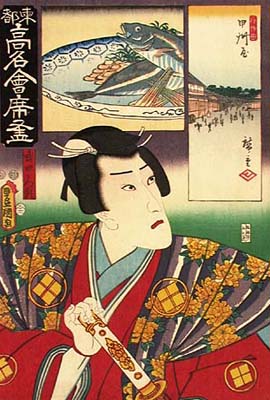
Ichikawa Danjûrô VIII playing the role of Takeda Katsuyori in the drama "Honchô Nijûshikô" Print made by Utagawa Kuniyoshi in 1832 Print made by Utagawa Kunisada in 1852 Print made by Utagawa Toyokuni in 1852 Print made by Utagawa Toyokuni in 1852 Print made by Utagawa Toyokuni in 1852 Print made by Utagawa Toyokuni in 1852 Print made by Utagawa Toyokuni in 1852 Print made by Utagawa Toyokuni in 1852 Print made by Utagawa Toyokuni in 1852 Print made by Utagawa Toyokuni in 1852 Print made by Utagawa Toyokuni in 1852 The Ichikawa Hakuen line of actors The Ichikawa Shinnosuke line of actors The Ichikawa Ebizô line of actors The Ichikawa Danjûrô line of actors |
|
|
| Contact | Main | Top | Updates | Actors | Plays | Playwrights | Programs | Links | FAQ | Glossary | Chronology | Illustrations | Prints | Characters | Derivatives | Theaters | Coming soon | News |