| ARASHI KOROKU I |
|
Stage names:
Other name: Zeshin Guild: Yoshidaya Line number: SHODAI (I) Poetry names: Koroku, Minshi, Sujô, Shichô, Sugidori (?) Existence: 1710 ~ 26th day of the 7th lunar month of 1786 [1] Connection: Master: Arashi San'emon III Son: Arashi Koroku III (Hinasuke I) Grandsons: Arashi Hinasuke II, Arashi Koroku IV, Arashi Hinasuke III, Arashi Koroku V Son-in-law: Sawamura Sôjûrô III Great-grandsons: Arashi Hinasuke IV, Sawamura Tanosuke II Disciples: Arashi Koshichi II, Arashi Konomatsu, Arashi Hinaji, Arashi Hachibei, Arashi Toyonojô, Arashi Toyomatsu, Arashi Kichiji, Arashi Kakichi Career: 1710 ~ 1727: he started his career at an early age in kodomo shibai, playing under the name of Yoshida Koroku. 11th lunar month of 1727: he became disciple of Arashi San'emon III, received the name of Arashi Koroku I and plays as a wakashugata the role of a yakko in Azuma Sanpachi's kaomise drama "Tônai Tarô Danjiri Roppô", which was produced by Sanogawa Mangiku at Ebisuya Kichirôbê's theater; he achieved a great success by performing the roppô technique. 11th lunar month of 1729: Koroku became zamoto and produced in Kyôto at Daikokuya Takenojô's theater Azuma Sanpachi's kaomise drama "Yomeiri Shichigosan". 11th lunar month of 1731: Koroku became wakaonnagata and produced in Kyôto at Hayagumo Chôdayû's theater Sawamura Bunji's kaomise drama "Asahi no Ichikura Eigô Seki". 11th lunar month of 1733: Koroku played at Kameya Kumenojô's theater (Kyôto) the role of Shinobu in the kaomise drama "Chôseiden Kogane no Shikigawara", which was produced by Sakakiyama Shirotarô I. 5th lunar month of 1735: first Kabuki adaptation of the puppet theater drama "Ashiya Dôman Ôuchi Kagami", which was produced by Nakamura Tomijûrô I in Kyôto at Miyako Mandayû's theater; Koroku played the role of Sakaki-no-Mae [casting]. 8th lunar month of 1741: the play "Shin Usuyuki Monogatari", which was originally written for the puppet theater, was adapted for Kabuki for the first time, in Kyôto at Hayagumo Chôdayû's theater; Koroku played the roles of Sonobe Ume-no-Kata and Kojorô [casting]. 5th lunar month of 1742: Chikamatsu Monzaemon's play "Shinshû Kawanakajima Kassen" was adapted for Kabuki for the first time, in Kyôto at the Kitagawa no Shibai; Koroku played the role of Danjô's sister [more details]. 11th lunar month of 1742: Koroku played at the Minamigawa no Shibai in the kaomise drama "Kaeribana Konrei Nagoya". 1st lunar month of 1743: Koroku's rank in the Kyôto hyôbanki, wakaonnagata section, was jô-jô-kichi (superior - superior - excellent) [visual]. Fall 1743: Koroku went back to Ôsaka. 11th lunar month of 1743: Koroku played at the Naka no Shibai in the kaomise drama "Shiki Samba Ôgi Ikusa", which was produced by Anegawa Shinshirô I and celebrated the shûmei of Shinozuka Jirozaemon II. 1st lunar month of 1744: Koroku's rank in the Ôsaka hyôbanki, wakaonnagata section, was jô-jô-kichi (superior - superior - excellent) [visual]. 11th lunar month of 1745: Koroku moved to the Ônishi no Shibai and played in the kaomise drama "Tônai Tarô Danjiri Roppô", which celebrated the shûmei of Arashi Shinpei I and Arashi San'emon IV. 12th lunar month of 1745: the drama "Natsu Matsuri Naniwa Kagami" was performed for the first time in Ôsaka, simultaneously in the three major theaters of the city, which started a competition for the best performance and line-up; Koroku played the roles of Otatsu and Okaji at the Ônishi no Shibai [casting]. Fall 1746: Koroku went to Edo. 11th lunar month of 1746: Koroku played at the Nakamuraza the role of the superheroine in the first version of "Onna Shibaraku", which was staged in the kaomise drama "Tenchi Taiheiki", which celebrated the shûmei of Hanai Saizaburô III, Sanjô Kantarô III and Matsushima Yaozô. 1st lunar month of 1747: Koroku's rank in the Edo hyôbanki, wakaonnagata section, was jô-jô-kichi (superior - superior - excellent) [visual]. 5th lunar month of 1747: the play "Sugawara Denju Tenarai Kagami" was produced at the Nakamuraza for the first time; Koroku played the roles of Sakuramaru [picture] and Chiyo [casting]. 11th lunar month of 1750: Koroku played in Kyôto at Ebisuya Kichirôbê's theater the role of Hama no Oteru in Fujikawa Sakoku's kaomise drama "Taira no Miyako Onna Ezôshi", which was produced by Sakakiyama Shirotarô II. 1st lunar month of 1751: Koroku played in the same theater the role of Shichirobê's daughter Oriyo in Fujikawa Sakoku's ni-no-kawari drama "Keisei Kane-ga-Fuchi". 11th lunar month of 1752: Koroku played at the Kado no Shibai in the drama "Nagoya Ori Hinatsuru no Nishiki", which was produced by Mimasu Daigorô I. 10th day of the 7th lunar month of 1754 [2]: his master Arashi San'emon III died. 22nd day of the 4th lunar month of 1756 [3]: his master's adopted son Arashi San'emon IV died. 1st lunar month of 1758: first Kabuki adaptation of the puppet theater drama "Gion Sairei Shinkôki", which was simultaneously produced at the Minamigawa no Shibai [casting] and the Kitagawa no Shibai [casting]. It used its real title at the former theater but it was entitled "Keisei Niwatoriyama" at the latter theater; Koroku played in the former theater the role of Princess Yuki. 11th lunar month of 1761: Koroku performed at the Naka no Shibai in the kaomise drama "Miyo no Hana Yunzei Kagami", which was produced by Mimasu Daigorô I. 12th lunar month of 1761: premiere at the Naka no Shibai of Takeda Haruzô's ni-no-kawari drama "Akiba Gongen Kaisen Banashi". It was the first drama in Kabuki history using gandô-gaeshi on stage; Koroku played the role of Kiba no Osai [casting]. 4th lunar month of 1762: first Kabuki adaptation of the 5-act puppet theater drama "Gosho Zakura Horikawa no Youchi", which was staged at the Naka no Shibai; Koroku played the role of Owasa [casting]. 9th lunar month of 1764: première in Ôsaka at the Naka no Shibai of "Hare Kosode Tsuzure no Nishiki", based on the puppet drama "Katakiuchi Tsuzure no Nishiki", which was produced by Mimasu Daigorô I. A similar play was staged one day before under a different title, "Oriawase Tsuzure no Nishiki", at the Kado no Shibai. The competition for the best performance and the best line-up was open between the 2 theaters. The performance at the Kado no Shibai was more successful than the one at the Naka no Shibai; Koroku played at the Naka no Shibai the role of Jirôemon's nyôbô Oharu [casting]. 12th lunar month of 1766: Koroku played at the Kado no Shibai the role of Enju in the drama "Hirakana Seisuiki", which was produced by Arashi Hinasuke I; his stage partners were Arashi Hinasuke I (Umegae), Ichinokawa Hikoshirô II (Kajiwara Genta Kagesue), Nakayama Shinkurô I (Gonshirô), Fujikawa Hachizô I (Matsuemon, Higuchi no Jirô Kanemitsu), Yoshizawa Ayame III (Oyoshi, Tomoe Gozen), Nakayama Raisuke I (Shigetada) and Arashi Shichigorô II (Kajiwara Heiji Kagetaka). 11th lunar month of 1768: he became tachiyaku and took the name of Arashi San'emon V at the Kado no Shibai, playing the role of Tônai Tarô in the kaomise drama "Shin-yakata Banzei no Kotobuki"; he achieved a great success by performing the roppô technique in the tanzen style. 12th lunar month of 1768: San'emon played in the same theater the roles of Oseki and Yogorô in the drama "Futatsu Chôchô Kuruwa Nikki". 3rd lunar month of 1769: San'emon's rank in the Ôsaka hyôbanki, tachiyaku section, was jô-jô-(hanshiro)kichi (superior - superior - (half-white) excellent) [visual]. Fall 1769 ~ Fall 1775: no record of Kabuki performances on stage. 10th lunar month of 1775: he was back on stage, in Kyôto, where he temporarily took back the name of Arashi Koroku I and did his isse ichidai performance by playing the role of Yamanba in the drama "Futaba Genji Komochi Yamanba", which was produced by Fujikawa Sango. 11th lunar month of 1775: Anegawa Kikuhachi, a disciple of his son, took the name of Arashi Koroku II in Kyôto; Arashi Koroku I retired under the name of Arashi Koshichi I. 5th lunar month of 1776: he was back on stage, in Ôsaka, where he temporarily took the name of Arashi Koroku (using the haimyô Koroku instead of the stage name Koroku, which was used by his disciple Arashi Koroku II) and did his isse ichidai performance by playing the role of Yamanba in the drama "Komochi Yamanba Iohata Nishiki". He definitively retired and took the tonsure to become a Buddhist priest named Zeshin. 26th day of the 8th lunar month of 1785 [4]: his son's disciple Arashi San'emon VI died. 26th day of the 7th lunar month of 1786 [1]: he died in Ôsaka [5]. Comments: Arashi Koroku I was a Kamigata wakaonnagata actors, who excelled in nuregoto and budôgoto roles. He decided to become tachiyaku at the end of his career. He was equally at home in sewamono and jidaimono dramas. He was also able to play some music instruments. [1] The 26th day of the 7th lunar month of the 6th year of the Tenmei era was the 19th of August 1786 in the western calendar. [2] The 10th day of the 7th lunar month of the 4th year of the Hôreki era was the 27th of August 1754 in the western calendar. [3] The 22nd of the 4th lunar month of the 6th year of the Hôreki era was the 20th of May 1756 in the western calendar. [4] The 26th day of the 8th lunar month of the 5th year of the Tenmei era was the 29th of September 1785 in the western calendar. [5] His tombstone was located in the precinct of Hômyôji Temple. |

 |
|
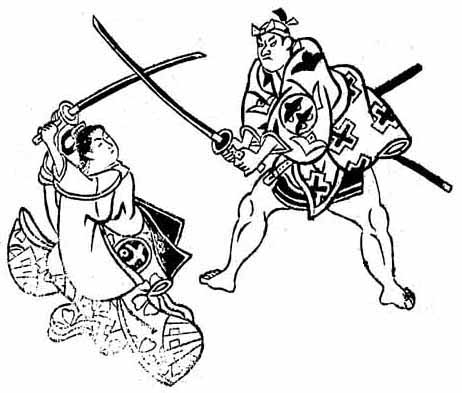
Arashi Koroku I (left) and Kasaya Matakurô I (right) in an illustration illustration from the book "Sanga no Tsu Yakusha Meijin Furue" (1750~1752) The Arashi Koroku line of actors The Arashi San'emon line of actors The Arashi Koshichi line of actors |
|
|
| Contact | Main | Top | Updates | Actors | Plays | Playwrights | Programs | Links | FAQ | Glossary | Chronology | Illustrations | Prints | Characters | Derivatives | Theaters | Coming soon | News |