JUNE 2026

4 shows in Tôkyô (Kabukiza, Sunpearl Arakawa, Sunshine Theatre), 2 in Fukuoka (Hakataza), 1 in Kyôto (Minamiza), 1 in Yokohama (Kanagawa Prefectural Youth Center Momijizaka Hall) & 1 in Shizuoka (Shizuoka Convention & Arts Center Granship)!

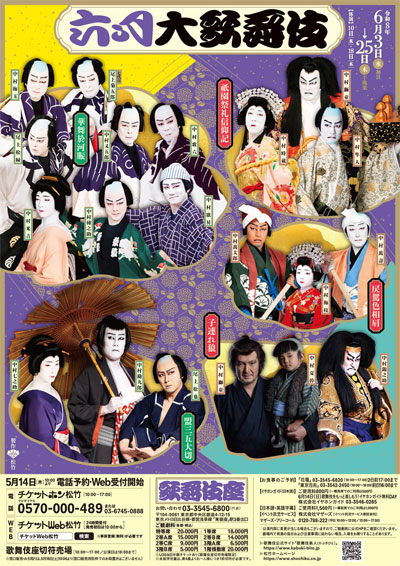
  • Living National Treasure Onoe Kikugorô, Living National Treasure Nakamura Baigyoku, Living National Treasure Nakamura Karoku, Nakamura Manju, Nakamura Kankurô, Nakamura Shichinosuke, Nakamura Kinnosuke, Onoe Shôroku, Nakamura Shidô, Onoe Matsuya, Nakamura Matagorô, Nakamura Tokizô, Bandô Minosuke, Nakamura Hayato & Nakamura Yonekichi perform at the Kabukiza!
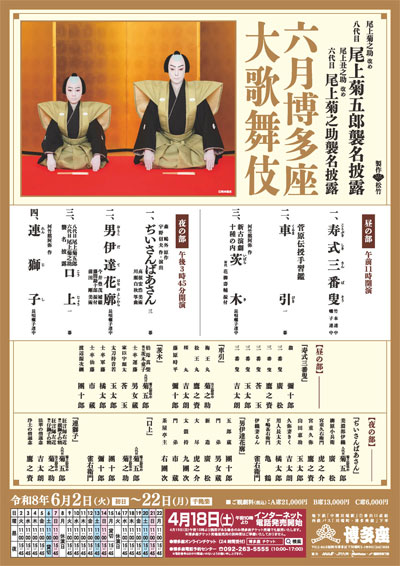
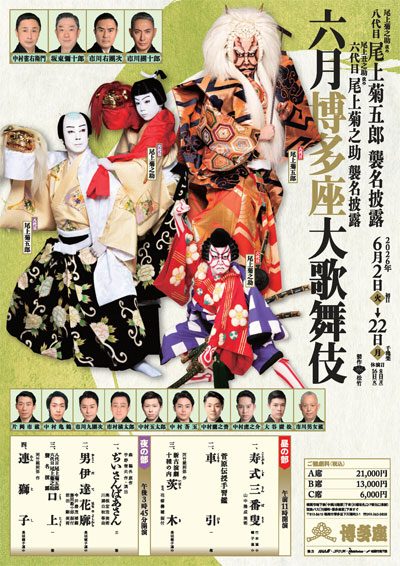
  • Onoe Kikugorô, Onoe Kikunosuke, Ichikawa Danjûrô, Nakamura Jakuemon & Bandô Yajûrô perform at the Hakataza!
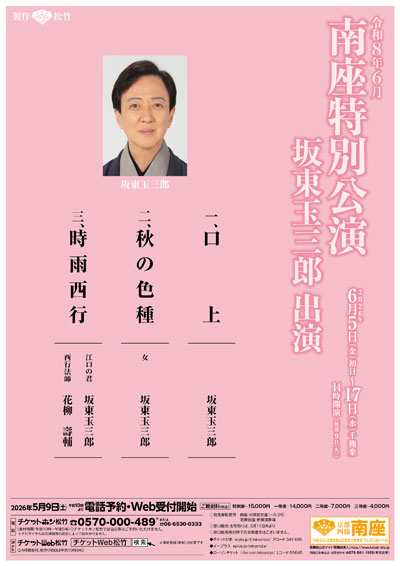
  • Living National Treasure Bandô Tamasaburô performs at the Minamiza!
  • Nakamura Shikan, Nakamura Kaishun & Kataoka Takatarô perform at the Sunpearl Arakawa, Kanagawa Prefectural Youth Center Momijizaka Hall and Shizuoka Convention & Arts Center Granship!
  • Kabukiza (Tôkyô)
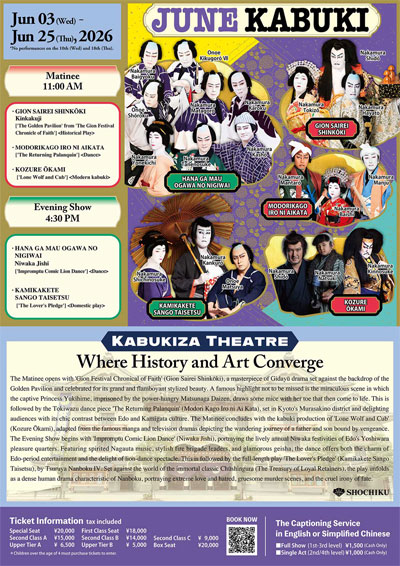
    Dates 3 ~ 25 June 2026
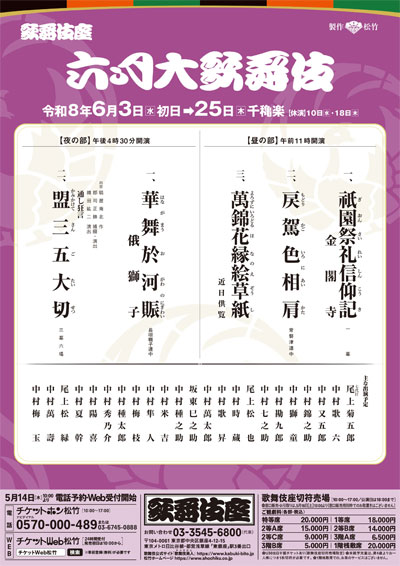
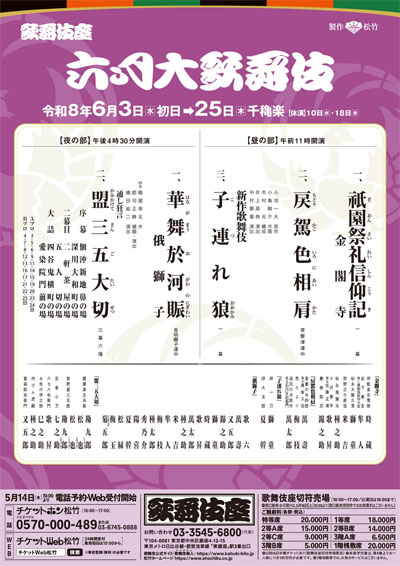
    Rokugatsu Ôkabuki
    June Grand Kabuki
    Matinée

    Gion Sairei Shinkôki (Kinkakuji)

    Modori Kago Iro ni Aikata

    Kozure Ôkami

    Evening

    Hana-ga-Mau Ogawa no Nigiwai (Niwaka Jishi)

    Kamikakete Sango Taisetsu

    Casting

    Living National Treasure Onoe Kikugorô, Living National Treasure Nakamura Baigyoku, Living National Treasure Nakamura Karoku, Nakamura Manju, Nakamura Kankurô, Nakamura Shichinosuke, Nakamura Kinnosuke, Onoe Shôroku, Nakamura Shidô, Onoe Matsuya, Nakamura Matagorô, Nakamura Tokizô, Bandô Minosuke, Nakamura Hayato, Nakamura Yonekichi, Nakamura Kashô, Nakamura Mantarô, Nakamura Tanenosuke, Nakamura Baishi, Nakamura Tanetarô, Nakamura Haruki, Nakamura Hidenosuke, Nakamura Natsuki

    Comments

    The 2 programs for the June Grand Kabuki at the Kabukiza.

  • Kinkakuji: "Kinkakuji" retains the epic scale of plays adapted from the Bunraku puppet theater and is full of miracles and larger-than-life characters common on the puppet stage. It is full of the classical forms of all kinds of stylized characters and the role of Princess Yuki is considered to be one of the most difficult and beautiful roles for an onnagata female role specialist. Matsunaga Daizen (Nakamura Shidô) has defeated the Shôgun and has set up base in the Golden Pavilion. The brilliant strategist Hisayoshi, disguised as a disgruntled retainer named Tôkichi (Nakamura Hayato), pretends to come under Daizen's employ to try to sabotage his plans from within. Princess Yuki (Nakamura Tokizô) is being held prisoner by Daizen, but is able to free herself by drawing a mouse in the cherry petals of the tree that she is tied to. It comes to life and chews the ropes holding her. Starring the best of the actors in their prime in a production sure to be full of fire and excitement. Featuring also Nakamura Yonekichi and Nakamura Kinnosuke in the roles of Kanônosuke Naonobu and Keijuin.
  • Modori Kago: two palanquin bearers, one from Ôsaka, the other from Edo (pre-modern Tôkyô), decide to stop and rest. As they do so, each boasts of the respective merits of his native town. Finally, the little apprentice courtesan (kamuro) they have been carrying, alights from the palanquin and joins them in their dance. Featuring Nakamura Mantarô as the palanquin bearer from Ôsaka (in reality Ishikawa Goemon), Nakamura Manju as the palanquin bearer from Edo (in reality Goemon's arch-enemy Mashiba Hisayoshi) and Nakamura Baishi as the kamuro.
  • Kozure Ôkami: set in the Edo period, 'Lone Wolf and Cub' (Kozure Ôkami) follows Ogami Ittô (Nakamura Shidô), the shogunate’s official executioner, who is ensnared in a plot by his sworn enemy, Yagyû Retsudô. Branded with false charges, stripped of his position, and devastated by the murder of his wife, Ittô sets out on a relentless journey of vengeance together with his young son, Daigorô (Nakamura Natsuki). Meanwhile, Retsudô dispatches assassin after assassin in pursuit of the pair, who come to be feared throughout the land as the 'Lone Wolf and Cub'. Epic in scale, the story of Ogami Ittô's revenge journey with Daigorô has inspired numerous film and television adaptations. In particular, the television series starring Yorozuya Kinnosuke, broadcast from 1973 to 1976, became a nationwide phenomenon. During the height of the series’ popularity, the work was adapted for the stage in 1974 as part of the celebrated 'Yorozuya Kinnosuke Special Performances' at the Kabukiza. Now returning to the Kabukiza in the month closely associated with Yorozuya acting house, this new production marks the first time that Nakamura Shidô directs at the theatre, collaborating with film director Inoue Masanori.
  • Niwaka Jishi: this lively dance evokes the atmosphere of an Edo period festival. The highlight of the piece is the lion dance performed by two of the handsome young men of the neighborhood. Starring Living National Treasure Onoe Kikugorô, Living National Treasure Nakamura Baigyoku, Living National Treasure Nakamura Karoku, Nakamura Kinnosuke, Onoe Shôroku, Nakamura Matagorô & Nakamura Shidô as the heads of a firefighting brigades. Starring Nakamura Manju, Nakamura Tokizô & Nakamura Yonekichi as the the geisha. Featuring Nakamura Hayato, Nakamura Kashô, Nakamura Mantarô & Nakamura Tanenosuke as the firemen. Featuring also several young actors as tekomai.
  • Kamikakete Sango Taisetsu: this play is a blend of "Chûshingura" with its tangled stories of loyalties and masterless samurai that ultimately avenge their master's death and the story of "Godairiki", about the love between a geisha named Koman and the samurai Satsuma Gengobê which is spoiled by the jealousy of a man named Sangorô. Sasano Sangorô (Onoe Matsuya/Nakamura Kankurô) is married to Koman (Nakamura Shichinosuke), but she becomes a geisha to help him to raise the money to help his lord, a man that he has never seen. In the pleasure quarters the samurai Satsuma Gengobê (Nakamura Kankurô/Onoe Matsuya) falls in love with her and spends huge sums of money on her, despite the fact that he needs money for the sake of the "Chûshingura" vendetta. Finally Gengobê gets money and Sangorô and Koman decide to defraud him of the money, which results in a massacre in the pleasure quarters. Ironically, Gengobê is none other than the unknown master for whom Sangorô was trying to raise money. This story of passion and greed takes place against the background of inexplicable fate and the strict requirements of samurai society and adds ample doses of sardonic humor, the perfect play for our times. Featuring also Nakamura Matagorô, Bandô Minosuke, Nakamura Kashô & Nakamura Tanenosuke.
  • Sources: Earphone Guide Website, Shôchiku Kabuki Official Website or others sources

    Hakataza (Fukuoka)
    Dates 2 ~ 22 June 2026
    Rokugatsu Hakataza Ôkabuki
    June Hakataza Grand Kabuki
    Matinée

    Kotobuki Shiki Sanbasô

    Sugawara Denju Tenarai Kagami (Kurumabiki)

    Ibaraki

    Evening

    Jiisan Baasan

    Otokodate Hana no Yoshiwara

    Kôjô

    Renjishi

    Casting

    Onoe Kikugorô, Onoe Kikunosuke, Ichikawa Danjûrô, Nakamura Jakuemon, Bandô Yajûrô, Ichikawa Udanji, Ichikawa Omezô, Bandô Kamezô, Kataoka Ichizô, Ichikawa Kudanji, Nakamura Toranosuke, Nakamura Takanosuke, Nakamura Kangyoku, Ôtani Hiromatsu, Nakamura Tamatarô, Kamimura Kichitarô, Ichimura Kitsutarô

    Comments

    Onoe Kikugorô VIII and his son Onoe Kikunosuke VI celebrate their shûmei in Fukuoka at the Hakataza.

    Minamiza (Kyôto)
    Dates 5~ 17 June 2026
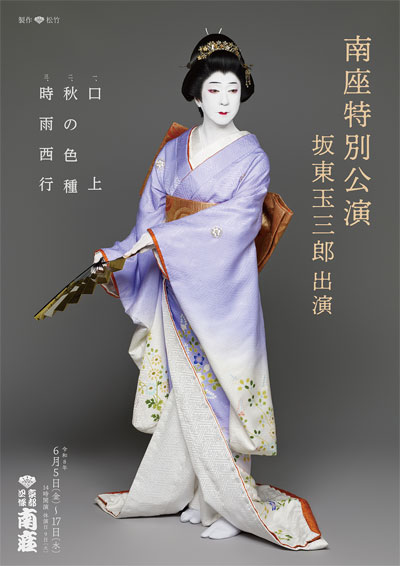
    Bandô Tamasaburô Minamiza Tokubetsu Kôen
    Bandô Tamasaburô Minamiza Special Performance
    Program

    Kôjô

    Aki no Irokusa

    Shigure Saigyô

    Casting

    Living National Treasure Bandô Tamasaburô, Hanayagi Jusuke

    Comments

    A special program in Kyôto at the Minamiza starring Living National Treasure onnagata Bandô Tamasaburô.

  • Kôjô: a kôjô with Living National Treasure Bandô Tamasaburô.
  • Aki no Irokusa:
    (Various Flowers of Autumn)
    This work was originally composed in 1845 as Nagauta music to celebrate the completion of the retreat for the lord of the Nanbu clan in Edo, and it was performed as a dance later. The lyrics include various plants of autumn such as wild bush clover, pampas grass and patrinia scabiosaefolia in its verse and is known as an excellent piece about that season. It is autumn. Various flowers of autumn bloom and the chirping of pine crickets is heard. A lady (Living National Treasure Bandô Tamasaburô) who stands quietly listening to the chirping insects, remembers the old story that King Xiang of the ancient Zhou (Shû in Japanese) dynasty had an affair with the goddess of the Wu Mountains (Fuzan in Japanese) in a dream, and she compares it to her own love. Having thought about her lover, she realizes that the pleasure of the four seasons does not change after many years and begins to dance.
  • Shigure Saigyô: this dance shows an encounter between the poet-priest Saigyô and a courtesan at Eguchi. But the courtesan is actually a merciful Buddhist deity. Starring Living National Treasure Bandô Tamasaburô as the courtesan and Hanayagi Jusuke as Saigyô.
  • Sources: Earphone Guide Website or Shôchiku Kabuki Official Website

    Sunpearl Arakawa (Tôkyô)
    Dates 5 ~ 20 June 2026
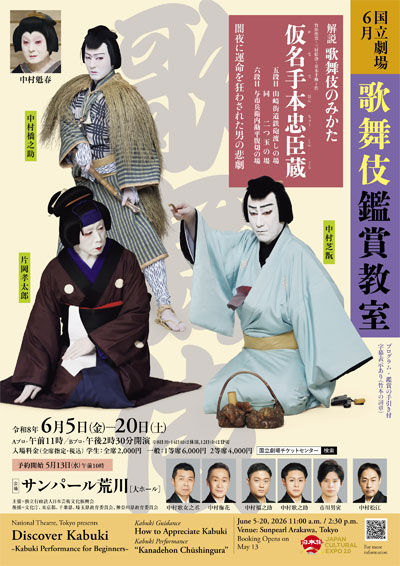
    Rokugatsu Kabuki Kanshô Kyôshitsu
    June Kabuki Appreciation Class
    Program

    Kabuki no Mikata

    Kanadehon Chûshingura

  • Teppô Watashi, Futatsudama
  • Kanpei Harakiri
  • Casting

    Nakamura Shikan, Nakamura Kaishun, Kataoka Takatarô, Nakamura Hashinosuke, Nakamura Matsue, Nakamura Fukunosuke, Nakamura Utanosuke, Nakamura Kamenojô, Nakamura Baika

    Comments

    Educational program at the Sunpearl Arakawa, instead of the at the National Theatre (rebuilding ongoing), called Kabuki Kanshô Kyôshitu ("Kabuki Appreciation Class"). This is the 109th edition and a very interesting formula for the beginners because there is lively presentation on stage (Kabuki no Mikata) of Kabuki or some aspects of the art like music, stage tricks or fighting scenes. It is followed by 2 acts from the classic "Kanadehon Chûshingura".

    Sunshine Theatre (Tôkyô)
    Dates 30 May ~ 7 June 2026
    Zenshinza Kabuki Kôen
    Zenshinza Kabuki Performances
    Program

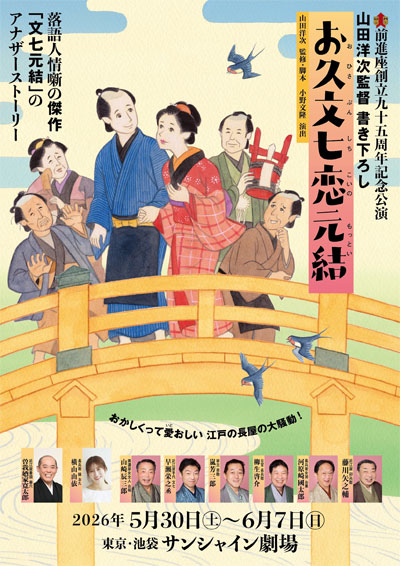
    Ohisa Bunshichi Koi no Mottoi
    Newly-created drama made by Yamada Yôji and based on "Bunshichi Mottoi"

    Casting

    Kawarasaki Kunitarô, Arashi Yoshisaburô, Fujikawa Yanosuke, Yamazaki Tatsusaburô, Matsunami Kihachirô, Hayase Einojô, Arashi Ichitarô, Yagyû Keisuke, Soganoya Kantarô & others

    Comments

    The usual Zenshinza Spring program, not at the National Theatre (closed) but at the Sunshine Theatre (Tôkyô)! It celebrates the 95th anniversary of this troupe, founded in 1931! The guest star is the Shinkigeki actor Soganoya Kantarô.

    Shizuoka Convention & Arts Center Granship (Shizuoka)
    Dates 23 June 2026
    Rokugatsu Kabuki Kanshô Kyôshitsu
    June Kabuki Appreciation Class
    Program

    Kabuki no Mikata

    Kanadehon Chûshingura

  • Teppô Watashi, Futatsudama
  • Kanpei Harakiri
  • Casting

    Nakamura Shikan, Nakamura Kaishun, Kataoka Takatarô, Nakamura Hashinosuke, Nakamura Matsue, Nakamura Fukunosuke, Nakamura Utanosuke, Nakamura Kamenojô, Nakamura Baika

    Comments

    Educational program in Shizuoka at the Shizuoka Convention & Arts Center Granship, instead of the at the National Theatre (rebuilding ongoing), called Kabuki Kanshô Kyôshitu ("Kabuki Appreciation Class"). This is the 109th edition and a very interesting formula for the beginners because there is lively presentation on stage (Kabuki no Mikata) of Kabuki or some aspects of the art like music, stage tricks or fighting scenes. It is followed by "Kanadehon Chûshingura".

    Kanagawa Prefectural Youth Center Momijizaka Hall (Yokohama)
    Dates 25 ~ 26 June 2026
    Rokugatsu Kabuki Kanshô Kyôshitsu
    June Kabuki Appreciation Class
    Program

    Kabuki no Mikata

    Kanadehon Chûshingura

  • Teppô Watashi, Futatsudama
  • Kanpei Harakiri
  • Casting

    Nakamura Shikan, Nakamura Kaishun, Kataoka Takatarô, Nakamura Hashinosuke, Nakamura Matsue, Nakamura Fukunosuke, Nakamura Utanosuke, Nakamura Kamenojô, Nakamura Baika

    Comments

    Educational program in Yokohama at the Kanagawa Prefectural Youth Center Momijizaka Hall, instead of the at the National Theatre (rebuilding ongoing), called Kabuki Kanshô Kyôshitu ("Kabuki Appreciation Class"). This is the 109th edition and a very interesting formula for the beginners because there is lively presentation on stage (Kabuki no Mikata) of Kabuki or some aspects of the art like music, stage tricks or fighting scenes. It is followed by "Kanadehon Chûshingura".

     
    Search this site powered by FreeFind
      Site map | Disclaimer
    Contact | Main | Top | Updates | Actors | Plays | Playwrights | Programs | Links | FAQ | Glossary | Chronology | Illustrations | Prints | Characters | Derivatives | Theaters | Coming soon | News