| Casting |
Living National Treasure Kataoka Nizaemon, Living National Treasure Nakamura Karoku, Matsumoto Kôshirô, Onoe Kikugorô, Nakamura Manju, Nakamura Kaishun, Nakamura Jakuemon, Kataoka Takatarô, Onoe Shôroku, Nakamura Kinnosuke, Nakamura Matagorô, Nakamura Hayato, Bandô Kamezô, Ichikawa Komazô,
Nakamura Tokizô, Nakamura Kashô, Nakamura Tanenosuke, Bandô Shingo, Ichikawa Danko, Ichikawa Somegorô, Kamimura Kichiya, Matsumoto Kingo, Sawamura Sônosuke, Ôtani Hirotarô, Onoe Tatsunosuke, Ichikawa Otora, Nakamura Tanetarô, Nakamura Hidenosuke, Nakamura Kichinojô, Kataoka Matsunosuke, Ichimura Kitsutarô
|
| Comments |
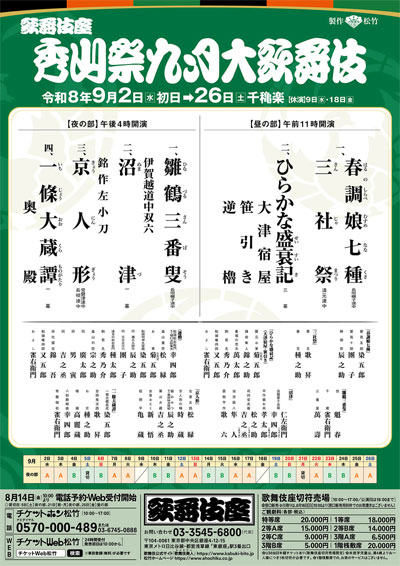
The 5th edition at the Kabukiza of the new "Shûzan Matsuri" (the festival of Shûzan), which is staged to commemorate late Nakamura Kichiemon II. Shûzan was the haimyô used by both Nakamura Kichiemon I and Nakamura Kichiemon II.
Musume Nanakusa: in the Edo period, every New Year,
plays appeared about the medieval vendetta carried out by the Soga brothers
Jûrô and Gorô. This colorful, old-fashioned dance mixes this tradition with
that of eating porridge containing seven auspicious herbs on the seventh
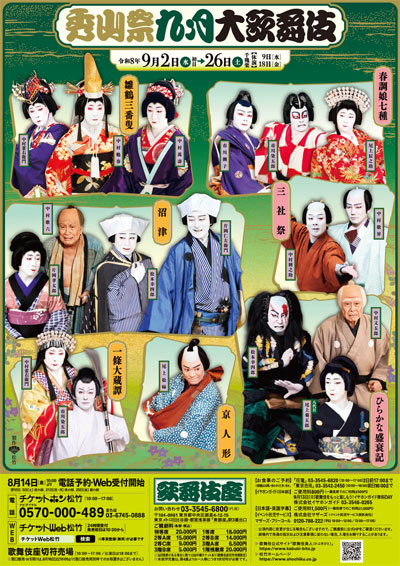
day of the new year. As the brothers Jûrô (Ichikawa Danko) and Gorô (Ichikawa Somegorô)
prepare to face their father's murderer and take revenge, along with beautiful
Shizuka Gozen (Onoe Tatsunosuke), they cut the herbs, as a symbolic act of vengeance.
Sanja Matsuri: a vigorous dance starring Nakamura Kashô and Nakamura Tanenosuke.
It is based on dolls at the Sanja festival
showing the founding of the temple at Asakusa
when two fishermen found a golden image of the Kannon
in their nets. In this case, the holy spirits that they encounter are two spheres
with the characters for "good" and "evil" on them, and the spirits possess
the two and animate them into a lively dance.
Hirakana Seisuiki: after the death of Kiso Yoshinaka,
his widow Lady Yamabuki (Kamimura Kichiya) and their young son Komawakamaru (Nakamura Hidenosuke) wander from province to province,
fleeing the Kamakura forces with the help of their loyal retainer Kamata Haito (Nakamura Kinnosuke) and Lady Yamabuki's
maid-in-waiting Ofude (Onoe Kikugorô). At last they arrive at an inn in Ôtsu,
where the boatman Gonshirô (Nakamura Matagorô) and his daughter Oyoshi (Nakamura Jakuemon) are also staying.
Before long, however, the Kamakura warrior Banba no Chûta (Nakamura Manju) tracks them down.
Meanwhile, another tragic drama unfolds for the survivors of the Yoshinaka faction.
Matsuemon (Matsumoto Kôshirô), who has married into the family of the country boatman Gonshirô, is actually
the warrior Higuchi Kanemitsu in disguise—a leading retainer of
Yoshinaka. Having learned special rowing skills, he is invited to
transport the Genji general Minamoto Yoshitsune,
whose forces were responsible for Yoshinaka's death.
Matsuemon sees this as the ultimate opportunity to take his revenge. However, before he can put his plan
into action, his identity is discovered, leading to a spectacular battle on sea and land that seals his fate.
Hinazuru Sanbasô: the okina appears accompanied by
the senzai and performs a stately, dignified dance praying for peace
and prosperity throughout the land. He is joined by the sanbasô,
who offers prayers for a bountiful harvest in a vigorous and energetic dance. This work adapts
the ceremonial dance "Shiki Sanbasô", traditionally performed as a prayer for peace, for onnagata (actor specialized in female roles).
Performed by Nakamura Kaishun, Nakamura Manju and Nakamura Jakuemon, it is an elegant and refined dance that showcases the grace and artistry of these distinguished performers.
Numazu: a dramatization of one of the most famous historical vendattas of the
Edo period. "Numazu" is one act that tells
of the sacrifices of those not directly involved in the vendetta itself but members
of the same family who are indebted to the two opposing sides.
The kimono merchant Jûbê (Living National Treasure Kataoka Nizaemon/Matsumoto Kôshirô) meets a porter Heisaku (Living National Treasure Nakamura Karoku)
as he travels west on business. They find that not only are they long-separated
father and son, but that they also lie on opposite sides of the vendetta.
Their loyalties prevent them from openly acknowledging their relationship.
Heisaku sacrifices his life to get information from his son essential to his
side's cause. Featuring Kataoka Takatarô in the role of Heisaku's daughter Oyone.
Kyô Ningyô: this dance tells the story of the woodcarver Hidari Jingorô,
famous for the sleeping cat on the great gate of Nikkô. He brings a statue of a
beautiful courtesan to life and then there is a spectacular fight scene with a
variety of carpenter’s tools. Starring Onoe Shôroku as Jingorô and Nakamura Tokizô as the doll
of the courtesan.
Ichijô Ôkura Monogatari: the world is ruled by Taira no Kiyomori, the leader of the Heike clan.
Tokiwa Gozen, the widow of the head of the defeated Genji clan and mother of Yoritomo and Yoshitsune,
the future leaders of the clan, has become the mistress of the dictator Kiyomori, then the wife of
Lord Ôkura, a seemingly simple-minded fool who spends all his time watching pretty women dance.
Outraged members of the Genji clan sneak into Lord Ôkura's mansion only to discover that
Tokiwa Gozen's immorality and Lord Ôkura's idiocy are a guise, the only way to survive in a world ruled by the enemy.
This performance stars Ichikawa Somegorô as Lord Ôkura, Nakamura Jakuemon as Tokiwa Gozen, Matsumoto Kôshirô as Yatsurugi Kageyu,
Nakamura Kashô as Yoshioka Kijirô and Nakamura Tanenosuke as Yoshioka's wife Okyô.
Sources: Earphone Guide Website, Shôchiku Kabuki Official Website or others sources
|