OCTOBER 2026

7 in Tôkyô (Kabukiza, Heisei Nakamuraza, New National Theatre, Meijiza, Nihonbashi Kôkaidô), 2 shows in Nagoya (Misonoza), 2 in Kyôto (Minamiza) & 1 in Tachikawa (Tachikawa Stage Garden)!

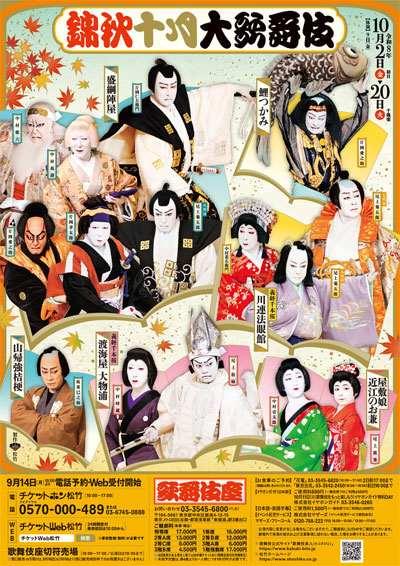
  • Living National Treasure Onoe Kikugorô, Living National Treasure Kataoka Nizaemon, Living National Treasure Nakamura Karoku, Onoe Kikugorô, Nakamura Manju, Nakamura Jakuemon, Kataoka Ainosuke, Kataoka Takatarô, Onoe Shôroku, Bandô Minosuke, Nakamura Kazutarô, Nakamura Tokizô, Bandô Kamezô, Kamimura Kichiya & Ichikawa Monnosuke perform at the Kabukiza !
  • Living National Treasure Kataoka Nizaemon, Nakamura Kankurô, Nakamura Shichinosuke, Nakamura Ganjirô, Nakamura Senjaku & Nakamura Shikan perform at the Heisei Nakamuraza!
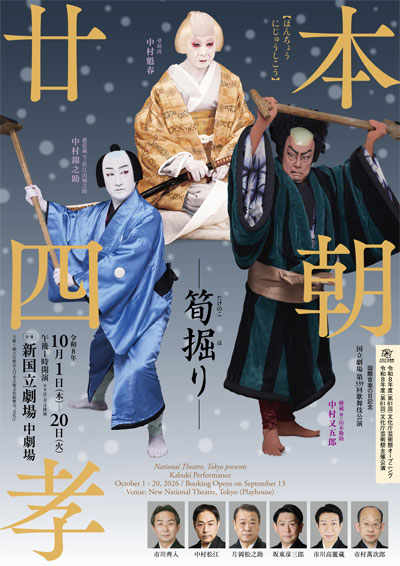
  • Nakamura Kinnosuke, Nakamura Kaishun, Nakamura Matagorô, Ichikawa Komazô, Bandô Hikosaburô & Ichimura Manjirô perform at the New National Theatre
  • Living National Treasure Bandô Tamasaburô, Onoe Tatsunosuke, Ichikawa Chûsha & Ichikawa Emisaburô perform at the Misonoza !
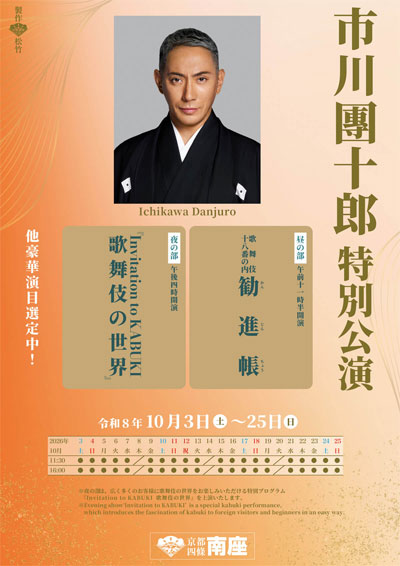
  • Ichikawa Danjûrô & ??? perform at the Minamiza!
  • Kabukiza (Tôkyô)
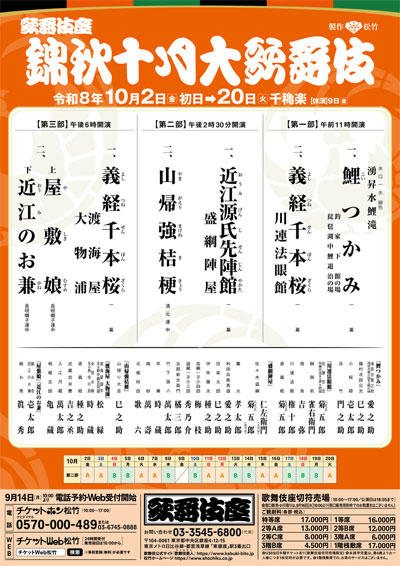
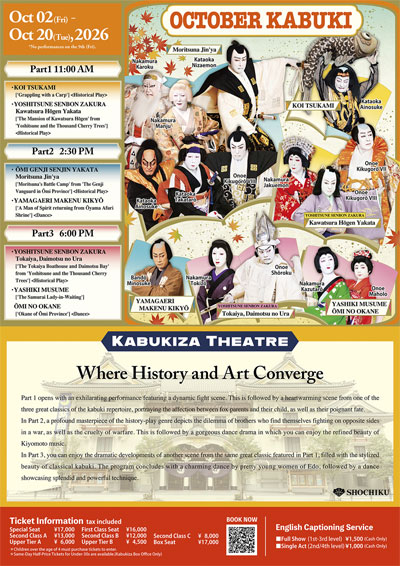
    Dates 2 ~ 20 October 2026
    Kinshû Jûgatsu Ôkabuki
    Autumn Brocade October Grand Kabuki
    1st program

    Waki Noboru Mizu-ni Koi Taki (Koi Tsukami)

    Yoshitsune Senbon Zakura
    (Kawatsura Hôgen Yakata)

    2nd program

    Ômi Genji Senjin Yakata
    (Moritsuna Jin'ya)

    Yamagaeri Makenu Kikyô

    3rd program

    Yoshitsune Senbon Zakura

  • Tokaiya
  • Funayagura
  • Daimotsu no Ura
  • Yashiki Musume

    Ômi no Okane

    Casting

    Living National Treasure Onoe Kikugorô, Living National Treasure Kataoka Nizaemon, Living National Treasure Nakamura Karoku, Onoe Kikugorô, Nakamura Manju, Nakamura Jakuemon, Kataoka Ainosuke, Kataoka Takatarô, Onoe Shôroku, Bandô Minosuke, Nakamura Kazutarô, Nakamura Tokizô, Bandô Kamezô, Kamimura Kichiya, Ichikawa Monnosuke, Kawarasaki Gonjûrô, Nakamura Tanenosuke, Nakamura Mantarô, Onoe Maholo, Nakamura Baishi, Nakamura Hidenosuke, Arashi Kitsusaburô, Nakamura Kichinojô

    Comments

    The Autumn Brocade October Grand Kabuki at the Kabukiza.

  • Koi Tsukami: a koi tsukami is a spectacular scene in a Kabuki drama, where a hero fights in real water (honmizu) the spirit of a giant carp. During the Edo period, it was developped by the Onoe clan, from Onoe Kikugorô I to Onoe Kikugorô III through Onoe Shôroku I. In modern times, it became the trademark of the Ichikawa Udanji line. "Waki Noboru Mizu-ni Koi Taki", a rarely-staged drama, was premiered in September 1914 at the Hongôza of the drama "Waki Noboru Mizu-ni Koi Taki" [more details] and it used the sekai of the Priest Seigen and the Princess Sakura. Starring Kataoka Ainosuke and Nakamura Kazutarô in the roles of Takimado Shiganosuke (in reality the spirit of a giant carp) and Princess Kozakura.
  • Kawatsura Hôgen Yakata: the epic "Yoshitsune and the Thousand Cherry Trees" ("Yoshitsune Senbon Zakura") features many characters around the famous general Yoshitsune, but none more memorable than a magic fox that takes the guise of Tadanobu, one of Yoshitsune's most trusted retainers. The fox wants to get close to a precious drum that Yoshitsune has made from the skins of his fox parents. In this excerpt from the longer play, the fox reveals his true identity with a series of spectacular stage tricks and Yoshitsune is moved to grant him the drum. Starring Onoe Kikugorô as the fox Tadanobu. Also featuring Nakamura Jakuemon and Living National Treasure Onoe Kikugorô as Shizuka Gozen and Minamoto no Yoshitsune. Featuring also Kawarasaki Gonjûrô (Kawatsura Hôgen) and Kamimura Kichiya (Kawatsura Hôgen's wife Asuka).
  • Moritsuna Jin'ya: this play is one of the greatest classics of the jidaimono historical play style. Two brothers, Sasaki Moritsuna and Sasaki Takatsuna are generals on opposing sides. Moritsuna's forces are greater in number and strength, but his brother's brilliant strategies allow him to escape by preying on Moritsuna's psychological weaknesses. Ruthlessly, Takatsuna has his son sacrifice his life to force Moritsuna to identify the head of an imposter as that of his dead brother. Starring Living National Treasure Kataoka Nizaemon/Onoe Kikugorô as Moritsuna, with Kataoka Takatarô as Kagaribi (the wife of Takatsuna), Nakamura Tokizô as Hayase (the wife of Moritsuna), Living National Treasure Nakamura Karoku as Hôjô Tokimasa, Kataoka Ainosuke as the crafty general Wada no Hyôe and Nakamura Manju as Mimyô (the mother of the Sasaki brothers).
  • Yamagaeri Makenu Kikyô: arriving on the road overlooking Mount Ôyama is Daikichi (Bandô Minosuke), a fireman returning to Edo after completing his pilgrimage to the sacred mountain. Like many pilgrims of the time, he uses the journey as an excuse for a carefree adventure, indulging in various mischievous escapades along the way. With lively humor and infectious enthusiasm, Daikichi recounts his experiences, entertaining the audience with tales of his travels and exploits.
  • Tokaiya/Daimotsu no Ura: these are two scenes from one of the greatest classics of the puppet theatre, which has also become a classic of Kabuki. After the wars between the Genji and Heike clans, the Genji are victorious and their leader Yoritomo is now Shôgun. But there is a falling out between Yoritomo and his brother Yoshitsune, the brilliant general responsible for the victory. Now Yoshitsune is fleeing through the country and this play fancifully has him encounter several famous warriors from the Heike clan, who are not dead, as history has it. Yoshitsune (Nakamura Tanenosuke) books passage on a boat to Kyûshû, but the captain is actually Taira no Tomomori (Onoe Shôroku), a general of the Heike clan that Yoshitsune helped to defeat. Tomomori was supposedly killed by Yoshitsune in the final battle of the war, but in this play, Tomomori is shown as surviving, living in disguise with the child emperor Antoku and his nursemaid (Nakamura Tokizô). At one moment the captain is a gallant commoner, but in the next, he is Tomomori, a high ranking general close to the emperor. His wife as well is a cheerful commoner who shows her true identity as a high-ranking lady-in-waiting in the magnificent robes of the imperial court. Tomomori uses the opportunity to try to get his revenge on Yoshitsune but is defeated again. Finally Tomomori holds a giant anchor and plunges into the sea. Featuring also Bandô Kamezô, Nakamura Kichinojô and Nakamura Mantarô in the roles of Sagami Gorô, Musashibô Benkei and Irie Tanzô.
  • Yashiki Musume: this dance shows two young women who are service at a samurai mansion and are excitedly going home for their one break in service for the year. Starring Nakamura Kazutarô and Onoe Maholo.
  • Ômi no Okane: Okane was a famous strong woman living on the shores of Lake Biwa and is known for stopping a runaway horse with her bare hands. This has become a Kabuki dance that combines strength and charming femininity. This production stars Nakamura Kazutarô as Okane.
  • Sources: Earphone Guide Website, Shôchiku Kabuki Official Website or others sources

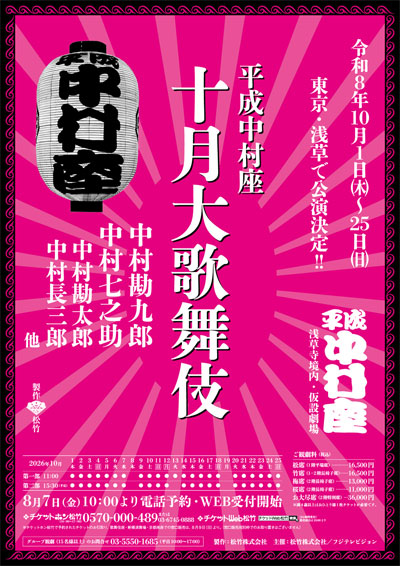
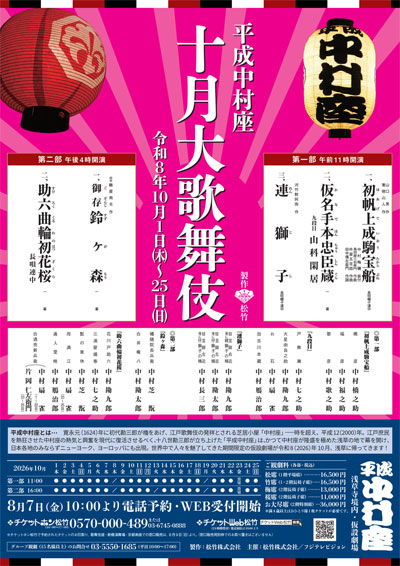
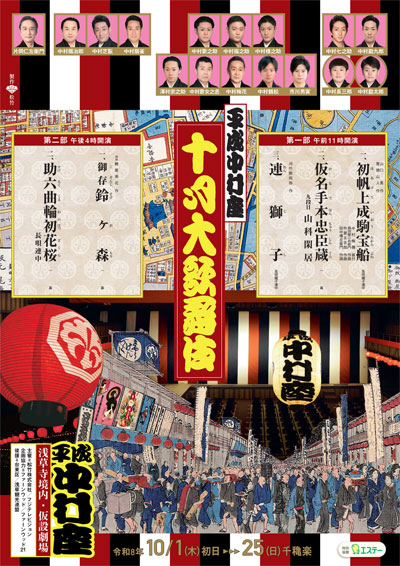
    Heisei Nakamuraza (Tôkyô)
    Dates 1 ~ 25 October 2026
    1st program

    Ho Agete Iô Takarabune

    Kanadehon Chûshingura
    (Yamashina Kankyo)

    Renjishi

    2nd program

    Gozonji Suzu-ga-Mori

    Sukeroku Kuruwa no Hatsuzakura

    Casting

    Living National Treasure Kataoka Nizaemon, Nakamura Kankurô, Nakamura Shichinosuke, Nakamura Ganjirô, Nakamura Senjaku, Nakamura Shikan, Nakamura Hashinosuke, Nakamura Fukunosuke, Nakamura Utanosuke, Nakamura Tsurumatsu, Sawamura Sônosuke, Ichikawa Otora, Nakamura Kantarô, Nakamura Chôzaburô, Nakamura Shinobu, Nakamura Baika, Nakamura Kamenojô

    Comments

    The Heisei Nakamuraza is back in Tôkyô in Asakusa in October 2026. Not in the Sumida Park as it used to be but in the precincts of the Sensôji Temple (at the back of the main temple hall).

  • Takarabune: this dance was created 10 years ago, in October 2016 to celebrate the name-taking ceremony of the three sons of Nakamura Shikan at the Kabukiza [more details]. This lively and celebratory dance is now performed by the three brothers, Nakamura Hashinosuke, Nakamura Fukunosuke & Nakamura Utanosuke, for the first time since its premiere.
  • Yamashina Kankyo: this is an act of the epic play based on a sensational incident in the early 17th century. Lord En'ya Hangan's attack on the senior official Kô no Moronô affected people even outside his own household. When Honzô, the senior retainer of another lord, stopped En'ya from killing Moronô, he thought that he was doing a good thing. But his actions earned him the scorn of Enya's retainers and brought personal tragedy to his daughter who was engaged to Rikiya, the son of Yuranosuke, En'ya's head retainer. The scene shows the tragedy as it affects Honzô's wife and daughter and how ultimately Honzô sacrifices his life to atone for his misjudgement. Starring Nakamura Ganjirô as Honzô, Nakamura Shichinosuke as his wife Tonase and Nakamura Tsurumatsu as his daughter Konami, with Nakamura Kankurô as Yuranosuke, Nakamura Senjaku as his wife Oishi and Nakamura Utanosuke as his son Rikiya.
  • Renjishi: 2 entertainers dance a tale of the legendary shishi or lion-like spirits that live at the foot of a holy Buddhist mountain. There is a comic interlude with 2 Buddhist pilgrims. Then, the shishi themselves appear and perform their dance with wild shaking of their long manes. The dance shows a parent shishi forcing his cub to undergo harsh training in order to grow up strong. This theme is often associated with the training a parent actor gives his son. This performance is unusual because it features 2 cubs instead of one, starring Nakamura Kankurô in the role of the parent shishi and his two sons, Nakamura Kantarô and Nakamura Chôzaburô, in the roles of the cubs.
  • Suzu-ga-Mori: The young samurai Shirai Gonpachi (Nakamura Kantarô) is ambushed near the execution grounds of Edo on a dark night, but he manages to escape after a gruesome but humorous fight scene. He is watched by Banzuiin Chôbê (Nakamura Shikan), an Edo boss, who is impressed with his fighting skills and agrees to give him shelter in the city. This meeting between the handsome young Gonpachi and the heroic Chôbê is one of the most famous meetings in Kabuki.
  • Sukeroku: the dandy Sukeroku is the most famous patron of the Yoshiwara pleasure quarters. But his reputation as the lover of Agemaki, the highest ranking courtesan in the quarter is matched by that of his tendency to pick fights. In fact, Sukeroku is the samurai Soga no Gorô in disguise, and he uses the fights to find a lost heirloom sword. His search takes place in the colorful atmosphere of the Yoshiwara where processions of beautiful courtesans compete with the splendor of cherry blossoms in full bloom. All the top stars in Kabuki appear in a procession of beautiful, exciting and amusing roles. Starring Nakamura Kankurô and Nakamura Shichinosuke as Hanakawado Sukeroku and Miuraya Agemaki. Featuring also Nakamura Shikan, Nakamura Senjaku/Living National Treasure Kataoka Nizaemon, & Nakamura Ganjirô in the roles of Ikyû, the shirozake seller Shinbê & the passer-by.
  • Sources: Earphone Guide Website, Shôchiku Kabuki Official Website or others sources

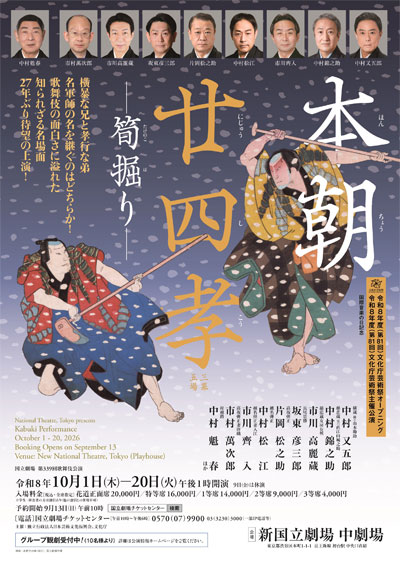
    New National Theatre (Tôkyô)
    Dates 1 ~ 20 October 2026
    Program

    Honchô Nijûshikô

  • Suwa Myôjin Hyakudo Ishi
  • Kikyô-ga-Hara
  • Kansuke Sumika
  • Kansuke Sumika Urate Takeyabu
  • Kansuke Monogatari
  • Casting

    Nakamura Kinnosuke, Nakamura Kaishun, Nakamura Matagorô, Ichikawa Komazô, Bandô Hikosaburô, Ichimura Manjirô

    Comments

    No performance at the National Theatre, which is no more operating in 2026 but there is a subsitute theater: the New National Theatre! This playhouse dedicated to opera, ballet or modern dances/dramas has become also a new home for Kabuki performances!

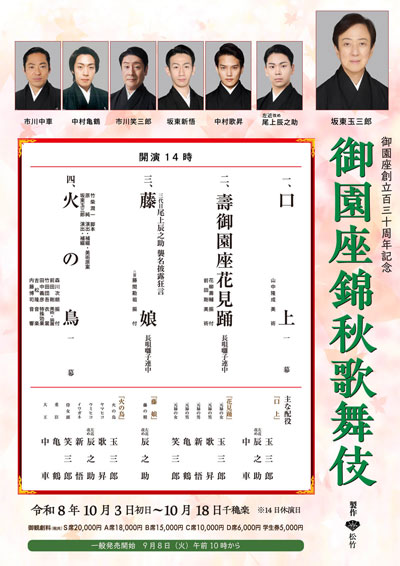
    Misonoza (Nagoya)
    Dates 3 ~ 18 October 2026
    Misonoza Nishiki Kabuki
    Misonoza Brocade Kabuki
    Program

    Kôjô

    Kotobuki Misonoza Hanami Odori

    Fuji Musume

    Hi no Tori

    Casting

    Living National Treasure Bandô Tamasaburô, Onoe Tatsunosuke, Ichikawa Chûsha, Ichikawa Emisaburô, Nakamura Kikaku, Nakamura Kashô, Bandô Shingo

    Comments

    A special Kabuki program in Nagoya at the Misonoza instead of the usual kaomise to celebrate the shûmei of Onoe Tatsunosuke III. It also celebrates the 130th anniversary of the opening of the Misonoza.

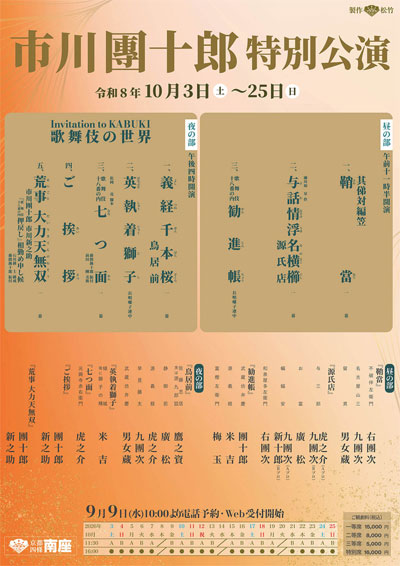
    Minamiza (Kyôto)
    Dates ?? ~ ?? October 2026
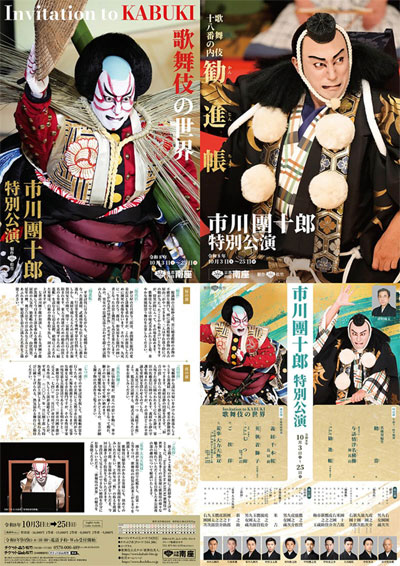
    Ichikawa Danjûrô Tokubetsu Kôen
    Ichikawa Danjûrô Special Performance
    Matinée

    Sayaate

    Yowa Nasake Ukina no Yokogushi (Genjidana)

    Kanjinchô
    A drama belonging to the Kabuki Jûhachiban

    Evening

    Invitation to KABUKI (Kabuki no Sekai)

  • Torii Mae
  • Hanabusa Shûjaku no Shishi
  • Nanatsu Men
    A drama belonging to the Kabuki Jûhachiban
  • Goaisatsu
  • Aragoto Dairiki Ten no Musô
    In reality the Kabuki Jûhachiban drama "Oshimodoshi"
  • Casting

    Living National Treasure Nakamura Baigyoku, Ichikawa Danjûrô, Ichikawa Udanji, Ichikawa Omezô, Ichikawa Kudanji, Nakamura Yonekichi, Ôtani Hiromatsu, Nakamura Toranosuke, Nakamura Takanosuke, Ichikawa Shinnosuke, Ichikawa Shinjûrô

    Comments

    A special program starring Ichikawa Danjûrô in Kyôto at the Minamiza.

    Meijiza (Tôkyô)
    Dates 2 ~ 3 October 2026
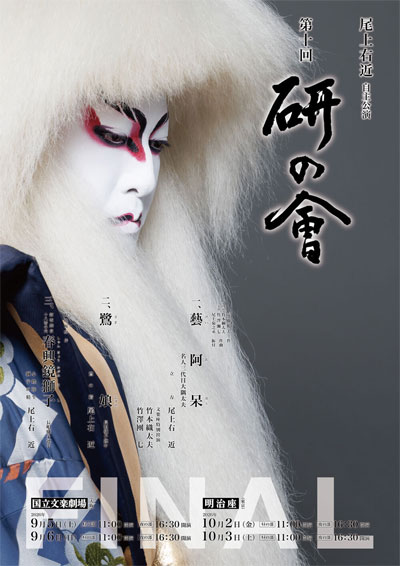
    Ken no Kai
    Program

    Gei Ahô

    Sagi Musume

    Shunkyô Kagami Jishi

    Casting

    Onoe Ukon

    Comments

    10th edition of the Ken no Kai, a 2-day 4-performance gala in Ôsaka at the National Bunraku Theatre starring Onoe Kikugorô VI's great-grandson Onoe Ukon. Ken no Kai literally means 'Ken's Association' with Ken being the first ideogram in Onoe Ukon's real first name Kensuke. The Ken no Kai is also held the 5th to the 6th of September in Ôsaka at the National Bunraku Theatre [more details].

    Nihonbashi Kôkaidô (Tôkyô)
    Dates 9 October 2026
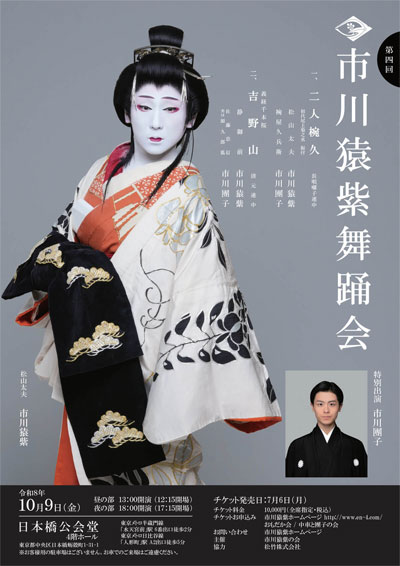
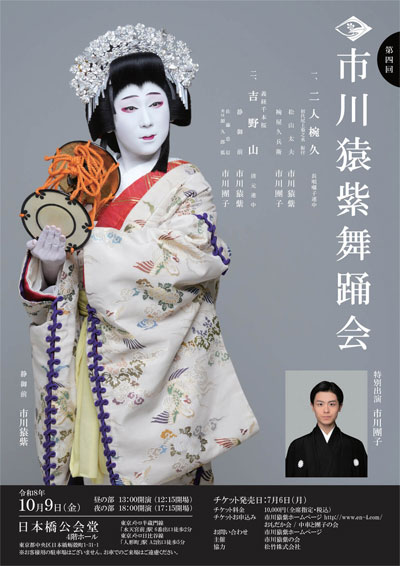
    Ichikawa Enshi Buyôkai
    Ichikawa Enshi Dance Gala
    Program

    Ninin Wankyû

    Yoshitsune Senbon Zakura (Yoshinoyama)

    Casting

    Ichikawa Enshi, Ichikawa Danko

    Comments

    4th edition of the gala for the young actor Ichikawa Enshi, a disciple of the Omodakaya guild.

  • Ninin Wankyû: the fabulously wealthy Wan'ya Kyûbê (nicknamed Wankyû) is disowned by his family for falling in love with the courtesan Matsuyama. Then, when she dies, he goes mad with grief and wanders through the countryside. This dance shows him as he imagines meeting Matsuyama again and there is a lively dance recalling their happiness together before the vision fades and he is left alone. Starring Ichikawa Danko as Wankyû and Ichikawa Enshi as Matsuyama.
  • Yoshinoyama: a dance travel scene from the epic "Yoshitsune Senbon Zakura". Now in exile and disgrace, Yoshitsune has left his lover Shizuka in the safekeeping of his trusted retainer Tadanobu. But she is unaware that this Tadanobu is actually a magical fox who has disguised himself to be near the treasured drum that Shizuka carries, a drum made from the skins of his fox parents. Starring Ichikawa Danko as Tadanobu, with Ichikawa Enshi as Shizuka.
  • Sources: Earphone Guide Website, Shôchiku Kabuki Official Website or others sources

     
    Search this site powered by FreeFind
      Site map | Disclaimer
    Contact | Main | Top | Updates | Actors | Plays | Playwrights | Programs | Links | FAQ | Glossary | Chronology | Illustrations | Prints | Characters | Derivatives | Theaters | Coming soon | News