DECEMBER 2025

2 shows in Kyôto (Minamiza) & 3 in Tôkyô (Kabukiza)!

  • Living National Treasure Kataoka Nizaemon, Living National Treasure Nakamura Karoku, Onoe Kikugorô, Onoe Kikunosuke, Nakamura Ganjirô, Nakamura Senjaku, Kataoka Ainosuke, Matsumoto Kôshirô, Kataoka Takatarô, Nakamura Kankurô, Nakamura Shichinosuke, Nakamura Kazutarô & Bandô Minosuke perform at the Minamiza!
  • Living National Treasure Bandô Tamasaburô, Nakamura Jakuemon, Onoe Shôroku, Nakamura Shidô & Ichikawa Chûsha perform at the Kabukiza!
  • Minamiza (Kyôto)
    Dates 1 ~ 25 December 2025
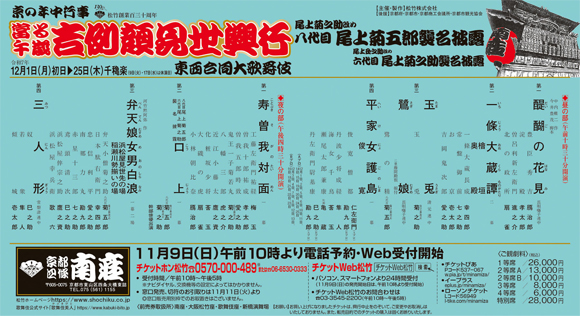
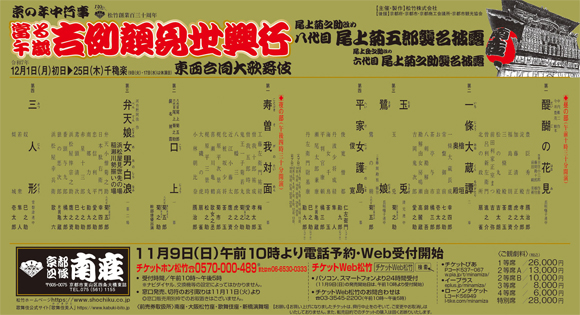
    Kichirei Kaomise Kôgyô
    Annual Festive Face-Showing Performances
    Matinée

    Daigo no Hanami

    Kiichi Hôgen Sanryaku no Maki

  • Higaki Jaya
  • Okuden (Ichijô Ôkura Monogatari)
  • Tama Usagi

    Sagi Musume

    Heike Nyogo no Shima (Shunkan)

    Evening

    Kotobuki Soga no Taimen

    Kôjô

    Benten Musume Meo no Shiranami

  • Hamamatsuya
  • Inasegawa Seizoroi
  • Mitsu Ningyô

    Casting

    Living National Treasure Kataoka Nizaemon, Living National Treasure Nakamura Karoku, Onoe Kikugorô, Onoe Kikunosuke, Nakamura Ganjirô, Nakamura Senjaku, Kataoka Ainosuke, Matsumoto Kôshirô, Kataoka Takatarô, Nakamura Kankurô, Nakamura Shichinosuke, Nakamura Kazutarô, Bandô Minosuke, Ichikawa Komazô, Kamimura Kichiya, Matsumoto Kingo, Kataoka Shinnosuke, Nakamura Toranosuke, Nakamura Kangyoku, Nakamura Takanosuke, Kamimura Kichitarô, Arashi Kitsusaburô, Kataoka Matsunosuke, Ichimura Kitsutarô, Nakamura Kamenojô, Onoe Kikuichirô

    Comments

    The traditional kaomise in Kyôto at the Minamiza. Onoe Kikugorô VIII and Onoe Kikunosuke VI celebrate their shûmei in Kyôto at the Minamiza.

  • Daigo no Hanami:
    (Blossom-viewing in Daigo)
    This is a dance portraying the famous blossom-viewing party held by the warlord Toyotomi Hideyoshi in the 3rd lunar month of 1598 in the garden of the Daigoji Temple in Kyôto. It was a grand banquet to which Hideyoshi's family, many daimyô lords, their wives and retainers were invited. Featuring Nakamura Ganjirô (Toyotomi Hideyoshi), Kamimura Kichiya (Matsu, Toshiie’s lawful wife), Kataoka Takatarô (Yodo-dono), Nakamura Toranosuke (Katô Kiyomasa) and Nakamura Senjaku (Kita no Mandokoro).
  • Ichijô Ôkura Monogatari: the world is ruled by Taira no Kiyomori, the leader of the Heike clan. Tokiwa Gozen, the widow of the head of the defeated Genji clan and mother of Yoritomo and Yoshitsune, the future leaders of the clan, has become the mistress of the dictator Kiyomori, then the wife of Lord Ôkura, a seemingly simple-minded fool who spends all his time watching pretty women dance. Outraged members of the Genji clan sneak into Lord Ôkura's mansion only to discover that Tokiwa Gozen's immorality and Lord Ôkura's idiocy are a guise, the only way to survive in a world ruled by the enemy. This performance stars Matsumoto Kôshirô as Lord Ôkura, Nakamura Shichinosuke as Tokiwa Gozen, Kataoka Ainosuke as Yoshioka Kijirô and Nakamura Kazutarô as Yoshioka's wife Okyô.
  • Tama Usagi:
    (The Rabbit in the Moon)
    This is a dance with musical accompaniment provided by the Kiyomoto Narrative Ensemble. It is the night of a full autumn moon. Looking up at the round moon, we see the shadow of a rabbit making rice dumplings. Before long, it springs out, landing in a field of pampas grass. It proceeds to demonstrate how it makes rice dumplings with a pestle and mortar. After this, it begins to relate a famous children's tale about Mt. Kachikachi, in which a tanuki racoon dog comes to blows with a rabbit. The story mixes in the antics of an elderly man and woman. On this moonlit night, the rabbit (Onoe Kikunosuke) seems in festive mood and continues to make merry through the night.
  • Sagi Musume: one of the most famous dances in Kabuki, this figure is familiar through pictures and Japanese dolls. A beautiful young woman all in white appears in the snowy landscape. She dances lightly of love, but then reveals that she is the spirit of a bird, a magnificent heron that struggles wounded through a snowstorm. Starring onnagata superstar Onoe Kikugorô in a dance that he has made famous through performances around the world.
  • Shunkan: the priest Shunkan (Living National Treasure Kataoka Nizaemon/Nakamura Kankurô) has been exiled to Devil's Island for plotting against the dictator Kiyomori. A pardon is given to his fellow conspirators, but Shunkan is only saved by an additional pardon given by Kiyomori's compassionate son. Even so, he gives up his place on the boat to freedom so his companion's new wife can accompany her husband back to the capital. The boat leaves and Shunkan is left watching is disappear in the distance, knowing he will be left on the island forever. Featuring Bandô Hikosaburô as the evil emissary Senoo and Bandô Minosuke/Nakamura Kankurô as the merciful envoy Tanzaemon. With Nakamura Kangyoku as the island girl Chidori, Arashi Kitsusaburô as Taira no Yasuyori and Nakamura Hayato as Fujiwara no Naritsune, Shunkan's fellow exile who has fallen in love with her.
  • Soga no Taimen: this is one of the oldest and most classical of all Kabuki plays. In the Edo period, every January, plays appeared about the vendetta carried out by the Soga brothers Jûrô and Gorô after eighteen years of hardship. In "Soga no Taimen" the brothers confront Kudô Suketsune, the man responsible for their father's death. More ceremony than play, it features each of the important Kabuki character types, including the bombastic aragoto style of Gorô and the soft wagoto style of Jûrô. This month features a cast headed by Living National Treasure Nakamura Baigyoku as Kudô and some of the most popular young stars in Kabuki with Kataoka Ainosuke as Gorô and Kataoka Takatarô as Jûrô. Featuring Nakamura Ganjirô, Nakamura Kangyoku & Nakamura Senjaku in the roles of Kobayashi no Asahina, the courtesan Kewaizaka no Shôshô (Gorô's lover) & the courtesan Ôiso no Tora (Jûrô's lover).
  • Kôjô: the close relationship between the actors and the audience is shown by these stage announcements, lavish ceremonies to commemorate various important events. In this case, all the stars of the cast assemble to celebrate the shûmei of Onoe Kikugorô VIII and Onoe Kikunosuke VI.
  • Benten Musume: this play is a sewamono (realistic play about commoners) written by the late 19th century playwright Mokuami who is famous for his plays about thieves. The thief Benten Kozô dresses up as a woman to commit extortion, but his plans are ruined when his disguise is seen through. In the highlight of the play, he undresses, showing his colorful tattoos and introduces himself in a famous poetic speech. Afterwards, he is joined by the members of his gang on a riverbank, and, using the playwright's famous poetic rhythms, in turn, they each boast of their careers as thieves. Onoe Kikugorô stars as Benten Kozô, with Matsumoto Kôshirô as Nippon Daemon, Nakamura Kankurô as Nangô Rikimaru, Kataoka Ainosuke as Tadanobu Rihei and Nakamura Shichinosuke as Akaboshi Jûzaburô.
  • Mitsu Ningyô:
    (The Three Dolls)
    The characters in this graceful dance are not actually dolls, but are three characters that are often depicted with dolls, a courtesan (Nakamura Kazutarô), a handsome youth (Nakamura Hayato) and a samurai footman (Bandô Minosuke).
  • Sources: Earphone Guide Website or Shôchiku Kabuki Official Website

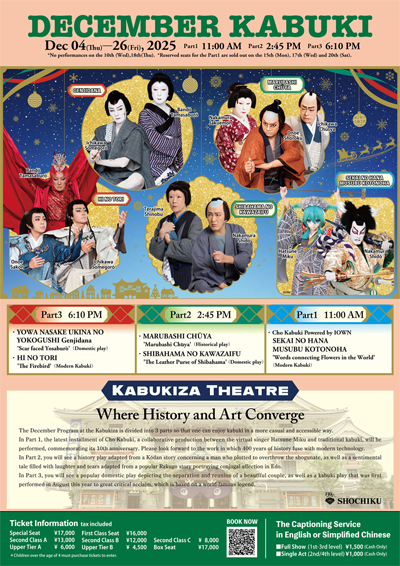
    Kabukiza (Tôkyô)
    Dates 4 ~ 26 December 2025
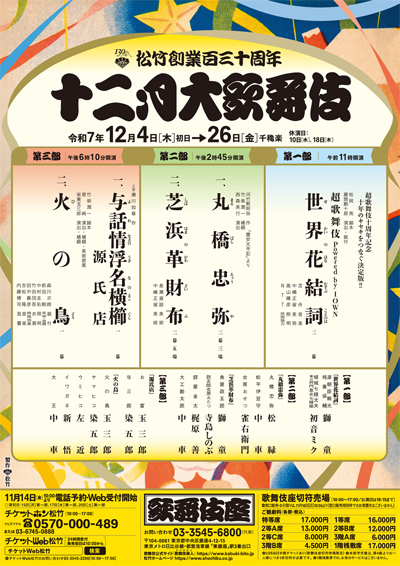
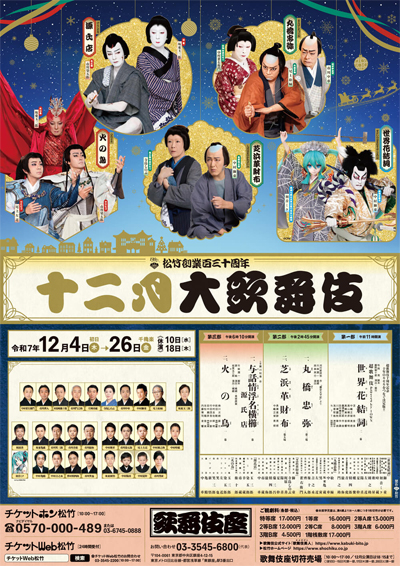
    Jûnigatsu Ôkabuki
    December Grand Kabuki
    1st Program

    Sekai no Hana Musubu Kotonoha

    2nd Program

    Keian Taiheiki (Marubashi Chûya)

    Shibahama no Kawazaifu

    3rd Program

    Yowa Nasake Ukina no Yokogushi (Genjidana)

    Hi no Tori

    Casting

    Living National Treasure Bandô Tamasaburô, Nakamura Jakuemon, Onoe Shôroku, Nakamura Shidô, Ichikawa Chûsha, Ichikawa Sai'nyû, Kataoka Ichizô, Ichikawa Monnosuke, Ichikawa En'ya, Ichikawa Emisaburô, Ichikawa Emiya, Bandô Kamezô, Kawarasaki Gonjûrô, Nakamura Kikaku, Nakamura Kashô, Bandô Shingo, Ichikawa Somegorô, Nakamura Tanenosuke, Onoe Sakon, Sawamura Kiyoshirô, Ichikawa Seiko, Ichikawa Otora, Nakamura Kichinojô, Matsumoto Kôzô, Nakamura Haruki, Nakamura Natsuki, Nakamura Chôshi, Onoe Kikusaburô, Terajima Shinobu, Kajihara Zen, Hatsune Miku

    Comments

    The December Grand Kabuki in Tôkyô at the Kabukiza.

  • Sekai no Hana Musubu Kotonoha: after the Jôhei and Tengyô Rebellion (935-941), the thief Kidômaru (Nakamura Kashô) encounters the ghost of Fujiwara no Sumitomo (Ichikawa Seiko) and learns that he is Sumitomo's son Motozumi. Those who side with him are monsters, such as the high priest Chiun and the hag Ibaraki. Having seen from the shadows, Hakamadare no Yasusuke (Nakamura Shidô) takes away a scroll in which techniques used for destroying monsters are written, and goes away. The Minamoto brothers Yorimitsu (Nakamura Shidô) and Yorinobu (Nakamura Tanenosuke) see female dancers perform at the feast in Shinsen'en and Yorimitsu falls in love with the dancer with green hair. She is, in reality, Nanaayadayû (Hatsune Miku) from the Kujô pleasure quarters, so he visits that place to see her. At the same time, Kidômaru breaks into the treasury of the Imperial Palace and steals the arrows Suiha and Hyô ha. Yorinobu stands in Kidômaru's way, but is defeated again. In the presence of the dying Yorinobu, his fiancée Princess Hatsune appears. Yorinobu tells her the situation and breathes his last, but Princess Hatsune is in reality a different person. In the meantime, Hakamadare, with Rashômon as his base of operation, encounters Lady Sayokaze (Nakamura Tokizô), the wife of Watanabe no Tsuna, and acts sympathetically. As the season proceeds, Yorimitsu becomes infatuated with Nanaayadayû and continues to frequent the pleasure quarters. His loyal retainer Hirai no Yasumasa comes to remonstrate with him. As Yorimitsu is angry about Yasumasa's behaviour, the proprietress of the Izumiya (Ichikawa Monnosuke) mediates between them. Nanaayadayû is, in reality, Masakado's daughter Princess Nanaaya, and Hakamadare and the high priest Chiun act in unexpected ways. What will become of Yorimitsu, his retainer and Hakamadare, as well as Princess Nanaaya and Kidômaru who go against them? This newly-created drama, mixing elements of previous Chôkabuki drama, is staged to commemorate the 10th anniversary of Chôkabuki.
  • Marubashi Chûya: this is a classic play by Kawatake Mokuami written in the Meiji Period, when Kabuki could show historical events. This is the story of Marubashi Chûya (Onoe Shôroku), who plotted to overthrow the Edo government. He approaches Edo Castle pretending to be drunk, but has actually come to measure the depth of the moat. Unfortunately, he is observed by Izu-no-Kami (Ichikawa Chûsha), one of the top officials of the shogunate. Later, Chûya has a dispute with his wife and his wife's father, that eventually leads to the failure of his revolt. Featuring also Nakamura Jakuemon as Chûya's wife Osetsu.
  • Shibahama no Kawazaifu: this is a play adapted from a rakugo story by San'yûtei Enchô which was originally performed in vaudeville by a solo performer. This tells the story of a man who is a drunk and good for nothing who picks up a leather purse full of coins while fishing. He takes it home and celebrates with a big drinking party. In the morning he asks his wife for the purse, but she insists that it was all a dream and shows how much money he has wasted with his drunken party. He decides to reform and becomes a hard worker. Three years later, the couple now lives comfortably and the wife says that she must apologize. She lied and hid the purse because she felt that this was the only way to get her husband on the right path. He thanks her and this purse which has given them so much. Starring Nakamura Shidô as the man and Terajima Shinobu as his wife.
  • Genjidana: Yosaburô (Ichikawa Somegorô) fell in love with Otomi (Living National Treasure Bandô Tamasaburô) the moment he first saw her on the beach. Otomi was the mistress of a powerful gangster and, when their relationship was discovered, Yosaburô was cut from head to toe and the two were dumped into the sea. Otomi lived and was taken in by a rich merchant. Yosaburô, who is now covered with scars, turns into a petty thief and extortionist but one day, finds that the woman he is about to blackmail is none other than Otomi, alive and well.
  • Hi no Tori: in the land ruled by the Great King (Ichikawa Chûsha), endless bloodshed has expanded his territory through repeated invasions of many nations. Now aged and suffering from illness, the Great King seeks to possess the Phoenix, a bird of eternal power, in hopes of gaining everlasting life. The two princes, Yamahiko (Ichikawa Somegorô) and Umihiko (Onoe Sakon), are ordered to capture the Phoenix (Living National Treasure Bandô Tamasaburô) and embark on a journey to a distant land where the Phoenix has been said to dwell since ancient times. In a garden where mysterious, shining golden apple trees grow thick, the two brothers encounter a figure who introduces himself as Iwagane (Bandô Shingo). Hi no Tori (The Phoenix), a story that has inspired ballet and manga, now comes to life as a brand-new Kabuki production.
  • Sources: Earphone Guide Website or Shôchiku Kabuki Official Website

     
    Search this site powered by FreeFind
      Site map | Disclaimer
    Contact | Main | Top | Updates | Actors | Plays | Playwrights | Programs | Links | FAQ | Glossary | Chronology | Illustrations | Prints | Characters | Derivatives | Theaters | Coming soon | News